Angle Consistency: 15° vs. 20°
A lower sharpening angle is not automatically better. Consistency, steel, blade geometry, and intended use determine which angle performs best.
Sharpening angle affects cutting performance, edge strength, and durability. This article explains the difference between 15° and 20° edges, why consistency matters more than chasing an exact number, and how the knife’s steel, geometry, and intended use should guide the final angle.
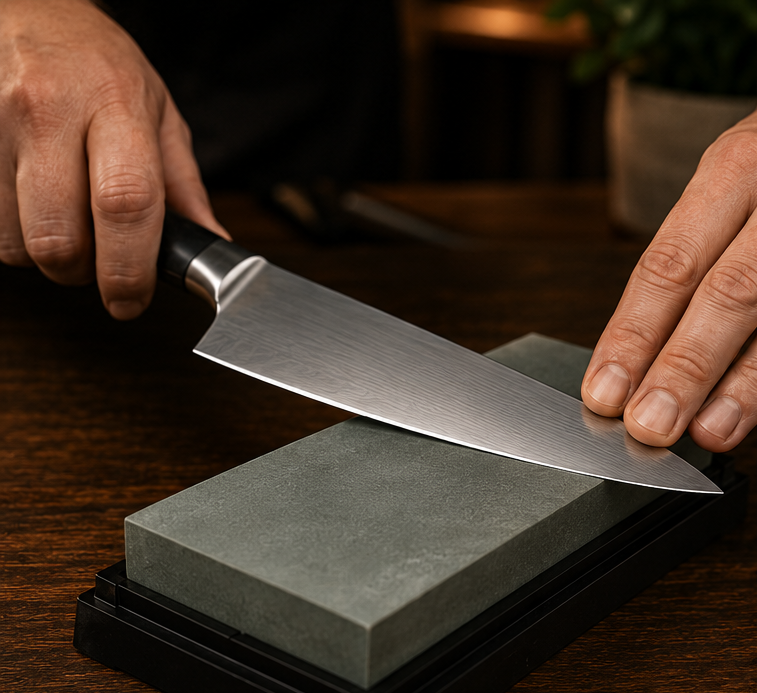
What a Sharpening Angle Means
A sharpening angle is the angle formed between one side of the blade and the sharpening surface. Most kitchen-knife angles are stated per side, not as the total angle of the finished edge.
For example, a knife sharpened at 15° on each side has a 30° included angle. A knife sharpened at 20° per side has a 40° included angle.
The angle influences how easily the knife cuts, how well the edge resists damage, and how frequently it may need maintenance. Lower angles create thinner edges, while wider angles provide more steel behind the cutting edge.
Per-Side Angle vs. Included Angle
| Per-Side Angle | Included Angle | General Character |
|---|---|---|
| 12° | 24° | Very fine edge with low damage tolerance |
| 15° | 30° | Fine cutting edge for suitable kitchen knives |
| 17° | 34° | Balance of cutting ability and durability |
| 20° | 40° | Stronger edge for harder use |
| 25° | 50° | Durable edge for heavy-duty cutting |
15° vs. 20° at a Glance
Both angles can work well. The better choice depends on the knife’s steel, blade geometry, and intended use.
15° Per Side
Finer EdgePros
Cuts with less resistance; supports precise slicing.
Cons
Less tolerant of twisting, impact, and rough cutting.
Best For
Thin kitchen knives with suitable steel and controlled use.
20° Per Side
Stronger EdgePros
More support behind the apex; generally more durable.
Cons
Creates slightly more cutting resistance than a thinner edge.
Best For
General-purpose knives, tougher foods, and harder use.
Matching the Angle to the Knife
The best sharpening angle depends on more than whether a lower or higher number sounds preferable. The knife must be considered as a complete system.
Steel: Harder steels may support thinner edges, but hardness alone does not guarantee durability. Toughness and heat treatment also affect how well the apex resists chipping or rolling.
Blade geometry: Thin blades generally cut well at lower angles. Thick blades may still feel resistant even when the edge itself is sharpened narrowly.
Intended use: A knife used for careful slicing can support a finer edge than one used around joints, dense foods, or rough cutting boards.
The goal is to choose the lowest practical angle that still gives the knife enough durability for the work it performs.
What Determines the Right Angle?
No single factor determines the best sharpening angle. These considerations should be evaluated together.
Steel and Heat Treatment
Determines how well the edge resists chipping, rolling, and wear. Harder steel may support a finer edge, but toughness also matters.
Blade Geometry
Thin blades usually benefit more from lower angles. Thick blades can still wedge in food even when the cutting edge is sharp.
Intended Use
Careful slicing may allow a finer edge. Dense foods, twisting, impact, and harder use generally require more support behind the apex.
Typical Angles by Knife Type
| Knife Type | Typical Angle Per Side | General Use |
|---|---|---|
| Thin Japanese-style chef knife | 12°–15° | Precise slicing with careful use |
| Western chef knife | 15°–20° | General kitchen preparation |
| Utility or petty knife | 15°–20° | Slicing, trimming, and everyday tasks |
| Boning knife | 17°–22° | Working around joints and tougher foods |
| Heavy cleaver | 20°–25° | Chopping and demanding use |
| Outdoor or work knife | 20°–25° | Durability and edge stability |
Preserve the Existing Angle or Change It?
In many cases, the best starting point is the angle already established on the knife. Preserving the existing bevel removes less steel, shortens sharpening time, and maintains the geometry the knife has already been using.
Changing the angle may make sense when the existing edge is too fragile, too thick, badly uneven, or poorly suited to the knife’s actual use. Lowering the angle can improve cutting performance, while increasing it can add durability.
Reprofiling should be a deliberate choice. It removes more steel than routine sharpening and may require additional thinning behind the edge to avoid creating a wide, heavy bevel.
Consistency Matters More Than an Exact Number
A consistent angle creates an even bevel and a stable cutting edge from heel to tip. Small variations are normal, especially during freehand sharpening, but repeated changes in angle can round the apex, widen parts of the bevel, and leave sections of the blade less sharp.
Guided systems improve repeatability, but clamp position, blade shape, pressure, and movement around the belly and tip can still affect the actual angle. Freehand sharpening depends on maintaining a steady blade position and using controlled pressure throughout each stroke.
The goal is not mathematical perfection. It is a clean, continuous edge sharpened at a practical and repeatable angle.
A Practical Rule for Choosing an Angle
Use the lowest angle that gives the knife reliable durability for its steel, blade geometry, and intended use.
A lower number is not automatically better, and an exact factory angle is not always necessary. A consistent, appropriate edge will usually perform better than a thinner edge the knife or user cannot support.
Key Takeaways
Sharpening angles are normally stated per side, not as the total included angle.
A 15° edge can cut with less resistance, while a 20° edge generally offers greater durability.
Consistency along the full edge matters more than hitting an exact angle perfectly.
The knife’s steel, blade geometry, and intended use should guide the final angle.
Preserve the existing bevel unless there is a clear reason to reprofile it.
Use the lowest practical angle that still provides reliable durability.
References
The following sources were used in preparing and supporting this article.
KS-123 Knife Angle Setter
Tormek
tormek.com
Knife Sharpening Basics
Korin
korin.com
How to Sharpen Any Knife: Back to Basics
Work Sharp
worksharptools.com