How Mixed Restaurant Knife Sets Affect Sharpening
Different steels, hardness levels, geometries, edge angles, and knife designs may require different maintenance and sharpening approaches.
Restaurants do not need to use one knife brand. From a sharpening perspective, the important issue is understanding how mixed steels, geometries, edge angles, and intended uses affect maintenance.
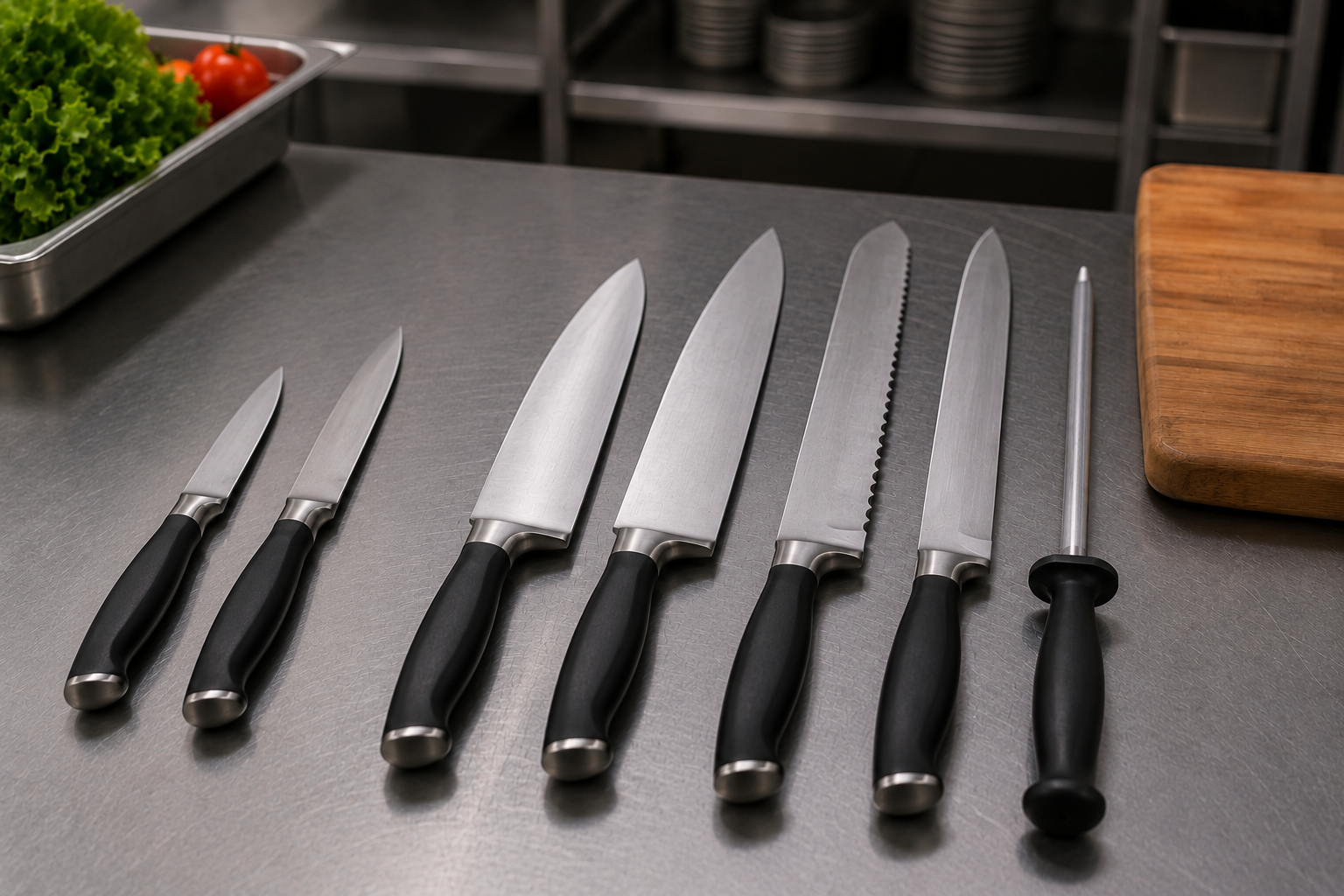
The Practical Point
Restaurants do not need to use one knife brand. From a sharpening and maintenance perspective, what matters is knowing which knives differ in steel, hardness, geometry, edge angle, construction, and intended use.
Mixed Knife Sets Are Normal
Restaurant knife collections often grow gradually. They may include older house knives, newer replacements, specialty tools, different brands, and employee-owned knives.
That variety is not automatically a problem.
The maintenance challenge begins when different knives are treated as though they all require the same edge angle, honing tool, sharpening process, repair decision, or service interval.
What May Differ From Knife to Knife
Steel and Hardness
Some edges roll more easily, while others may resist wear longer but be more sensitive to chipping.
Edge Angle
A durable shared-use knife may need more edge support than a thin precision slicer.
Blade Geometry
Thickness behind the edge, taper, curvature, and grind affect cutting performance and sharpening decisions.
Construction
Bolsters, serrations, single-bevel designs, flexible blades, and unusual profiles may require different handling.
Intended Use
Chef knives, boning knives, slicers, bread knives, and cleavers should not receive identical edges.
Condition
Dullness, chips, broken tips, corrosion, profile wear, and handle problems change what service is appropriate.
The Steel Name Is Not the Whole Story
Two knives marked with the same steel name may still perform differently because of heat treatment, hardness, edge geometry, blade thickness, and prior sharpening.
A harder edge may hold useful sharpness longer in controlled work but may chip when twisted or used against bone or frozen food.
A softer edge may roll sooner yet be easier to maintain and more tolerant of rough shared use.
These differences are reasons to inspect each knife—not reasons for a restaurant to choose one particular brand.
Geometry May Matter More Than the Logo
A thin knife can move through food efficiently even after the apex loses some refinement. A thicker knife may feel dull sooner because it wedges more deeply in food.
The angle at the very edge is only part of the geometry. Thickness behind the edge, blade height, taper, curvature, and overall grind all affect cutting performance.
For sharpening, the objective is to preserve useful geometry and provide enough support for the knife’s actual work.
Mixed Sets and Similar Sets
Either arrangement can work when the knives are identified and maintained correctly.
Mixed Knife Set
More VariationPros
Allows different tools, designs, and personal preferences for different jobs.
Cons
Requires clearer identification and greater care when choosing angles, honing tools, and repair methods.
Best For
Kitchens that understand which knife belongs to each task and keep useful service records.
Similar Knife Group
More ConsistencyPros
May simplify training, storage, replacement, recordkeeping, and routine maintenance.
Cons
Similar appearance does not eliminate individual damage, wear, or condition differences.
Best For
House knife groups performing the same general work.
Honing Tools Are Not Universal
A smooth or lightly grooved steel may help realign a mild roll on some softer Western-style knives.
A harder or thinner knife may respond better to a fine ceramic rod, light stropping, or professional maintenance.
Abrasive diamond rods remove steel more aggressively and should not be treated as harmless alignment tools.
When a mixed knife set is maintained with one rod and one technique, some knives may be helped while others are rounded, scratched, or damaged.
Specialty Knives Need Separate Consideration
Some knives should be identified separately because their construction or use changes the sharpening process.
• Serrated knives require work that preserves the serration pattern.
• Single-bevel knives require attention to the primary bevel and back side.
• Flexible boning and fillet knives need edge support suited to bending and close work.
• Heavy cleavers require geometry appropriate for impact and bone-related tasks.
• Thin slicers should not receive the same durable edge used on rough shared prep knives.
• Ceramic knives are not accepted by Gibson County Knife Sharpening; the owner should contact the manufacturer for approved service or replacement options.
Every Knife Is Still Evaluated Individually
Even when several knives are the same brand and model, each may have different wear, damage, geometry, and prior sharpening. Gibson County Knife Sharpening does not apply one automatic process to an entire restaurant batch.
Identification and Records Help
Numbering or otherwise identifying restaurant knives makes maintenance history easier to understand.
Useful records may include:
• Knife identification or station.
• Knife type and intended use.
• Sharpening and repair dates.
• Edge damage, corrosion, or handle concerns.
• Repeated rolling or chipping.
• Whether the knife responds appropriately to honing.
• How long the returned edge remains useful.
Records can reveal that a recurring problem is linked to one knife, task, station, cutting surface, or use pattern.
What GCKS Can Explain
Restaurant owners and chefs should choose the knives that fit their own menu, staff, workflow, budget, sanitation requirements, and purchasing preferences.
Gibson County Knife Sharpening can stay within the sharpening and maintenance side of that decision by explaining:
• Which knives appear to need different edge approaches.
• Which knives may not be suitable for the same honing method.
• Which damage is routine and which may require repair or replacement.
• Which knives should be identified separately in maintenance records.
• Whether repeated problems suggest a mismatch between the edge and the knife’s actual use.
We do not need to recommend one brand or tell a restaurant how to run its knife-purchasing program.
Key Takeaways
One Brand Is Not Required
Mixed knife sets can work well when each tool is identified and maintained appropriately.
Differences Affect Maintenance
Steel, hardness, geometry, edge angle, construction, use, and condition may require different approaches.
Stay Within the Sharpening Role
GCKS can explain maintenance implications while restaurant owners and chefs make operational purchasing decisions.
References
The following sources were used in preparing and supporting this article.
Knife Steels Rated by a Metallurgist: Toughness, Edge Retention, and Corrosion Resistance
Knife Steel Nerds
knifesteelnerds.com
Knife Steel—Can You Tell the Difference?
Knife Steel Nerds
knifesteelnerds.com
Honing Steels
Victorinox
victorinox.com
How to Sharpen Your Knives
ZWILLING
zwilling.com