Rust Prevention for Kitchen Knives
Prompt cleaning, complete drying, and proper storage prevent most knife corrosion.
Rust prevention is mostly routine care: wash the knife promptly, dry every surface, avoid trapped moisture, and store the blade where it remains clean, protected, and easy to inspect.
Why Knives Rust
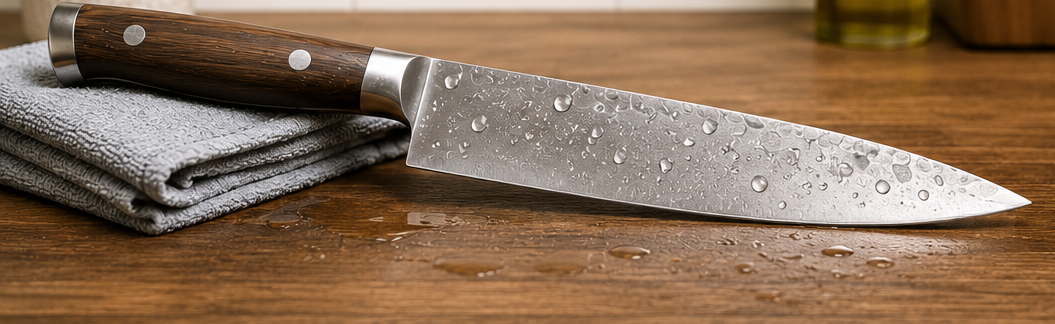
Rust forms when iron in the steel reacts with oxygen and moisture. Salt, acids, heat, and contamination can accelerate the process.
Carbon steel reacts more quickly because it contains less chromium than most stainless steel. Stainless steel is more resistant, but it is not rust-proof. Prolonged moisture, salty residue, acidic foods, harsh detergent, and contact with rusting metal can still cause staining, pitting, and corrosion.
Common Causes of Knife Corrosion
Most rust begins with ordinary kitchen habits that leave moisture or corrosive residue on the blade.
Standing Moisture
Water left on the blade, edge, bolster, rivets, or handle seams encourages corrosion.
Salt and Brines
Salt attracts moisture and accelerates corrosion on both carbon and stainless steel.
Acidic Foods
Tomatoes, citrus, vinegar, onions, apples, and pickled foods react strongly with steel.
Dishwasher Exposure
Heat, strong detergent, prolonged moisture, and metal contact can damage blades, edges, and handles.
Humid Storage
Damp drawers, garages, basements, campers, guards, and sheaths may trap moisture around the blade.
Metal Contamination
Ordinary steel wool, rusty racks, and carbon-steel particles can leave rust-prone contamination behind.
Patina, Staining, and Rust
| Surface Condition | Typical Appearance | Recommended Action |
|---|---|---|
| Stable patina | Smooth gray, blue, purple, brown, or dark coloration | Usually leave it in place and continue normal care |
| Cosmetic staining | Cloudy, blotchy, dark, or uneven areas | Clean and monitor for texture or orange corrosion |
| Fresh surface rust | Light orange or reddish spotting | Remove promptly using the least aggressive suitable method |
| Active corrosion | Rough, flaky, powdery, or spreading rust | Remove immediately and inspect for deeper damage |
| Pitting | Small holes, craters, or dark depressions | Professional evaluation may be appropriate, especially near the edge |
The Daily Prevention Routine
Wash the knife promptly after use with warm water, mild dish soap, and a soft sponge. During longer preparation sessions, wipe and dry reactive blades periodically when working with acidic or salty foods.
Never leave a knife soaking or hidden beneath dishes. Wash it individually, rinse away all residue, and dry both blade faces, the spine, heel, bolster, rivets, handle, and seams.
Before storage, inspect for water droplets, food residue, orange spotting, and moisture inside the block, guard, sheath, or drawer insert.
Storage and Rust Risk
A clean knife can still rust when stored in a damp, dirty, or poorly ventilated location.
Open or Ventilated Storage
Lower Moisture RiskPros
Magnetic strips and open racks provide airflow and make the blade easy to inspect.
Cons
They must be securely installed and kept away from steam, sinks, and splashing water.
Best For
Frequently used knives in a dry kitchen.
Blocks and Drawer Inserts
Good With MaintenancePros
Protect edges and keep knives organized.
Cons
Slots can collect crumbs, grease, and moisture if they are not cleaned and dried.
Best For
Everyday storage when the system fits properly and remains clean.
Blade Guards and Wooden Sheaths
Protective but EnclosedPros
Provide excellent edge protection and flexible storage.
Cons
Even a small amount of moisture can remain trapped against the blade.
Best For
Clean, completely dry knives that are inspected regularly.
Leather Sheaths
Use With CautionPros
Useful for transport and short-term protection.
Cons
Leather absorbs humidity and may hold moisture or reactive compounds against the steel.
Best For
Short-term transport rather than long-term kitchen storage.
When Protective Oil Helps
A knife used every day may not need oil when it is cleaned, dried, and stored correctly. A very thin protective layer can be useful for carbon steel, humid environments, long-term storage, or knives used only occasionally.
Use plain food-safe mineral oil or another food-safe knife oil. Avoid vegetable, olive, or canola oil because cooking oils may oxidize, become sticky, develop odors, or turn rancid.
Apply oil only after the knife is completely clean and dry. Wipe a thin film over the blade and spine, then remove all visible excess.
Handling Fresh Rust
Fresh surface rust is usually easier to correct than deep corrosion. Begin with the least aggressive suitable method and remember that any abrasive may alter the finish.
A baking-soda paste, rust eraser, mild metal polish, or very fine abrasive pad may help with light oxidation. Work gently, follow the existing scratch direction on satin blades, and avoid logos, decorative etching, cladding lines, and polished finishes unless you understand how the abrasive will affect them.
Do not use ordinary steel wool or chlorine bleach. Steel wool may leave rust-prone particles and scratches, while chlorine can attack steel and cause pitting.
When Corrosion Needs More Attention
Pitting means corrosion has removed metal below the original surface. Deep rust, pits near the cutting edge, orange staining around the handle joint, blade looseness, gaps, odor, or hidden corrosion should be evaluated before the knife returns to use.
Key Takeaways
Most corrosion is prevented before it starts.
Clean Promptly
Remove salt, acid, food residue, and fingerprints before they remain on the steel.
Dry Completely
Check the edge, spine, heel, bolster, handle, rivets, and seams before storage.
Control Storage Moisture
Blocks, guards, sheaths, and drawers must remain clean, dry, and easy to inspect.
Treat Rust Early
Light orange spotting is easier to remove before it spreads or becomes pitting.
References
The following sources were used in preparing and supporting this article.
About Carbon Knife Care
Korin
korin.com
How to Keep Your Shun Knives in Top Condition
Shun Cutlery
shun.kaiusa.com
Caring for Your Japanese Knives: Storage, Cleaning and Maintenance
Shun Cutlery
shun.kaiusa.com