Oiling High-Carbon Steel Knives
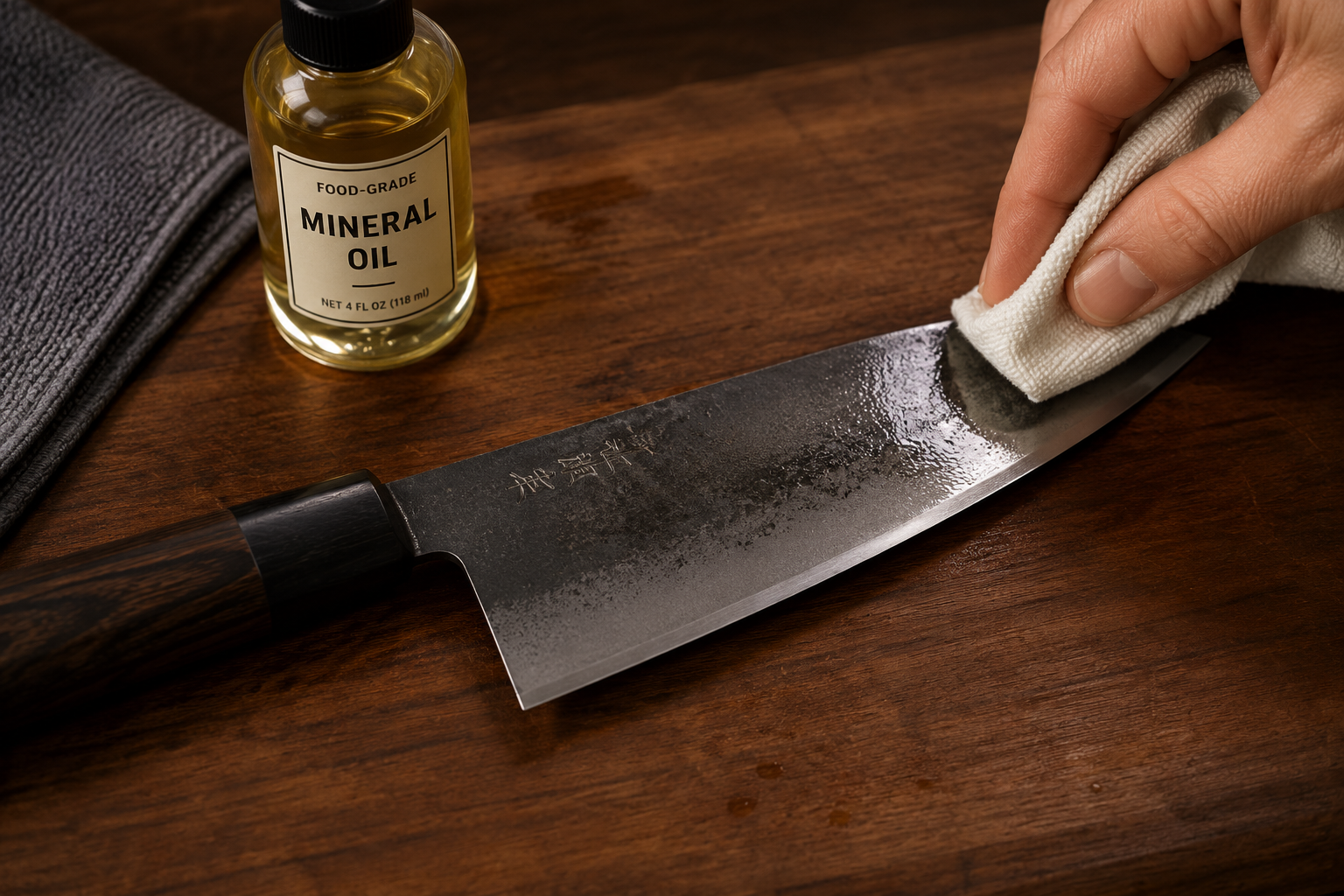
A very thin layer of food-safe oil can help protect reactive steel during storage.
Cleaning and complete drying are the first line of defense for carbon-steel knives. Oiling adds temporary protection when a knife will sit unused, humidity is high, or the blade has shown a tendency to rust.
Why Oiling Helps
Carbon steel reacts readily with moisture, oxygen, salt, food acids, and humidity. A thin oil film creates a temporary barrier that reduces contact between the steel and those conditions.
Oiling does not replace washing and drying. Food residue, water, salt, and acids should never be sealed beneath oil. Clean the knife first, dry every exposed surface completely, and only then apply a protective coating.
When Oiling Is Most Useful
Not every carbon-steel knife needs oil after every use. Frequency depends on use, humidity, storage, and the steel’s tendency to rust.
Daily Use
A knife used every day may need only prompt washing and drying, with occasional oiling when conditions are humid.
Occasional Use
A knife that sits unused for several days or weeks benefits more from a light protective film.
Long-Term Storage
Clean, dry, lightly oil, and inspect the blade periodically rather than storing it indefinitely without checking.
Humid Conditions
Garages, basements, coastal areas, and unconditioned rooms may require more frequent inspection and oiling.
Choosing an Oil
| Oil or Product | Recommended? | Why |
|---|---|---|
| Food-grade mineral oil | Yes | Odorless, colorless, inexpensive, stable, and resistant to becoming rancid |
| Knife-care camellia oil | Yes, when labeled food-safe | Commonly used on carbon-steel knives; always confirm the specific product is intended for kitchen use |
| Mineral oil and beeswax blend | Sometimes | Can provide longer-lasting protection but leaves a heavier coating |
| Olive, canola, or vegetable oil | No | Cooking oils can oxidize, become sticky, collect debris, develop odors, or turn rancid |
| Machine oil, motor oil, or penetrating spray | No | These products are not intended for food-contact surfaces and may contain unsuitable additives |
How to Oil the Knife
1. Wash the knife by hand with mild soap and warm water.
2. Rinse away all food residue and soap.
3. Dry the blade, spine, heel, handle junction, bolster, and handle completely.
4. Place one or two drops of food-safe oil on a clean, lint-free cloth.
5. Wipe a very thin film across both blade faces, the spine, and other exposed reactive steel.
6. Use a second clean cloth to remove all visible excess.
7. Store the knife in a clean, dry location.
Apply oil to the cloth rather than pouring it directly onto the blade. Work from the spine toward the edge and keep fingers away from the sharpened apex.
How Much Oil?
The blade should look clean and lightly polished—not wet. If oil is dripping, pooling, beading along the edge, or collecting near the handle, too much has been applied.
A heavy coating does not provide proportionally better protection. It mainly attracts lint, dust, and debris.
Storage, Humidity, and Use
The knife and the storage system must both be completely dry. Damp blade guards, fabric rolls, wooden blocks, drawer inserts, and leather sheaths can hold moisture directly against the steel.
Leather is useful for transport but may not be ideal for long-term storage because it absorbs moisture. In humid environments, inspect stored knives more often and consider moving them to a drier location.
Before using a knife that has been stored with oil, wipe the blade with a clean cloth. After extended storage, wash, rinse, and dry it before preparing food.
After cutting acidic foods such as tomatoes, citrus, onions, apples, or vinegar-based ingredients, wash and dry the knife promptly. Apply oil afterward when the knife will be stored.
Different Carbon-Steel Constructions
The amount of exposed reactive steel varies among knives.
Monosteel Carbon
Both blade faces, the spine, heel, and any exposed tang may require protection.
Stainless-Clad Carbon
The exposed carbon-steel core near the cutting edge remains reactive even though most of the blade face is stainless.
Iron-Clad Knives
Much of the blade face may be reactive, so prompt drying, frequent inspection, and storage oiling are especially useful.
Carbon Damascus
Damascus describes layered construction or patterning, not corrosion resistance. Carbon-steel layers should be treated as reactive steel.
Oil Does Not Remove Rust
A smooth gray, blue, purple, brown, or dark patina is different from active orange or red rust. Oiling may reduce future exposure during storage, but it does not stop normal patina development during use.
Do not oil over unresolved rust. Orange, red, rough, flaky, raised, or powdery corrosion should be addressed before the knife is cleaned, dried, protected, and returned to storage.
Professional help may make sense when rust covers a large area, pitting reaches the cutting edge, corrosion extends beneath the handle or bolster, or the knife is vintage, custom, collectible, or sentimental.
Common Oiling Mistakes
Most problems come from moisture, the wrong product, too much oil, or skipped inspection.
Oiling a Damp Blade
Oil can trap moisture against the steel and encourage corrosion.
Using Cooking Oil
Vegetable oils may become sticky, smelly, or rancid during storage.
Using Too Much
Heavy coatings attract lint, dust, food particles, and debris.
Ignoring Existing Rust
Oil does not remove active corrosion or restore damaged steel.
Storing in Damp Material
Wet guards, rolls, blocks, and sheaths can hold moisture against the blade.
Forcing Oil Into the Handle
Excess oil around gaps, rivets, ferrules, or scales can trap debris, stain materials, or affect some adhesives.
Key Takeaways
Oiling is simple when it follows proper cleaning and drying.
Clean and Dry First
Never trap food residue, acids, salt, or moisture beneath an oil coating.
Use Food-Safe Oil
- Food-grade mineral oil is the simplest general choice
- food-safe camellia oil can also work.
Apply a Thin Film
One or two drops on a cloth are usually enough. Buff away all visible excess.
Inspect During Storage
Humidity, damp storage materials, and active rust still require attention even when the blade has been oiled.
References
The following sources were used in preparing and supporting this article.
Tsubaki Oil (Japanese Camellia Oil)
Korin
korin.com
Masamoto Sohonten Carbon-Steel Knife Care Guidance
Korin
korin.com
KRAMER Carbon Steel Use and Care Kit
ZWILLING
zwilling.com