Every Knife Is Sharpened Individually
Gibson County Knife Sharpening is not a high-volume production shop. Each knife receives individual attention based on its steel, geometry, condition, construction, intended use, and previous sharpening.
Even similar knives can require different angles, abrasives, repairs, finishing methods, and testing. Each knife is inspected and sharpened as an individual rather than being pushed through a preset high-volume process.
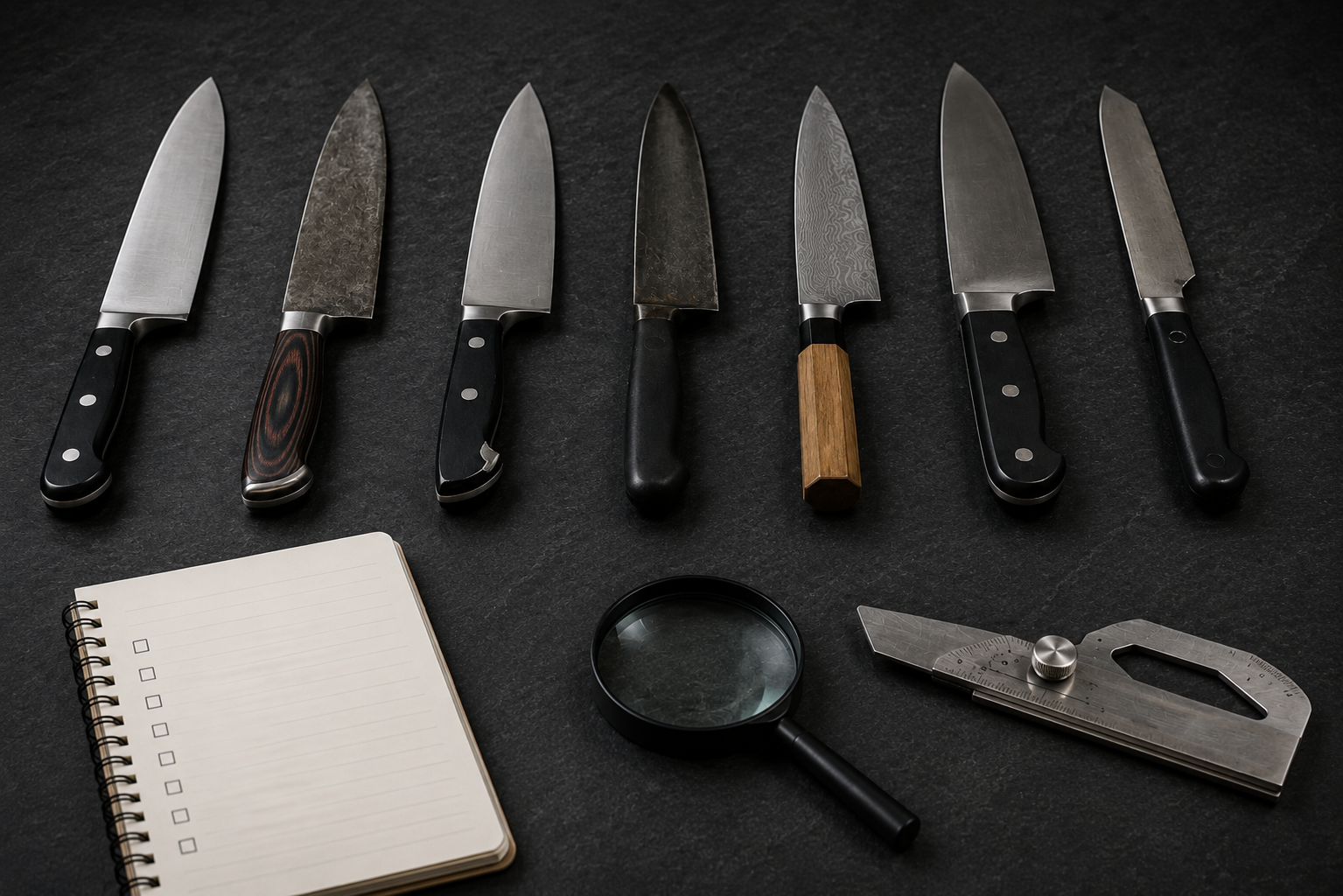
One Knife at a Time
Gibson County Knife Sharpening is not a high-volume production shop. Each knife is inspected, sharpened, deburred, tested, cleaned, and reviewed as an individual before work moves on.
Sharpening Begins With the Actual Knife
The sharpening angle, starting abrasive, equipment setup, repair plan, finishing method, and testing approach are selected only after the knife has been inspected.
A blade may be lightly dull, severely worn, chipped, rolled, thick behind the edge, asymmetrical, previously overground, damaged near the heel or tip, or affected by corrosion.
Two knives with the same brand and model can still arrive in very different condition and require different work.
What Changes the Sharpening Process
Steel
Hardness, wear resistance, toughness, burr behavior, and heat treatment affect how the edge responds.
Blade Geometry
Thickness, taper, curvature, bevel shape, and support behind the apex affect cutting and sharpening.
Edge Condition
Light dullness, severe wear, rolls, chips, broken tips, and corrosion require different starting points.
Intended Use
Delicate slicing, everyday home cooking, shared kitchen use, and heavier work require different priorities.
Previous Sharpening
Existing angles, uneven bevels, recurves, rounded shoulders, and excess steel removal affect the next service.
Knife Construction
Bolsters, cladding, coatings, flexibility, serrations, and asymmetrical grinds require individual handling.
Steel Changes the Feel and the Decisions
Steel affects how quickly material is removed, how the burr forms, how easily it releases, and how stable the finished apex remains.
Softer steel may sharpen quickly but form a larger, flexible burr and may benefit from more support at the edge. Harder or more wear-resistant steel may take longer, require efficient abrasives, and support a finer edge, but it may be less tolerant of twisting or impact.
The steel name alone is never the complete answer. Heat treatment, geometry, damage, and actual use still matter.
Geometry Matters Beyond Sharpness
The apex begins the cut, but the blade behind it must continue through the food.
A knife can test extremely sharp and still wedge in carrots, potatoes, squash, and other dense foods because it is too thick behind the edge.
Two knives sharpened at the same angle may also show very different bevel widths because their blade thickness differs. Bevel appearance alone does not prove that an angle is correct or incorrect.
When excessive thickness is the real problem, thinning may be needed in addition to ordinary sharpening.
Condition Determines the Starting Point
| Condition | Typical Approach | Primary Goal |
|---|---|---|
| Lightly dull | Begin with a controlled finer or moderate abrasive stage. | Restore performance without resetting the whole edge. |
| Severely dull | Use enough abrasive action to recreate a continuous apex. | Remove rounded and flattened edge steel. |
| Chipped | Lower and blend the surrounding edge until the missing section is removed. | Restore a continuous cutting line. |
| Rolled | Remove or correct weakened folded steel and create a more stable apex. | Prevent repeated folding during use. |
| Broken tip | Reshape the spine, edge, or both before final sharpening. | Create a new functional point. |
| Thick behind the edge | Evaluate thinning before or along with edge work. | Reduce wedging and cutting resistance. |
The Intended Use Changes the Finished Edge
A knife used for delicate slicing does not face the same stress as a shared kitchen knife or a blade used for heavier preparation.
A careful home cook using a wood board may benefit from a thinner, more refined edge. A knife shared by several users may need more support and a durable working finish.
The owner’s cutting style, board material, cleaning habits, storage, and previous edge failures all help determine the most useful result.
Previous Sharpening Becomes Part of the Knife
Existing bevels may be even and consistent, or they may contain several angles, rounded shoulders, deep scratches, recurves, incomplete heel contact, and unequal steel removal.
Matching the existing edge can preserve geometry and reduce unnecessary metal removal when the edge is appropriate. A complete angle reset may be needed when the existing bevel is inconsistent or unsuitable.
Factory specifications are useful background, but the actual knife must still be inspected. Factory bevels are not always identical from side to side or from heel to tip.
Symmetry Is Not Always the Goal
Some knives are intentionally asymmetrical. Making both bevels look identical can change how the knife cuts. Functional geometry and the original design matter more than artificial visual symmetry.
Blade Shape and Construction Affect the Setup
Straight, curved, flexible, recurved, wide, narrow, and heavily tapered blades do not move across sharpening equipment in the same way.
A narrow paring knife offers less clamping area and requires careful tip control. A wide cleaver may need different support and a stronger edge. A flexible blade requires light pressure and added support.
Full bolsters can block access near the heel and may eventually prevent the edge from contacting the cutting board. Coated, polished, etched, hammered, and patterned blades may require added protection during clamping and repair.
Tools and Abrasives Are Chosen for the Knife
Routine sharpening may use the Tormek water-cooled system and controlled finishing tools. Major repair, thinning, bolster reduction, tip reshaping, or profile correction may require variable-speed belt equipment before final edge formation.
Not every knife begins coarse or finishes at a very high grit. A touch-up may need only limited refinement and deburring. A damaged edge may require coarse repair followed by finer stages.
The final finish is selected for performance. Some knives benefit from a smoother edge, while others work better with useful microscopic bite.
Deburring Is Adapted to the Steel
Some steels form small burrs that release cleanly. Others produce flexible, stubborn wire edges.
Deburring may use lighter alternating passes, ceramic or other fine abrasives, leather wheels, leather belts, felt finishing, and controlled stropping compounds.
A microbevel may be added when the knife needs more support at the apex without significantly thickening the complete edge.
The goal is a clean, stable apex—not temporary sharpness created by weakened burr material.
Each Knife Is Tested on Its Own Terms
A thin slicing knife and a heavy cleaver should not be judged by identical expectations.
Testing may include:
• Direct-light inspection for remaining flat spots, chips, and incomplete edge sections.
• Paper testing for snagging, roughness, and continuity.
• Practical cutting tests for bite, steering, wedging, and cutting resistance.
• Board-contact checks for the heel, belly, and full edge profile.
• Canon macro photography when detailed documentation is useful.
• Brubacher Edge Sharpness Scale testing when a repeatable numerical measurement is useful.
The sharpest possible measurement is not always the best practical edge. Stability and durability matter too.
Repeat Service Builds a Better History
The first sharpening establishes a starting point. A future visit can show how the knife and owner responded to that edge.
Repeated rolling may suggest that the edge needs more support. Chipping may point to impact, twisting, hard cutting surfaces, or a geometry mismatch. Strong edge retention may confirm that the previous angle and finish were appropriate.
Because the shop focuses on individual knives rather than high-volume throughput, those observations can be used to refine future service.
When Sharpening May Be Declined
Individual evaluation also reveals when work may be unsafe or impractical. A knife may be declined because of a structural crack, severe corrosion, major distortion, an unstable handle, insufficient remaining steel, or a repair that cannot be completed safely with the available process.
Key Takeaways
Every Knife Gets Individual Attention
The shop is not built around high-volume production. Each knife is inspected and sharpened on its own.
The Process Is Adapted
Steel, geometry, condition, construction, intended use, and previous sharpening determine the method.
The Best Edge Is the Useful Edge
Clean cutting, complete deburring, suitable geometry, and durability matter more than chasing one preset angle or score.
References
The following sources were used in preparing and supporting this article.
Knife Sharpening
Tormek
tormek.com
How to Sharpen a Knife: Back to Basics
Work Sharp
worksharptools.com
Knife Steels Rated by a Metallurgist
Knife Steel Nerds
knifesteelnerds.com
PT50 Series Edge Sharpness Testers and the BESS
Edge On Up
edgeonup.com