Knife Care Training for Restaurant Cooks
Clear expectations, hands-on demonstrations, proper tools, and simple reporting procedures help restaurant knives remain sharp, safe, and ready for service.
Knife care should be included in onboarding and reinforced during normal supervision. Cooks need practical instruction on safe use, cutting boards, cleaning, storage, honing, inspection, damage reporting, and removing unsafe knives from service.
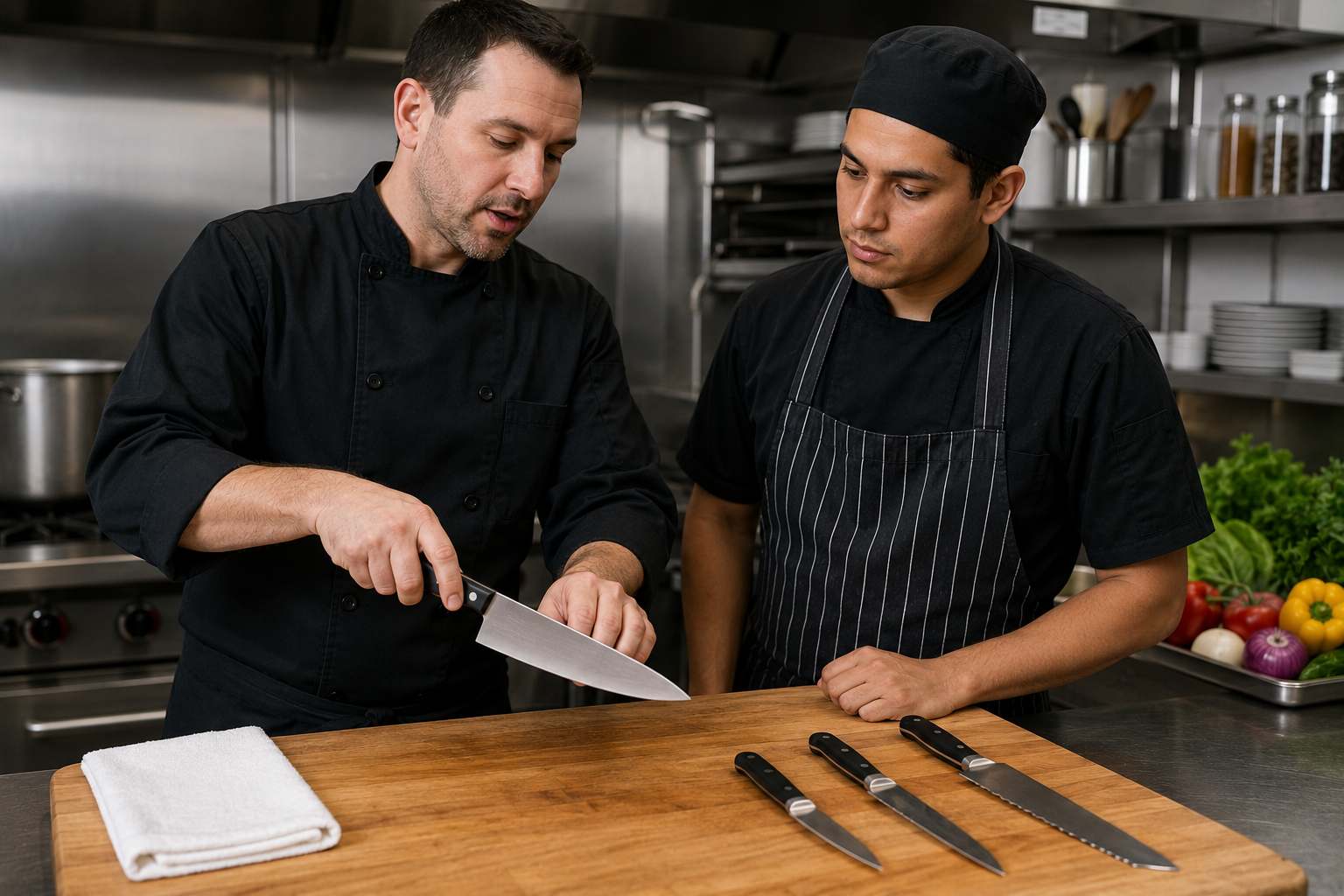
The Practical Approach
Teach knife care during onboarding, reinforce it through normal supervision, and correct unsafe or damaging habits before they become routine.
Knife Care Belongs in Onboarding
New cooks are often trained on recipes, sanitation, production standards, and station setup while knife care is left to informal observation.
That creates inconsistent habits and preventable damage.
A short, structured lesson should explain how the restaurant expects knives to be selected, used, cleaned, inspected, stored, maintained, and reported when problems appear.
What Every Cook Should Learn
Choose the Right Knife
Match the blade to the ingredient and never treat a kitchen knife as a general-purpose tool.
Use an Approved Surface
Cut only on stable boards that protect the edge and suit the task.
Handle the Edge Safely
Keep hands clear of the cutting path and treat every knife as freshly sharpened.
Clean and Dry Promptly
Wash knives individually, dry them completely, and return them directly to storage.
Recognize Problems
Identify dullness, chips, rolls, corrosion, broken tips, bends, and loose handles.
Report and Remove
Take damaged knives out of service and notify the designated manager or lead.
Demonstrate a Stable Cutting Setup
Speed should develop from repetition and control—not pressure to work faster than the cook can safely manage.
• Use a board large enough for the task.
• Place a damp towel or nonslip mat beneath the board when needed.
• Keep bowls, scraps, towels, and loose utensils away from the cutting path.
• Create a flat side on round ingredients before continuing.
• Keep the guiding hand out of the blade’s expected path.
• Work at a controlled pace.
Teach Safe Hand Position
A claw-style guiding grip can help keep fingertips away from the cutting edge.
Curl the fingertips inward, keep the thumb behind them, and let the knuckles remain nearer the side of the blade.
The guiding hand should move backward gradually as the knife advances. The grip reduces risk but does not make rushed or careless cutting safe.
Prevent Damaging Habits
No Sideways Scraping
Use the spine or a bench scraper to move food across the board.
No Twisting
Do not rotate a blade while it is wedged in dense food.
No Prying
Do not open lids, separate frozen items, or use knives as screwdrivers.
No Striking the Spine
Hitting the knife to force it through food reduces control and may damage the blade.
No Hard Surfaces
Do not cut on glass, ceramic, stone, metal counters, plates, or trays.
Never Catch a Falling Knife
Step back and allow it to fall rather than reaching toward the blade.
Teach Cooks to Recognize Dullness
Employees should report declining performance instead of compensating with more force.
Common signs include:
• Sliding across tomato, pepper, or onion skin.
• Crushing herbs or delicate produce.
• Tearing proteins rather than slicing cleanly.
• Requiring more pressure than normal.
• Cutting well in one area but poorly in another.
• Failing to improve after approved honing.
• Wedging in food that the knife previously cut easily.
Explain Honing and Sharpening
These terms should not be used interchangeably.
Honing
MaintenancePros
May realign a mildly rolled edge on suitable knives.
Cons
Cannot restore a rounded, worn, chipped, or heavily damaged apex.
Best For
Trained employees using an approved rod with light pressure and a stable angle.
Sharpening
RestorationPros
Recreates the cutting edge by removing worn or damaged steel.
Cons
Requires controlled equipment, technique, and evaluation.
Best For
Knives that no longer respond to maintenance or have actual edge damage.
Teach Safe Cleaning and Storage
Never leave a knife submerged in water or hidden beneath towels, scraps, pans, or utensils.
• Keep the knife visible while carrying and cleaning it.
• Wash one knife at a time.
• Keep fingers away from the edge.
• Rinse and dry the blade, edge, handle, rivets, and joints completely.
• Return the knife directly to its assigned rack, guard, roll, or storage position.
• Keep storage clean and dry.
• Avoid loose drawer storage unless every blade is individually protected.
Dishwashers expose knives to detergent, heat, moisture, impacts, and handling risks. Quality kitchen knives should generally be washed by hand and dried immediately.
Inspect Before Use
A quick inspection can identify problems before food preparation begins.
• Confirm that the knife is clean and dry.
• Check the edge for chips, rolls, or flat spots.
• Inspect the tip for bending or breakage.
• Look for rust, pitting, or unusual discoloration.
• Check the handle for looseness, cracks, swelling, or gaps.
• Check the blade for bending, twisting, or structural damage.
• Confirm that the knife belongs at the assigned station.
Remove Unsafe Knives From Service
A damaged knife should be labeled, guarded, and stored separately so another employee cannot return it to service by mistake. Clear removal criteria should include significant chips, broken tips, cracks, loose handles, severe corrosion, structural bends, contamination, or repeated slipping.
Make Reporting Easy and Blame-Aware
Employees are more likely to report problems when the process is simple and honest reporting does not automatically result in blame.
Provide a designated out-of-service location and a clear person to notify.
Record:
• Knife identification or station.
• The problem observed.
• The task being performed.
• How the issue occurred, when known.
• Confirmation that the knife was removed and replaced with a safe backup.
Reckless or repeated misuse still requires correction, but hiding damage creates a greater risk.
Reinforce Training Through Supervision
Hands-on demonstrations are more effective than written rules alone.
Supervisors should use consistent language, demonstrate the same approved methods, and correct problems early.
Effective coaching includes:
• Explaining why the rule matters.
• Supplying bench scrapers, box cutters, approved boards, guards, and sharp backups.
• Recognizing employees who report damage and protect equipment.
• Reviewing incidents to determine whether tools, training, staffing, or procedures need improvement.
• Providing short refresher demonstrations as menus, staff, and equipment change.
Provide Sharp Backups
Training cooks to remove dull or damaged knives works only when the kitchen provides a safe replacement. A rotation system keeps production moving without forcing employees to use unsafe tools.
Practical Training Checklist
• Explain which knives belong to each station and task.
• Demonstrate stable board setup and safe hand position.
• Show how to cut without excessive impact, twisting, or scraping.
• Explain honing, sharpening, and repair.
• Demonstrate safe washing, drying, inspection, and storage.
• Review conditions requiring immediate removal from service.
• Show where damaged knives and reports belong.
• Confirm that sharp backup knives are available.
• Observe the employee performing the procedures.
• Document completion and schedule refresher training.
Key Takeaways
Train Before Problems Develop
Knife care belongs in onboarding and should be reinforced during everyday supervision.
Make Expectations Clear
Employees should know how to use, clean, store, inspect, and report every knife.
Support the Training
Approved boards, correct tools, sharp backups, and simple reporting systems make good habits practical.
References
The following sources were used in preparing and supporting this article.
Young Worker Safety in Restaurants: Food Preparation
Occupational Safety and Health Administration
osha.gov
Food Services: Kitchen Equipment
Occupational Safety and Health Administration
osha.gov
FDA Food Code
U.S. Food and Drug Administration
fda.gov
Training and Education
CDC Restaurant Food Safety
cdc.gov