Hunting and Outdoor Knives
Outdoor knives perform best when their blade shape, steel, edge geometry, handle, construction, and maintenance match the work they actually do.
Hunting, camping, fishing, and outdoor work place different demands on a knife. The right design balances cutting performance, toughness, corrosion resistance, control, maintenance, and safe carry.
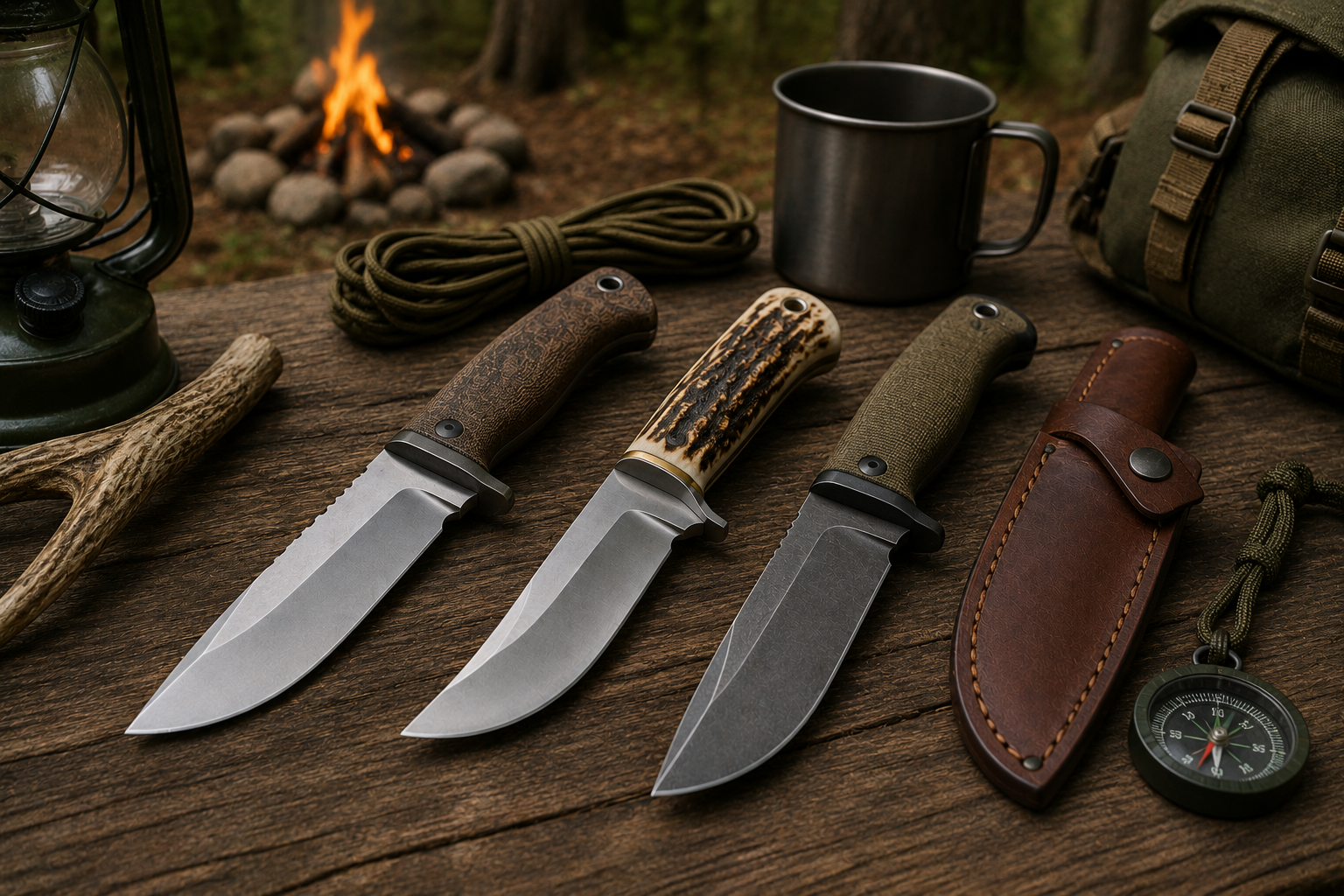
The Practical Approach
Choose an outdoor knife for the work you actually perform—not for how large, heavy, or aggressive it looks. Control, useful geometry, durability, corrosion resistance, and ease of maintenance matter more than appearance.
Start With the Real Tasks
Outdoor knives may cut rope, open packaging, prepare food, trim materials, process game, carve wood, make kindling, or perform routine camp chores.
No single knife design is ideal for every task.
A practical choice begins with questions such as:
• What will the knife cut most often?
• Will it be exposed to rain, humidity, saltwater, blood, food, dirt, or sap?
• Is compact carry more important than strength and easy cleaning?
• Will detailed control or heavier work matter more?
• Can the edge be maintained easily away from the workshop?
Fixed Blade or Folding Knife?
Both can be useful outdoors, but their strengths and maintenance needs differ.
Fixed Blade
Simple and StrongPros
No pivot or lock, easier cleaning, and generally better suited to wet, dirty, or demanding work.
Cons
Requires a secure sheath and usually takes more space to carry.
Best For
Hunting, field dressing, camp work, fishing, and jobs where contamination or structural stress is likely.
Folding Knife
Compact and ConvenientPros
Easy to carry and useful for light utility work.
Cons
The pivot and locking mechanism collect debris and require regular inspection, cleaning, and lubrication.
Best For
Light outdoor tasks where portability matters more than heavy-duty use.
Construction Affects Strength
Many fixed-blade outdoor knives use full-tang construction, meaning the blade steel continues through most or all of the handle.
This can provide strong support, but a full tang does not make a knife indestructible.
Steel thickness, heat treatment, edge geometry, handle attachment, blade shape, and proper use all matter. Prying, twisting, striking metal, or treating the knife as a crowbar can damage even a heavily built fixed blade.
Blade Features That Change Performance
Blade Length
Longer blades provide reach, while shorter blades generally provide better control for detailed work.
Point Shape
A fine point improves precision but may be more vulnerable to bending or breakage.
Belly
A curved belly supports slicing and skinning, but too much curve can reduce control in straight cuts.
Blade Thickness
Thicker blades tolerate more stress but may wedge and require more force during slicing.
Edge Geometry
Thin edges cut efficiently, while thicker edges provide more support during rougher work.
Handle and Guard
Grip security, comfort, cleanability, and protection against sliding onto the edge are essential outdoors.
Knife Steel Is a Balance of Properties
Outdoor knife steel must balance toughness, edge retention, corrosion resistance, hardness, and ease of sharpening.
No steel leads every category.
Knife Steel Nerds testing shows that toughness and edge retention generally involve tradeoffs, while edge geometry strongly influences both cutting ability and resistance to damage.
A high-wear steel may stay sharp longer but require more effort to sharpen in the field. A tougher steel may tolerate impact better but need more frequent edge maintenance. Heat treatment and geometry can matter as much as the steel name.
Stainless and Carbon Steel Outdoors
Both can perform well when matched to the environment and maintained appropriately.
Stainless Steel
More Corrosion ResistantPros
Generally better suited to wet, humid, salty, or unpredictable environments.
Cons
Stainless does not mean rustproof, and some high-alloy steels are difficult to sharpen in the field.
Best For
Fishing, boating, humid climates, food use, and situations where moisture control is difficult.
Carbon and Low-Alloy Steel
Often Tough and ServiceablePros
Many examples are tough and relatively straightforward to sharpen.
Cons
Usually requires faster cleaning, drying, and corrosion protection.
Best For
Users willing to maintain the blade carefully and keep it dry between uses.
Hunting and Game Processing
A hunting knife should provide control without unnecessary blade length or point exposure.
A curved belly can assist with skinning, while a controlled point helps reduce accidental punctures.
• Use deliberate, shallow cuts near delicate areas.
• Keep the cutting path away from the supporting hand.
• Avoid striking hard bone with a thin edge.
• Expect hide, hair, dirt, and bone contact to reduce sharpness.
• Clean and dry the knife as soon as practical.
• Wash and sanitize the knife appropriately before later food use.
A knife used for game processing should be inspected carefully for edge damage, corrosion, loose handles, and trapped residue.
Use a Better Tool When One Exists
A knife is primarily a cutting tool. Use a saw, hatchet, axe, multitool, or pry tool when that equipment is better suited to the job.
Batoning, Prying, and Sideways Force
Batoning means striking the spine of a knife to split wood. Some outdoor knives are designed to tolerate limited batoning, while others are not.
Knots, twisted grain, thin blades, fine tips, and weak handle construction increase the risk of damage.
Prying and twisting are especially harmful because they place lateral force on the edge, point, tang, pivot, and handle.
• Do not pry open rigid objects.
• Do not twist a blade that is embedded in wood or other material.
• Avoid staples, wire, screws, cans, and other metal contact.
• Stop when the knife requires excessive force.
• Follow the knife manufacturer’s intended-use guidance.
Clean, Dry, and Inspect After Use
Dirt, moisture, blood, fish residue, sap, food, salt, and plant material can remain on the blade, handle, pivot, or sheath.
• Remove visible residue.
• Wash the knife appropriately for its materials and use.
• Clean around fasteners, guards, pivots, and textured handles.
• Dry the blade, handle, hardware, and sheath completely.
• Inspect the edge, point, handle, lock, and fasteners.
• Apply a suitable protective coating when needed.
• Do not return a wet knife to a sheath or closed pack for extended storage.
Folders and Sheaths Need Separate Attention
Folding knives collect lint, grit, mud, sand, food, and plant debris around the pivot and lock.
Remove a folder from service when the lock slips, fails to engage fully, or releases unexpectedly.
Leather sheaths can retain moisture and encourage corrosion during long-term storage. Synthetic sheaths resist moisture better but can still trap water and grit.
Inspect every sheath for:
• Secure retention.
• Loose stitching or damaged fasteners.
• Blocked drainage.
• Grit or debris.
• Areas where the edge can contact screws, rivets, or worn material.
• Damage that may allow the blade to cut through the sheath.
Field Sharpening Is Maintenance, Not Major Repair
A lightly worn edge can often be restored with a compact diamond plate, ceramic rod, fine stone, strop, or guided field sharpener.
Major chips, severe rolls, broken tips, and major profile damage are better handled with stable equipment and controlled workshop conditions.
A basic field-maintenance process is:
• Clean the blade.
• Inspect for chips, rolls, and flat spots.
• Identify the existing bevel.
• Use the least aggressive abrasive that will work efficiently.
• Maintain a consistent angle from heel to tip.
• Reduce and remove the burr.
• Slow down near the tip to avoid rounding it.
• Test the edge carefully before returning the knife to use.
Inspect Before Every Trip
• Check the edge for dullness, chips, and flat spots.
• Inspect the point for bends or breakage.
• Confirm that handle scales and fasteners are secure.
• Check fixed blades for cracks or movement near the handle.
• Confirm that folding locks engage fully.
• Inspect the sheath for damage and secure retention.
• Look for rust, trapped moisture, and contamination.
• Verify that the knife can be carried safely and legally where it will be used.
Outdoor Knife Safety
Uneven ground, cold hands, gloves, rain, fatigue, and poor lighting can make field use less predictable.
Establish Stable Footing
Stop moving and get balanced before beginning a cut.
Cut Away From the Body
Keep hands, legs, and torso outside the expected cutting path.
Control the Material
Secure what is being cut rather than holding it loosely in the palm.
Use Deliberate Pressure
Stop and reassess when the knife requires excessive force.
Keep Others Clear
Make sure companions remain outside the cutting and follow-through area.
Never Catch a Falling Knife
Step away and allow it to fall rather than reaching toward the blade.
First Aid and Local Rules
Carry appropriate first-aid supplies and know how to control serious bleeding. Outdoor locations may be far from immediate medical help.
For severe bleeding, secure the knife, call emergency services, and apply firm direct pressure with clean material while following current first-aid guidance.
Knife laws and property rules vary by state, city, park, hunting area, campground, workplace, and landowner. Blade length, concealment, fixed blades, opening mechanisms, and restricted locations may all matter.
This article provides general knife-care information and is not legal or medical advice.
Key Takeaways
Match the Knife to the Work
Blade shape, size, steel, geometry, construction, and handle should reflect the tasks actually performed.
Maintain It After Every Trip
Cleaning, drying, inspection, corrosion prevention, and light edge maintenance protect the knife and sheath.
Use the Correct Tool
Avoid prying, twisting, metal contact, and using a knife as a substitute for a saw, axe, or pry tool.
References
The following sources were used in preparing and supporting this article.
Knife Steels Rated by a Metallurgist: Toughness, Edge Retention, and Corrosion Resistance
Knife Steel Nerds
knifesteelnerds.com
How to Design Knives That Do Not Fail
Knife Steel Nerds
knifesteelnerds.com
LifeSharp: How It Works
Benchmade Knife Company
support.benchmade.com
Life-Threatening External Bleeding
American Red Cross
redcross.org