Sharpening vs. Replacement Cost
The useful comparison is not sharpening versus the cheapest new knife. It is restoring a known, serviceable knife versus buying a genuinely comparable replacement.
A dull knife is not automatically worn out. Sharpening is often the practical choice when the blade and handle remain sound, while replacement becomes more reasonable when damage, safety, or poor remaining geometry limits the result.
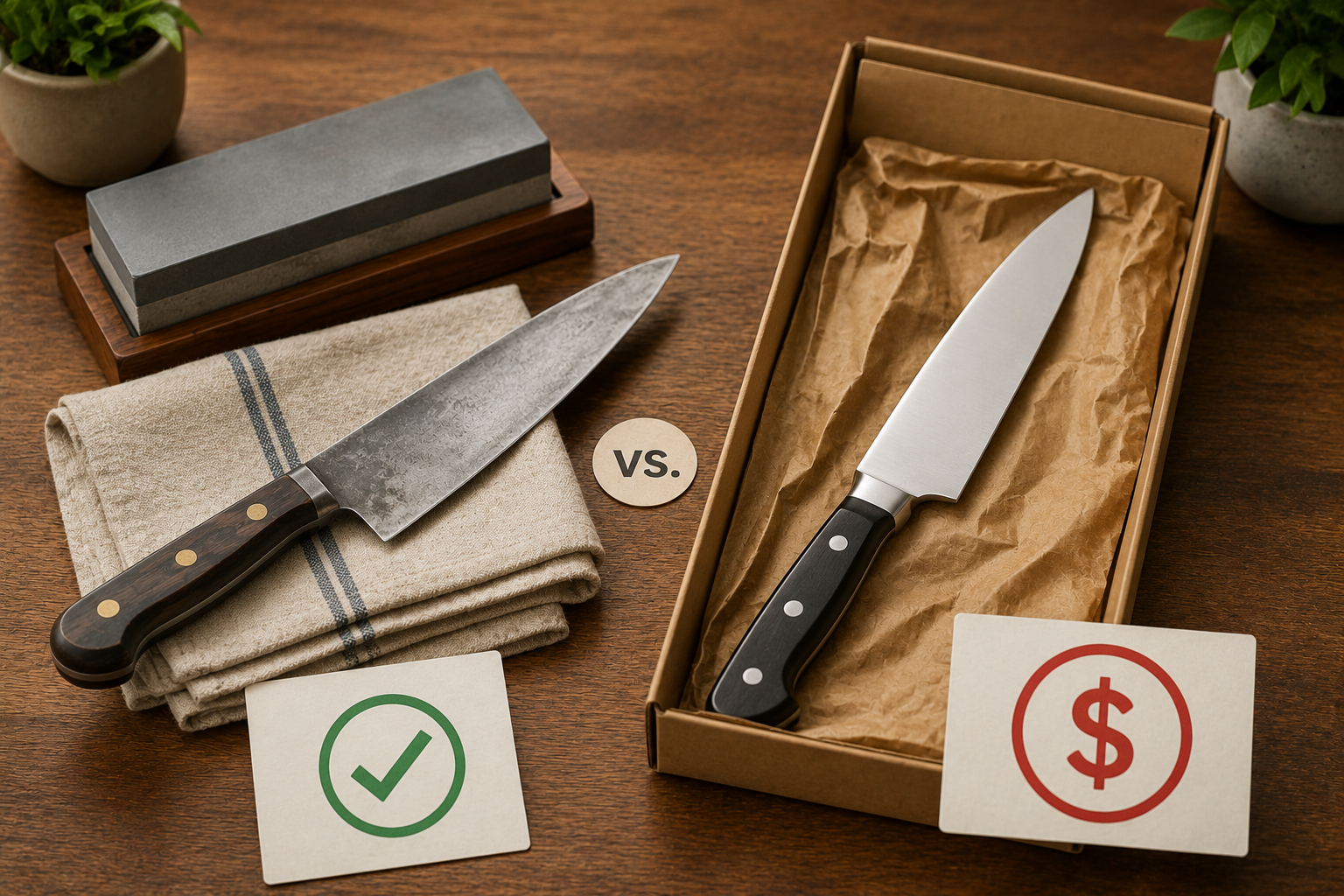
The Main Question
A dull knife is usually a maintenance problem, not proof that the entire knife needs to be replaced.
Compare Like With Like
The useful comparison is the cost of sharpening versus the cost of a replacement with similar quality and usefulness.
A cheaper new knife may differ in:
• Steel and heat treatment.
• Blade geometry.
• Handle comfort.
• Balance and weight.
• Construction quality.
• Expected service life.
Replacing a familiar knife with the least expensive available option is not always an equal comparison.
A Practical Starting Comparison
| Knife Condition | Sharpening Consideration | Replacement Consideration |
|---|---|---|
| Routine dullness | Usually needs ordinary edge restoration. | Replacement is often unnecessary when the knife remains sound and useful. |
| Minor chips or tip damage | May need additional correction and reshaping. | Compare the expected result with a similar replacement. |
| Premium or specialty knife | Sharpening often preserves substantial practical value. | A comparable replacement may be expensive or difficult to find. |
| Comfortable budget knife | May still be worth sharpening when used regularly. | Purchase price alone does not determine usefulness. |
| Severe damage or unsafe construction | Sharpening may not address the real problem. | Replacement or specialist evaluation may be more practical. |
A Familiar Knife Has Practical Value
A knife used for years may already fit the cook’s hand, grip, cutting style, and workspace.
The user knows its balance, blade length, handle shape, and behavior in food. A new knife may be heavier, thicker, less comfortable, or simply less suitable.
Familiarity does not make an unsafe knife worth keeping, but it should be included in the comparison.
Routine Sharpening Removes Very Little Steel
A kitchen knife normally contains far more steel than is removed during ordinary sharpening.
Timely sharpening generally requires less material removal than correcting an edge that has become extremely dull, deeply chipped, or badly misshapen.
The amount of work depends on condition:
• Routine dullness usually needs limited edge restoration.
• Chips require removal of steel until the damage is cleared.
• A broken tip may require reshaping and a small profile change.
• Severe corrosion or major distortion may limit what can be corrected practically.
Early Maintenance Usually Simplifies the Decision
Sharpening before severe dullness or damage develops generally requires less correction and preserves more of the original blade.
Budget Knives Can Still Be Worth Sharpening
An inexpensive knife is not automatically disposable.
Sharpening may make sense when the knife:
• Fits the hand comfortably.
• Performs a regular kitchen task.
• Has a secure handle and sound blade.
• Needs routine sharpening or limited correction.
• Would otherwise be replaced with a similar knife repeatedly.
The decision should be based on usefulness and condition, not purchase price alone.
When Replacement Becomes More Reasonable
Replacement may be the better choice when:
• The blade has a structural crack.
• The handle is loose, cracked, or cannot be secured safely.
• Corrosion or pitting is deep and widespread.
• The blade has a major bend or distortion.
• Extensive correction would leave impractical geometry.
• Very little useful blade remains.
• A suitable replacement costs less than the work required.
Cost should never override safety.
Sentimental Value Changes the Calculation
Some knives have family, professional, or personal value that cannot be measured by replacement price.
A meaningful knife may justify sharpening or careful correction even when buying an ordinary replacement would cost less.
The expected result should still be realistic, especially when the knife has substantial damage or may no longer be suitable for active use.
Maintenance Also Delays Replacement
Keeping an existing knife in useful service delays the materials, manufacturing, packaging, transportation, and disposal associated with replacement.
EPA describes sustainable materials management as using and reusing materials more productively across their life cycles.
Knife care also affects long-term value:
• Use a knife-friendly cutting board.
• Hand wash and dry promptly.
• Store the edge safely.
• Avoid prying, twisting, frozen food, and inappropriate bone contact.
• Use the spine or a scraper to move food.
• Sharpen when performance begins to decline.
A Simple Decision Checklist
• Is the blade structurally sound?
• Is the handle secure and comfortable?
• Does the knife perform a useful task?
• Does it need routine sharpening or substantial correction?
• What would a genuinely comparable replacement cost?
• Will useful blade geometry remain afterward?
• Does the knife have personal or professional value?
• Is continued use safe?
When the knife remains safe, useful, and structurally sound, sharpening is often the more practical choice.
Key Takeaways
Compare Equivalent Knives
The cheapest new knife may not match the quality, comfort, or usefulness of the existing one.
Condition Drives Cost
Routine sharpening is different from correcting chips, tip damage, severe corrosion, or major distortion.
Safety Comes First
Cracks, unsafe handles, severe corrosion, and impractical remaining geometry may make replacement the better choice.
References
The following sources were used in preparing and supporting this article.
Sustainable Materials Management Basics
U.S. Environmental Protection Agency
epa.gov
Sustainable Materials Management: Non-Hazardous Materials and Waste Management Hierarchy
U.S. Environmental Protection Agency
epa.gov
Food Services: Kitchen Equipment
Occupational Safety and Health Administration
osha.gov
How to Sharpen Your Knives
ZWILLING
zwilling.com