How Swordmaking Influenced Japanese Kitchen Knives
Japanese kitchen knives share parts of a larger metalworking tradition, but they are specialized culinary tools—not miniature swords.
Swordmaking contributed knowledge of steel selection, forging, heat treatment, grinding, polishing, and divided craftsmanship. Japanese kitchen knives also developed through regional toolmaking, culinary traditions, modern steel production, and specialized food preparation.
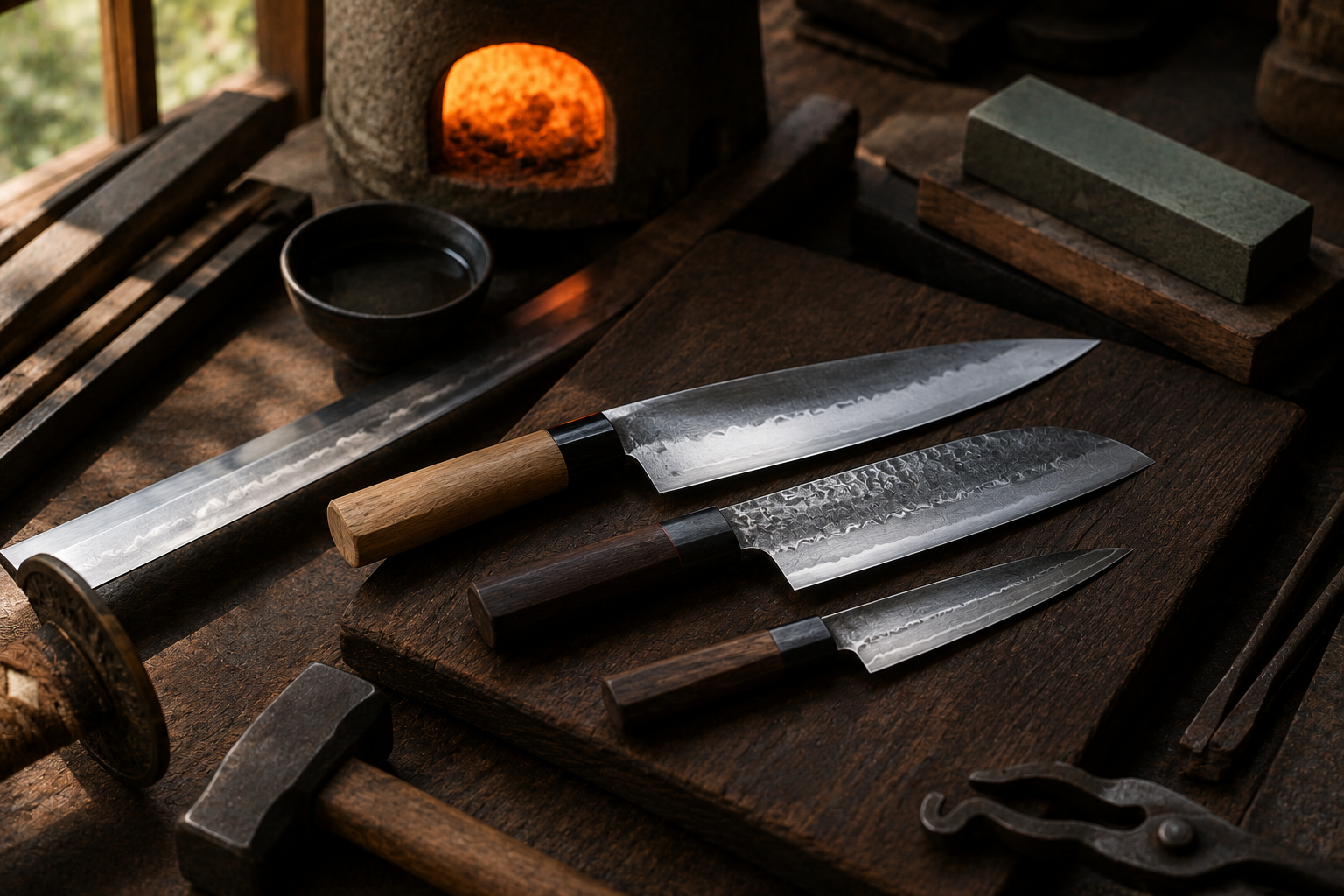
The Connection Is Real—but Often Exaggerated
Japanese swords and kitchen knives share knowledge of steel, forging, heat treatment, grinding, polishing, and edge geometry. They were nevertheless developed for very different purposes, dimensions, stresses, and cutting tasks.
A Larger Metalworking Tradition
Japanese blade history includes more than swords.
Smiths and regional workshops also produced agricultural tools, carpentry tools, razors, scissors, household blades, and food-preparation knives.
Kitchen cutlery developed from this broader working tradition as well as from:
• Regional food preparation.
• Fishing and butchery practices.
• Professional culinary specialization.
• Imported Western knife forms.
• Modern steelmaking and manufacturing.
Swordmaking is one influence, not the complete origin story.
Skills Shared Across Blade Crafts
| Craft Stage | Swordmaking Purpose | Kitchen-Knife Connection |
|---|---|---|
| Steel selection | Choose material with suitable hardness and toughness | Match steel properties to edge retention, toughness, and maintenance |
| Forging and shaping | Establish blade form and material distribution | Create profile, taper, thickness, and laminated construction |
| Heat treatment | Develop a hardened edge while managing brittleness | Control hardness, toughness, and edge stability |
| Grinding | Establish cross-section, ridges, and final geometry | Control bevels, blade thickness, food release, and cutting resistance |
| Polishing and sharpening | Refine geometry and reveal blade structure | Finish surfaces and create a functional cutting edge |
Why Traditional Sword Steel Was Folded
Traditional Japanese swords are associated with tamahagane, produced from iron-rich sand in a tatara smelter.
The Metropolitan Museum of Art explains that traditional tamahagane contains impurities and unevenly distributed carbon. Folding and forge welding helped consolidate the steel, work out impurities, and distribute carbon more evenly.
Folding also created visible grain patterns in the finished blade.
Modern factory steels are produced with far greater consistency. A modern kitchen-knife steel does not need to be folded to become pure or high performing.
Pattern Does Not Automatically Mean Performance
A folded, layered, hammered, or Damascus-style appearance does not by itself establish steel quality, heat treatment, geometry, or cutting performance.
Laminated Construction Is a Clear Technical Connection
Traditional and modern Japanese knives often combine steels with different properties.
A hard steel may form the cutting edge while softer or tougher material supports it. Stainless cladding may also cover much of a reactive carbon-steel core.
Common arrangements include:
• Ni-mai: two-layer construction often associated with single-bevel knives.
• San-mai: a hard core placed between outer layers.
• Warikomi: hard edge steel inserted into softer supporting material.
• Stainless-clad carbon steel: reactive edge steel with corrosion-resistant outer layers.
Lamination is functional construction. It should not be confused with a decorative surface pattern.
Sakai Shows How Kitchen-Knife Craft Became Specialized
Sakai’s official history connects its cutlery industry strongly to tobacco-leaf knives produced beginning in the sixteenth century—not simply to sword conversion.
Sakai cutlery developed a divided system of work:
• A smith forges and heat-treats the blade.
• A specialist grinds and sharpens it.
• Another craftsperson installs the handle and completes assembly.
That division of labor resembles the coordinated work found in other Japanese blade crafts while remaining focused on culinary tools.
Sakai became especially associated with traditional professional kitchen knives and single-bevel construction.
Single-Bevel Knives Reflect Culinary Specialization
Traditional Japanese kitchen knives are often highly task-specific.
Korin identifies the yanagiba, deba, and usuba as core traditional knife forms:
• Yanagiba: long drawing cuts through raw fish.
• Deba: fish butchery and filleting with a thick, substantial blade.
• Usuba: precise vegetable preparation.
These knives commonly use a large bevel on one side and a concave or nearly flat reverse.
Single-bevel geometry can support highly controlled cuts, but it also steers differently and requires a specialized sharpening approach.
Modern Japanese Knives Are Not Limited to Traditional Methods
Contemporary Japanese knives may use:
• Carbon steel.
• Stainless steel.
• Powder-metallurgy steel.
• Factory-produced laminated steel.
• Controlled electric furnaces.
• Power hammers and presses.
• Modern grinding machines and abrasives.
• Computer-controlled manufacturing.
A knife may be hand-forged while using modern steel and equipment. A factory knife may still require substantial skill in heat treatment, grinding, finishing, assembly, and quality control.
Traditional knowledge and modern technology often work together.
Hardness and Thin Geometry Require Appropriate Use
Many Japanese kitchen knives use relatively hard steel and thin edge geometry.
That combination can provide efficient cutting and strong edge retention, but it may be less tolerant of misuse.
Avoid:
• Twisting the edge in a cut.
• Prying.
• Cutting frozen food.
• Striking bones with an unapproved knife.
• Cutting on glass, stone, ceramic, or metal.
• Scraping the edge sideways across the board.
• Leaving reactive steel wet or covered with acidic residue.
The design should be judged by its intended kitchen work, not by romantic comparisons with swords.
Common Claims and Better Explanations
| Claim | Better Explanation |
|---|---|
| Japanese kitchen knives are miniature swords. | They share parts of a blade-making tradition but use culinary geometry and task-specific construction. |
| Folded steel is always superior. | Folding refined inconsistent traditional material; modern steels do not need it for purity. |
| Every wavy line is a hamon. | It may be a cladding line, layered pattern, surface finish, etching, or true hardening boundary. |
| Hand-forged means entirely traditional. | Modern hand forging often uses industrial steel, powered equipment, and controlled heat treatment. |
| Harder always means better. | Hardness supports some thin edges but must be balanced with toughness, geometry, and intended use. |
| All Japanese knives are single bevel. | Many traditional professional forms are single bevel, while gyuto, santoku, nakiri, and many modern knives are double bevel. |
What Matters in the Finished Kitchen Knife
For practical use, focus on:
• Intended task.
• Blade thickness and geometry.
• Single-bevel or double-bevel construction.
• Steel and heat treatment.
• Handle fit and balance.
• Sharpening requirements.
• Corrosion care.
• Maker or manufacturer guidance.
Historical tradition adds context and meaning, but performance still depends on how the individual knife was designed, made, sharpened, and used.
Key Takeaways
Shared Craft, Different Tool
Swordmaking contributed knowledge and traditions, but kitchen knives evolved for specialized food preparation.
Kitchen History Is Broader
Toolmaking, regional cutlery, culinary practice, Western influence, and modern manufacturing also shaped Japanese knives.
Judge the Actual Knife
Geometry, steel, heat treatment, construction, sharpening, and intended use matter more than romantic marketing.
References
The following sources were used in preparing and supporting this article.
The Japanese Blade: Technology and Manufacture
The Metropolitan Museum of Art
metmuseum.org
Cutlery
Sakai City
city.sakai.lg.jp
Traditional Industries
Sakai City
city.sakai.lg.jp
Japanese Knife FAQ
Korin
korin.com