Do You Need a Full Knife Set?
Most home cooks can begin with three dependable knives and add specialty blades only when their cooking habits justify them.
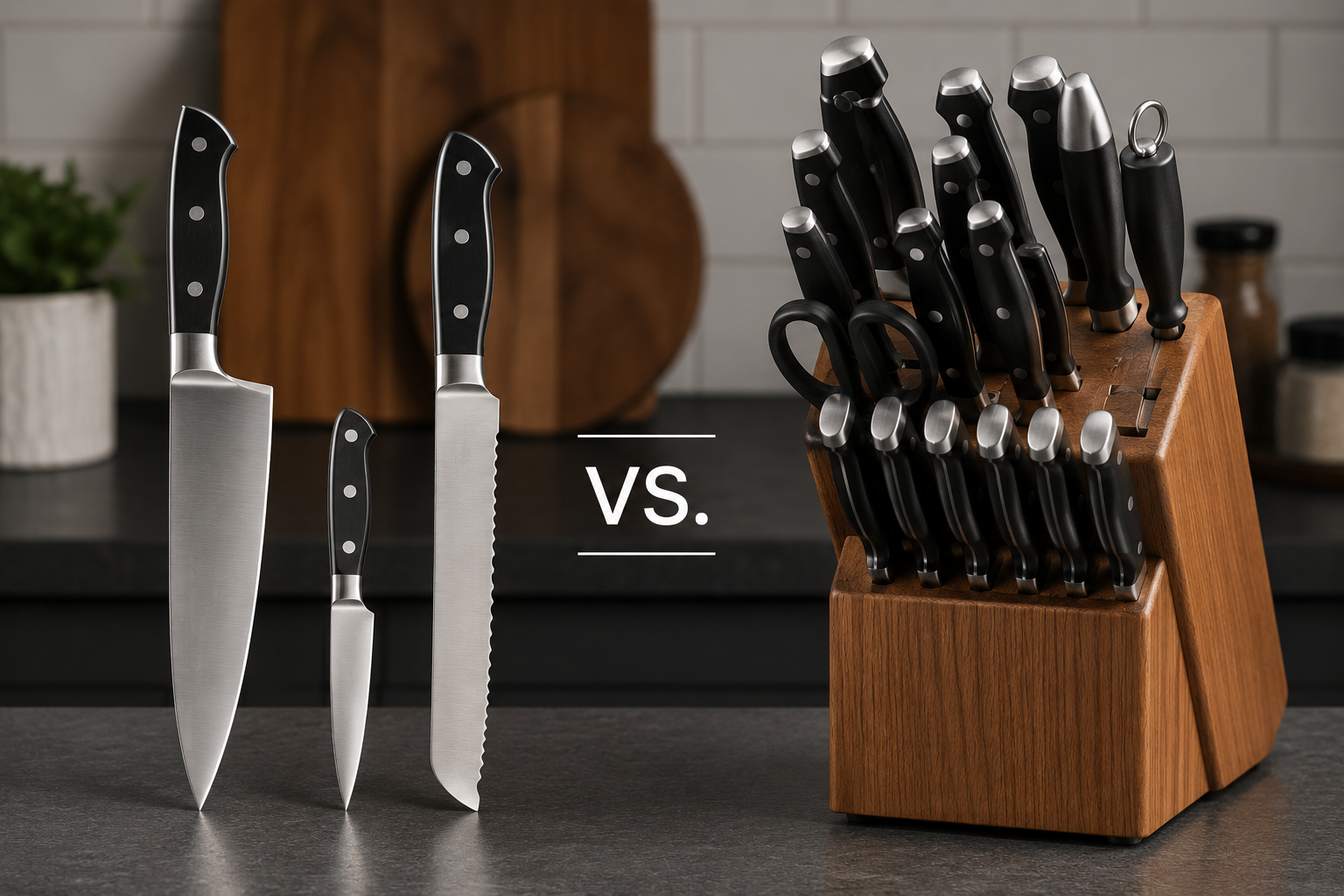
A chef’s knife, paring knife, and serrated bread knife can handle most everyday kitchen work. Full sets can still make sense, but only when the included knives, accessories, storage, and price match the way you actually cook.
Why Complete Knife Sets Are Appealing
Knife sets appear to solve several problems at once. The knives match, the block provides storage, and the buyer does not need to choose individual blades.
A set can be an attractive gift or a quick way to equip a new kitchen. The problem is that the number printed on the box often says more about marketing than practical usefulness.
A 12-piece or 15-piece set may count steak knives, kitchen shears, a honing rod, and the storage block. The number of actual food-preparation knives may be much smaller.
The Three Essential Knives
For many home kitchens, these three knives perform nearly all routine cutting work.
Chef’s Knife
The primary kitchen knife for chopping vegetables, slicing meat, mincing herbs, dicing onions, and general meal preparation.
Paring Knife
A short, precise blade for peeling, trimming, coring, hulling, and other small tasks that feel awkward with a larger knife.
Serrated Bread Knife
A long serrated blade for crusty bread, soft cakes, ripe tomatoes, and foods with a firm exterior and delicate interior.
What Each Essential Knife Does Best
| Knife | Best Uses | Less Suitable For |
|---|---|---|
| Chef’s knife | Chopping, slicing, dicing, mincing, and most general preparation | Peeling in the hand, cutting crusty bread, or working close to small bones |
| Paring knife | Peeling, trimming, coring, hulling, and close detail work | Large produce, long slicing tasks, and heavy chopping |
| Serrated bread knife | Bread, cakes, tomatoes, and foods with a tough exterior and soft interior | Fine chopping, peeling, and most straight-edge cutting tasks |
Why Large Sets Often Contain Filler
A larger number of pieces does not necessarily mean more useful kitchen capability.
Repeated Sizes
Sets may include several medium-length knives that perform nearly the same job.
Overlapping Names
Utility, sandwich, tomato, slicing, and compact chef’s knives may overlap enough that one or more remain unused.
Specialty Shapes
Boning, carving, fillet, or tomato knives are useful only when the cook regularly performs those tasks.
Accessories Counted as Pieces
Shears, honing rods, steak knives, and the block may inflate the advertised count even though they are not food-preparation knives.
Matching Over Performance
Every knife may share the same handle and appearance even when another design would suit a specific role better.
Budget Spread Thin
A set price divided across many pieces may mean thicker geometry, rougher handles, lower-grade components, or less attention to each knife.
Full Set or Individual Knives?
Either approach can work when it matches the buyer’s cooking habits, budget, and available space.
Full Knife Set
Convenient All-in-One PurchasePros
Matching appearance, included storage, easy gifting, and possible savings when most pieces will be used.
Cons
May contain duplicates, low-use accessories, unwanted steak knives, or handles and geometry that are not ideal for every task.
Best For
A new kitchen, frequent specialty work, a smaller no-filler set, or a strong discount on knives you would buy individually.
Individual Knives
Focused and FlexiblePros
Allows different sizes, weights, brands, handles, and designs to be selected for each role.
Cons
Requires more comparison and may not include coordinated storage.
Best For
Buyers who value performance, want to build gradually, or prefer to spend more on the knives used most often.
Steak Knives, Shears, and Honing Rods
Steak knives can be useful, but they belong mainly at the dining table rather than in food preparation. A block with eight steak knives may appear large while containing only four or five kitchen knives. Consider steak knives separately and buy them only when they serve a real need.
Kitchen shears can be useful for herbs, packaging, poultry tasks, and other jobs, but their inclusion should not determine whether the knives themselves are a good value.
A honing rod can help maintain some straight-edged knives between sharpenings, but it is an accessory rather than another knife. Its usefulness depends on the rod material and whether it suits the steel and edge geometry of the knives you own.
Useful Fourth and Fifth Knives
Add a specialty knife when a repeated task proves that it would improve control, speed, or results.
Boning Knife
Useful for trimming meat, removing skin, and working around joints and bones.
Slicing or Carving Knife
Helpful for long, clean slices through roasts, brisket, turkey, and ham.
Utility Knife
A medium-length knife for tasks that feel too small for a chef’s knife and too large for a paring knife.
Nakiri
A thin, flat-edged vegetable knife for cooks who prepare large amounts of produce and prefer push cutting.
Fillet Knife
A narrow, flexible blade for removing skin and bones from fish.
Cleaver
A specialized tool whose design may suit vegetable preparation or heavy work, depending on the type of cleaver.
Storage, Maintenance, and the Cutting Board
Large blocks occupy counter space and may contain narrow slots that scrape blades or trap moisture. A smaller collection can be stored in a compact block, drawer insert, magnetic strip, or individual guards.
Every knife eventually needs cleaning, inspection, edge maintenance, and sharpening. A focused collection costs less to maintain, makes changes in sharpness easier to notice, and reduces the chance that unused knives remain hidden with rust, chips, loose handles, or damaged edges.
The cutting board affects every knife. Glass, stone, ceramic, and similarly hard surfaces can dull edges quickly. Three dependable knives used on a suitable wood or plastic board are often more useful than a larger set used on a damaging surface.
Questions to Ask Before Buying a Set
• How many actual kitchen knives are included?
• Would I use every blade at least several times a year?
• Are several knives performing nearly the same job?
• Do steak knives or accessories inflate the piece count?
• Are the handles comfortable in my hand?
• Does the bolster allow the full cutting edge to be sharpened?
• Can individual knives be replaced if one is lost or damaged?
• Does the block fit my counter and provide room for future additions?
• Would three better individual knives cost the same or less?
• Do I have room to store and maintain the entire set safely?
Common Buying Mistakes
The best collection is determined by use, not by how complete the block looks.
Choosing by Piece Count
More pieces do not guarantee better quality, usefulness, or value.
Ignoring Handle Comfort
Matching handles may look attractive but can feel uncomfortable across every knife in the set.
Filling Every Block Slot
An empty slot does not mean the kitchen is missing an important tool.
Buying Specialty Knives Too Soon
Wait until a recurring task proves that another knife would improve control or save time.
Forgetting Maintenance Costs
A large set may cost more to sharpen and maintain than the buyer expects.
Sacrificing Quality for Matching Pieces
A mixed collection of well-chosen knives can outperform a visually perfect but mediocre set.
Key Takeaways
Start small and add knives with purpose.
Three Knives Cover Most Tasks
A chef’s knife, paring knife, and serrated bread knife form a practical foundation for most home cooks.
Sets Can Still Make Sense
A carefully chosen set is useful when most included pieces match your cooking habits and the price is strong.
Add Specialty Knives With Purpose
A new blade should solve a real, repeated task rather than fill an empty slot.
Consider the Whole System
Comfort, storage, cutting boards, maintenance, sharpening, and replacement matter along with purchase price.
References
The following sources were used in preparing and supporting this article.
Three Knives Every Kitchen Needs
WÜSTHOF
wusthof.com
Knife Guide
ZWILLING
zwilling.com
Which Knife Does What?
Victorinox
victorinox.com