Knife Storage Options
The right system protects the edge, controls the blade, stays clean and dry, and fits the people and space around it.
Knife blocks, magnetic strips, drawer organizers, blade guards, and rolls can all store knives safely when they fit the blades, remain clean and dry, and prevent accidental contact.
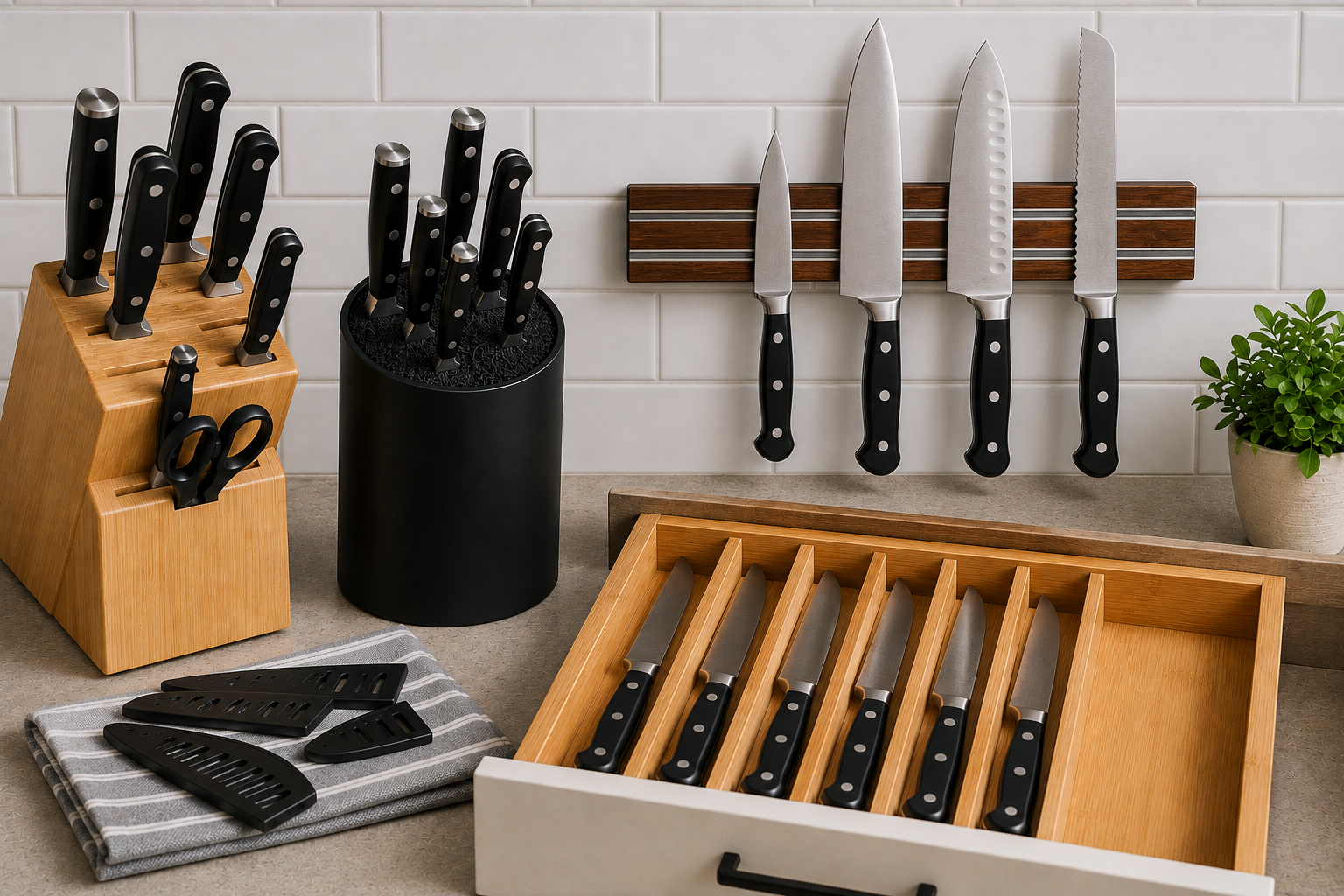
What Good Knife Storage Should Do
A good storage system protects the edge and tip, controls the blade, remains clean and dry, fits the knife securely, and prevents access by children, pets, or anyone reaching blindly into a drawer.
Common Storage Options at a Glance
No single option is best for every kitchen. Space, knife sizes, access, cleaning, and household safety should guide the choice.
Knife Block
Countertop AccessPros
Organized, convenient, and keeps knives separated.
Cons
Uses counter space, fixed slots may not fit every blade, and interiors can trap debris or moisture.
Best For
A stable collection whose knives fit the slots correctly.
Magnetic Strip or Block
Visible and FlexiblePros
Saves drawer space, fits mixed collections, and makes knives easy to identify.
Cons
Requires secure mounting, careful placement, sufficient magnet strength, and safe handling.
Best For
Kitchens with suitable wall or counter space away from children, traffic, heat, and water.
In-Drawer Organizer
Protected and HiddenPros
Keeps knives separated, out of sight, and off counters and walls.
Cons
Requires enough drawer depth, length, and width.
Best For
Homes that prefer hidden storage or need controlled access.
Blade Guards
Affordable and PortablePros
Compact, flexible, and useful in drawers, boxes, rolls, and during transport.
Cons
Must fit the blade correctly and should never be placed on a wet knife.
Best For
Small collections, unusual blade shapes, transport, or added protection inside another system.
Knife Roll or Case
Transport StoragePros
Organizes and contains knives for work, classes, travel, and sharpening trips.
Cons
Poor fit or weak retention can allow blades to shift, collide, or cut the material.
Best For
Professional cooks, students, mobile cooks, and anyone who transports knives.
Knife Blocks
Traditional blocks provide quick access and keep knives separated, but fixed slots must match blade length, height, width, spine thickness, and profile. A knife should never be forced into a slot.
Horizontal slots or designs that support the knife on its spine can reduce direct edge contact. Regardless of orientation, insert and remove knives carefully rather than dragging the edge along the slot.
Block interiors can collect dust, crumbs, moisture, and residue. Store only clean, completely dry knives, keep the block away from sink splashes and steam, remove loose debris periodically, and replace a block with persistent odor, mold, or interior damage.
Universal blocks accept mixed blade shapes more easily, but rods or bristles may rub polished surfaces and trap debris. Removable, washable inserts are preferable.
Magnetic Storage
Wall strips and magnetic countertop blocks save space and accommodate mixed collections. The system must be securely mounted or stable, strong enough to hold every knife, and positioned away from sinks, stoves, traffic paths, children, and pets.
Do not let a knife snap forcefully against the magnet. Place the spine against the strip first, rotate the blade face gently into position, and confirm the knife is fully supported. Remove it by rotating the edge away and lifting the spine free without dragging the blade.
Wood-faced or otherwise blade-friendly surfaces may reduce scratching compared with exposed metal. Leave enough space between knives so handles and blades do not collide.
Drawer Organizers and Blade Guards
In-drawer organizers keep knives protected and out of sight. Measure the drawer depth, width, and usable length before buying, and confirm that every blade and handle fits without forcing or crowding.
Blade guards can be used alone or inside an organizer. The guard should cover the full edge and tip without being too short, narrow, loose, or tight. A forced fit can rub the edge, trap moisture, or become dangerous to remove.
To install a guard, wash and dry the knife completely, hold the handle with the edge facing away, align the guard with the spine and blade face, and slide it into place without pressing against the edge.
Knife Rolls and Transport Cases
A roll or case should secure each knife so blades cannot slide out, collide, or cut through the material. Check slot capacity, blade length, handle retention, stitching, fasteners, seams, and cleanability.
Individual guards can provide additional protection inside a roll, especially for thin fabric, delicate tips, close spacing, or highly finished blades. The roll contains and organizes the collection; guards protect individual edges and tips.
Household and Location Safety
Young children should not be able to see and reach knife handles. A locked drawer, secured upper cabinet, or another controlled system may be safer than an exposed magnetic strip or countertop block.
Cats may jump onto counters, and large dogs may reach handles near the edge. Storage should be stable and positioned where paws, tails, climbing, or normal traffic cannot dislodge a knife.
Avoid sinks, dishwashers, stovetops, steam-producing appliances, and direct sunlight. Moisture can cause corrosion and handle damage, while heat can dry wood, soften adhesives, and damage storage materials. Hidden or under-cabinet storage should never create a surprise blade hazard.
Special Storage Needs
Carbon-steel knives must be completely dry before storage. For longer storage, a thin layer of food-safe oil may be appropriate. Avoid enclosed spaces that trap humidity and inspect infrequently used knives periodically.
Wood handles should be kept away from standing water, extreme dryness, high heat, dishwasher exposure, and prolonged sunlight. Dry the blade, bolster, ferrule, pins, and handle joints.
Original boxes can work for occasional storage, moving, gifting, or collecting, but cardboard and foam may trap moisture and odors. Expensive or custom knives may benefit from soft-lined guards, wood-faced magnets, fitted drawer inserts, and ventilated storage.
Commercial kitchens need storage that supports sanitation, rapid access, employee safety, repeated cleaning, and inventory control. Personal rolls, secured racks, labeled guards, and controlled storage areas may be more practical than open countertop blocks.
Choosing for the Collection
| Collection | Practical Options | Planning Notes |
|---|---|---|
| Two or three knives | Individual guards, compact drawer organizer, or short magnetic strip | A large fixed block may waste space and limit flexibility. |
| Growing mixed collection | Universal block, longer magnetic strip, modular drawer system, or guards | Leave room between knives and avoid buying a system that is already full. |
| Custom or delicate knives | Soft-lined guards, wood-faced magnet, fitted drawer insert, or ventilated case | Protect unusual blade heights, finishes, reactive steel, natural handles, and thin tips. |
| Mobile or professional collection | Durable roll or hard case with guards and secure retention | Confirm capacity, full blade coverage, cleanability, and safe transport. |
Common Storage Mistakes
Storing Knives Wet
Trapped moisture can cause rust, staining, odor, and handle damage.
Loose Drawer Storage
Exposes edges and tips to impact while creating a hidden cut hazard.
Forcing a Knife Into a Slot
Can scrape the blade, damage the edge, and trap the knife.
Overcrowding a Magnet
Handles and blades can collide during placement and removal.
Using the Wrong Guard
A short, loose, or overly tight guard may expose or damage the blade.
Ignoring Children and Pets
Reachable handles and unstable storage can create preventable hazards.
Storage Inspection Checklist
Each knife has a designated protected location. The edge and tip cannot strike other tools or hard surfaces. The system is stable and properly installed. Knives can be inserted and removed without touching the edge. The interior can be inspected or cleaned. Moisture is not trapped around the blade or handle. Children and pets cannot reach or dislodge the knives. The system fits the full blade length, height, and thickness. There is enough room to remove one knife without striking another.
Key Takeaways
Protect the Edge and User
Good storage separates the blade from utensils, hard surfaces, and accidental hand contact.
Choose for the Kitchen
Available space, blade dimensions, collection growth, children, pets, and transport needs should guide the system.
Store Knives Clean and Dry
Even the best system can trap residue and moisture when knives are put away dirty or damp.
References
The following sources were used in preparing and supporting this article.
How to Store Your WÜSTHOF Knives
WÜSTHOF
wusthof.com
How to Keep Your Shun Knives in Top Condition
Shun Cutlery
shun.kaiusa.com
Knife Blocks and Storage
ZWILLING
zwilling.com