Do Honing Rods Actually Sharpen Knives?
Traditional honing steels mainly maintain and realign a mildly rolled edge. Ceramic and diamond rods are abrasive and may remove steel, but none replaces full sharpening when the edge is worn or damaged.
Honing and sharpening are related but different. A smooth steel can realign a mildly rolled edge, while ceramic and diamond rods remove some steel. A rounded, chipped, or heavily worn edge still requires controlled sharpening.
The Practical Answer
Honing rods can improve a knife's cutting performance, but the traditional explanation that a steel simply "realigns" or "straightens" a folded edge is incomplete. Microscopic studies show that contact with a honing rod can remove weakened metal, burnish or deform the apex, fracture damaged steel, and create a very small microbevel. Ceramic and diamond rods are intentionally abrasive and function as fine sharpening tools. A worn, rounded, chipped, or damaged edge still requires proper sharpening.
Why the Terms Are Confusing
Honing rods are commonly called sharpening steels, and the terms honing and sharpening are often used as though they describe completely different processes.
Traditional explanations frequently say that honing simply pushes a bent or rolled edge back into alignment without removing metal. The actual behavior at the microscopic apex is more complicated.
Depending on the rod, knife steel, pressure, and angle, a honing rod may burnish or deform steel, remove small amounts of material, break away weakened portions of the apex, or create a small microbevel.
The important distinction is practical: a maintenance rod may temporarily improve cutting performance, while true sharpening intentionally removes enough steel to recreate a clean, properly shaped cutting edge.
Honing and Sharpening
Honing and sharpening can both alter the apex. The main difference is the amount of steel removed and the purpose of the process.
Honing
Edge MaintenancePros
May temporarily improve cutting performance by modifying the microscopic apex with only a few light passes.
Cons
Cannot restore severely worn geometry, remove significant chips, repair a damaged tip, or indefinitely compensate for edge wear.
Best For
An edge that has lost some crispness but is otherwise in good condition and responds quickly to light maintenance.
Sharpening
Edge RestorationPros
Removes worn or damaged material and forms a fresh, continuous apex with controlled edge geometry.
Cons
Requires deliberate steel removal and more control than a quick maintenance touch-up.
Best For
Rounded, worn, chipped, damaged, heavily degraded, or unresponsive edges.
Not All Rods Work the Same Way
Smooth Steel
A smooth steel is less abrasive than ceramic or diamond, but it can still alter the apex through concentrated pressure, burnishing, deformation, fracture, and small amounts of metal removal.
Grooved Steel
Raised grooves increase contact pressure and scraping action. A grooved steel can remove or displace more material than a smooth rod and may be surprisingly aggressive.
Ceramic Rod
Ceramic is an abrasive material. A ceramic rod removes steel and can refine the apex or create a small microbevel, making it a fine sharpening tool rather than a purely realigning tool.
Diamond Rod
Diamond-coated rods remove steel relatively quickly. They should be considered compact abrasive sharpening tools rather than devices that merely straighten an edge.
When Honing May Be Useful
A honing or touch-up rod may be useful when:
• The knife still cuts reasonably well but has lost some of its crispness.
• There are no significant chips, broken areas, or obvious edge damage.
• The rod is appropriate for the knife's steel and edge geometry.
• A few light, controlled passes produce an obvious improvement.
• The user can maintain a consistent angle without excessive pressure.
There is little reason to hone a knife simply because it has been used. If the knife is still cutting properly, leaving the apex alone is often the best maintenance decision.
When Honing Will Not Be Enough
Rounded Apex
When the apex has rounded from wear, the bevels must be sharpened until they meet again at a fresh cutting edge.
Chips or Missing Steel
Chipped or missing sections of the edge require controlled steel removal until a continuous cutting line is restored.
Heavy Wear
As the edge wears, repeated touch-ups eventually stop restoring satisfactory performance. Proper sharpening is then needed to recreate the apex and restore useful geometry.
No Improvement
If a few careful passes produce little or no improvement, continuing to work the edge is unlikely to solve the underlying problem and may make it worse.
Pressure and Angle Matter
Honing should not require dramatic speed or force.
A rod contacts an extremely small area at the knife's apex. That concentrated contact means surprisingly high pressure can be produced even with modest hand force.
Excessive pressure can unnecessarily deform, abrade, or fracture the apex. Abrasive ceramic and diamond rods can also remove more steel than intended.
The knife should meet the rod at or near the intended edge angle. Too low an angle may fail to reach the apex, while too high an angle can rapidly create a larger microbevel or round the cutting edge.
A few slow, light, alternating passes are preferable to many fast, forceful strokes.
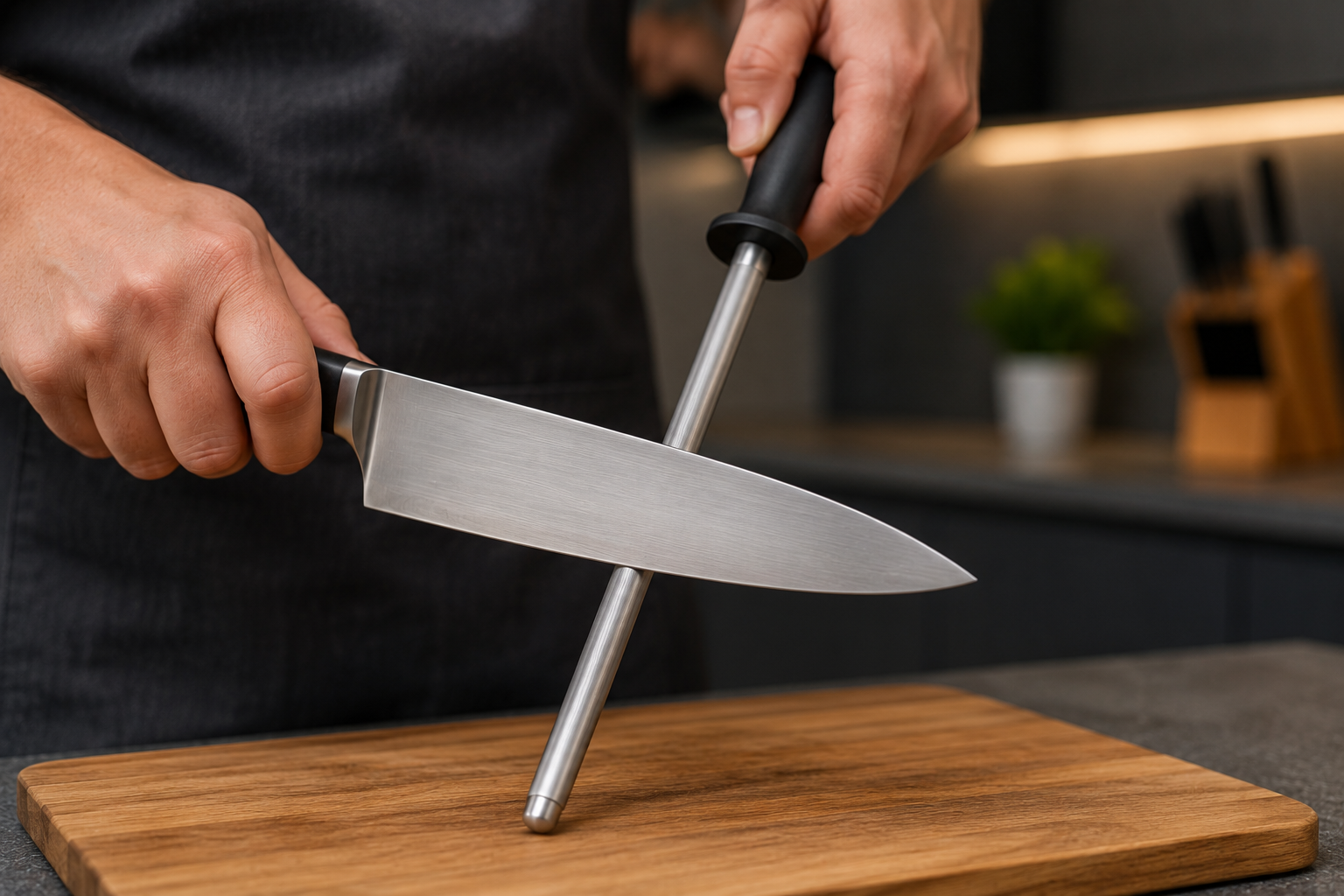
A Safer Basic Honing Method
If you choose to use a honing rod:
• Place the tip of the rod securely on a stable, nonslip surface.
• Hold the rod vertically or at a slight comfortable angle.
• Place the heel of the knife against the rod at the intended edge angle.
• Draw the knife down and across the rod toward the tip using very light pressure.
• Repeat on the opposite side.
• Use only a few alternating passes, then stop and test the knife.
Anchoring the rod is generally easier to control and safer than holding it in the air while rapidly swinging the knife against it.
Some Knives Need Different Maintenance
Thin, hard Japanese-style knives deserve particular caution around traditional grooved steels. Their fine edge geometry and harder steels may be less tolerant of concentrated lateral force than many softer Western kitchen and butcher knives.
Depending on the knife, a fine ceramic abrasive, controlled stropping, a fine stone, or professional sharpening may provide a more predictable maintenance method.
Serrated knives also require a different approach. Running a conventional honing rod along both sides of a serrated blade can alter the points and scallops rather than properly restore the cutting edge.
When the manufacturer provides specific maintenance instructions for a particular knife or steel, those recommendations should also be considered.
How to Tell Whether It Helped
Do not judge a honing session by the number of strokes. Judge it by whether cutting performance actually improved.
Signs of improvement may include:
• Tomato or pepper skin is easier to begin cutting.
• The edge feels more consistent from heel to tip.
• Paper slicing becomes smoother and requires less force.
• Areas that previously slipped or caught begin cutting normally.
If a few light passes do not produce a noticeable improvement, stop. The knife probably needs sharpening, repair, or a different maintenance method rather than additional honing.
Do Not Hone by Habit
A professionally sharpened knife does not need to be honed simply because it has been used. Every interaction with the apex has the potential to alter it. If the knife is still cutting properly, leave the edge alone. When performance begins to decline, a few light passes with an appropriate maintenance tool may help. When that no longer restores satisfactory cutting performance, the knife needs sharpening.
Key Takeaways
Honing Alters the Apex
The familiar explanation that honing simply pushes a rolled edge back into alignment is incomplete. Even smooth steels can physically alter the microscopic apex.
Abrasive Rods Sharpen
Ceramic and diamond rods intentionally remove steel. They are more accurately understood as fine abrasive sharpening or touch-up tools.
Maintain Only When Needed
If a properly sharpened knife still cuts well, there is no need to hone it. When light maintenance no longer restores performance, the edge needs proper sharpening.
References
The following sources were used in preparing and supporting this article.
How to Sharpen Your Knives
ZWILLING
zwilling.com
Honing Steels
Victorinox
victorinox.com
What Do "Knife Sharpening" Honing Steels Actually Do?
youtube.com