Knife Sharpening Frequently Asked Questions
Practical answers about sharpening, repairs, edge angles, testing, appointments, turnaround, and caring for a freshly sharpened knife.
Professional sharpening is adapted to each knife’s steel, geometry, condition, intended use, and previous sharpening. These answers explain what can be serviced, what repairs may change, how sharpness is evaluated, and what customers should expect.
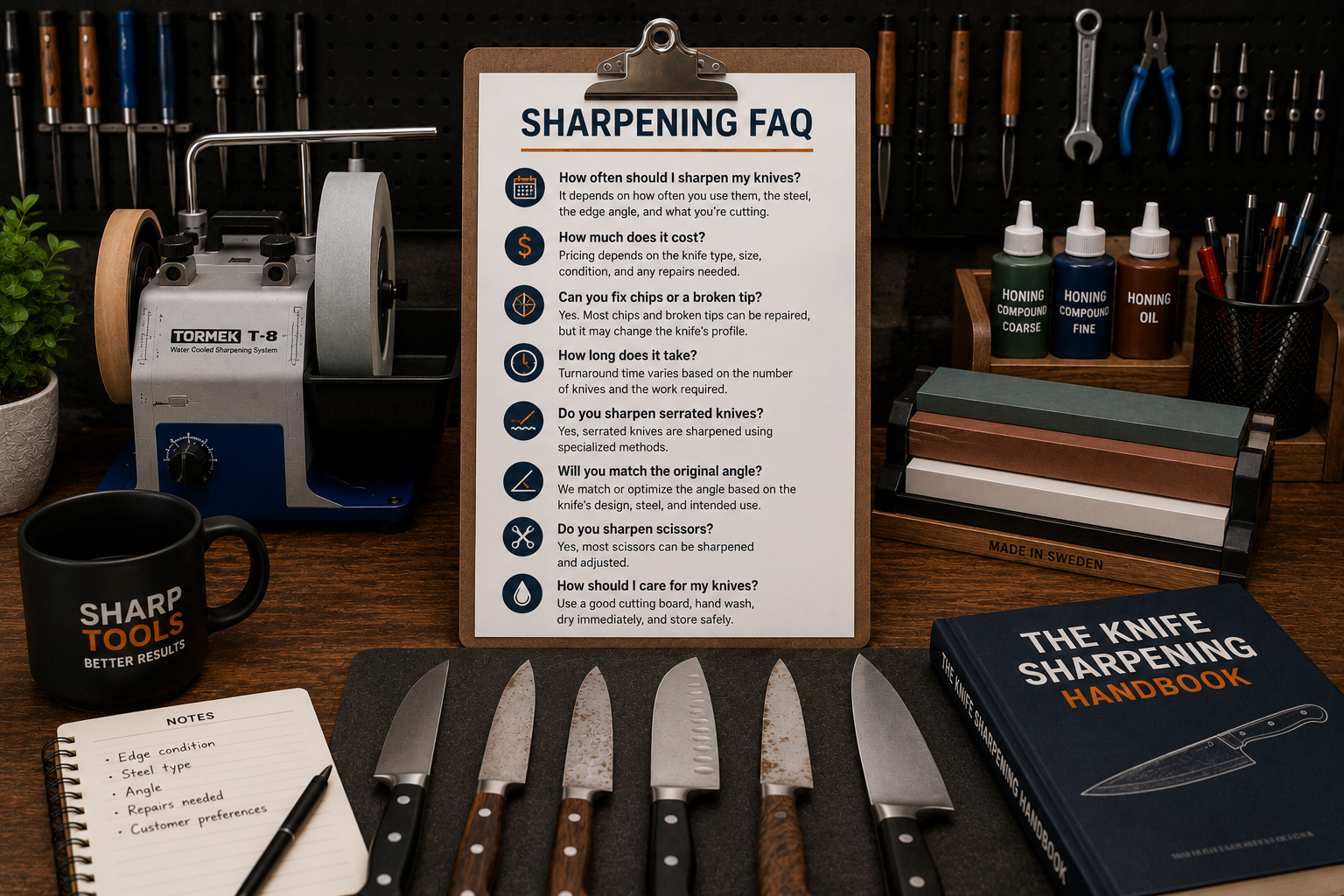
Professional Sharpening in One Sentence
Professional sharpening removes a controlled amount of steel to restore appropriate bevels, form a clean apex, remove the burr, verify performance, clean the knife, and protect it for return.
Sharpening, Honing, and Service Frequency
What does sharpening mean?
Sharpening removes weakened steel until the bevels meet at a new, narrow, continuous apex.
How is honing different?
Honing or light maintenance can improve an edge that still exists. Sharpening is needed when the apex is too worn or damaged for light maintenance to restore.
How can I tell when a knife needs sharpening?
Common signs include increased cutting pressure, slipping on tomato or pepper skin, crushing produce, tearing herbs, ragged slicing, poor response to honing, or reflected flat spots under direct light.
How often should knives be sharpened?
There is no universal schedule. Sharpen according to declining performance. Frequency depends on use, steel, geometry, board material, storage, cleaning, and technique.
Can a knife be sharpened too often?
Every sharpening removes steel. Timely, controlled maintenance usually removes less steel than waiting for severe dullness or damage.
Steel Removal and Blade Size
How much steel is removed?
Routine sharpening removes a small amount near the edge. More steel is required for chips, broken tips, severe dullness, recurves, thick geometry, corrosion, or badly uneven bevels.
Will sharpening make my knife smaller?
Blade height decreases gradually over many service cycles. The change from ordinary sharpening is usually small. Major repair can create a more visible change because damaged steel must be removed.
The goal is always to use the least aggressive effective process and remove only the steel needed to create a stable edge.
Which Knives Can Be Serviced?
| Knife Type or Condition | Current Service Position | Important Notes |
|---|---|---|
| Straight-edged kitchen knives | Generally accepted | Chef’s, paring, utility, slicing, and similar knives are evaluated individually. |
| Serrated bread knives | Accepted when suitable for the available process | Serration size, shape, wear, and damage affect whether the original pattern can be preserved. |
| Japanese and premium knives | Evaluated individually | Double bevels, asymmetry, hard steel, thin geometry, finishes, and owner preferences require added care. |
| Custom, collectible, or sentimental knives | Evaluated with detailed documentation | Major profile or finish changes require approval. |
| Ceramic knives | Not accepted | Contact the knife manufacturer for sharpening, repair, or replacement options. |
| Scissors | Not included as ordinary knife sharpening | Scissors require separate equipment and evaluation. |
| Cracked, severely corroded, badly distorted, or structurally unsafe knives | May be declined | Unsafe work will not be performed. |
Ceramic Knives
Gibson County Knife Sharpening does not sharpen or repair ceramic knives. Ceramic blades are hard and brittle and require specialized processes. Contact the original manufacturer for approved sharpening, repair, warranty, or replacement options.
Edge Angles and Microbevels
What angle should a kitchen knife use?
There is no single correct angle. The choice depends on steel, hardness, blade thickness, original geometry, intended use, previous edge behavior, and owner technique.
Is 15 degrees always better than 20 degrees?
No. A lower angle may cut more easily but can be too delicate for the knife or task. A wider angle may provide more support. Consistency and suitability matter more than selecting the lowest number.
Will the factory angle be matched?
The existing bevel can often be preserved, but factory angles may vary and previous sharpening may have changed them. The knife is evaluated before deciding whether to match or modify the edge.
Can I request an angle?
A request can be considered when it suits the knife and intended use.
What is a microbevel?
A microbevel is a very narrow secondary bevel created at a slightly wider angle to strengthen the apex while retaining much of the cutting efficiency of thinner geometry.
How Sharpness Is Evaluated
A finished knife should begin cuts with light pressure and perform consistently from heel to tip. The edge should also be durable enough for the steel and intended work.
Quality control may include direct-light inspection, paper testing, practical cutting tests, close inspection, and numerical sharpness testing. No single test describes the complete knife.
A sharp apex can still cut poorly when the blade is excessively thick behind the edge. That condition causes wedging and may require thinning rather than another sharpening of the apex.
What Is a BESS Score?
BESS stands for Brubacher Edge Sharpness Scale.
A BESS test measures the maximum force, expressed in grams, required for an edge to cut standardized test media. A lower Brubacher Edge Sharpness Scale score means less force was needed and the tested point of the edge was sharper.
The score is a useful before-and-after measurement and consistency check. It does not describe blade thickness, food release, slicing geometry, edge durability, or performance along the entire blade. BESS testing is therefore used as one part of quality control rather than the only definition of a good edge.
Damage and Repair
Can chips be repaired?
Most small and moderate chips can be removed by lowering and blending the surrounding edge. Large chips require more blade-height reduction and may change bevel width or profile.
Can a broken tip be repaired?
Many tips can be reshaped by removing steel from the spine, edge, or both. The new point is formed from the remaining blade and may not match the original exactly.
Can a bent knife be straightened?
Minor distortion may sometimes be improved, but hardened steel can crack when forced. Severe bends or twists may be unsafe or impractical.
Can rust and scratches be removed?
Light surface rust may be reduced. Deep pitting is permanent steel loss. Scratch correction and blade refinishing are separate from routine sharpening and may alter logos, etching, coatings, patterned cladding, patina, or decorative finishes.
What are thinning and bolster reduction?
Thinning removes steel above the cutting edge to reduce wedging. Bolster reduction removes excess metal that prevents the heel from contacting the cutting board.
Approval Before Additional Work
Additional work is discussed when it changes the estimated price, blade height, tip shape, profile, finish, safety, or expected result. Common reasons for contact include large chips, broken tips, deep corrosion, thinning, bolster interference, structural concerns, or repair costs approaching replacement value.
Equipment, Burrs, and Edge Finish
What equipment is used?
The process may use a water-cooled sharpening system, abrasive belts, bench stones, guided equipment, ceramic abrasives, leather wheels, strops, or a combination. Equipment is selected for the knife and the stage of work.
Does powered sharpening damage knives?
Not automatically. Problems result from poorly controlled speed, pressure, heat, abrasive condition, angle, or contact time. Appropriate powered equipment can remove only the steel required when used carefully.
What is a burr?
A burr is a thin strip of weakened metal formed at the apex during sharpening. It may confirm that the bevel reached the edge, but it must be removed.
Why is deburring important?
A retained wire edge may feel sharp briefly and then fold or break away. A durable edge depends on a clean, stable apex.
Will the edge be polished?
The finish is selected for the knife and task. Some edges benefit from refinement, while many kitchen knives perform well with a moderately toothy working finish.
Appointments, Estimates, and Turnaround
Are drop-off and pickup by appointment?
Yes. Appointments ensure that someone is available, the knives can be reviewed properly, and the home-based workshop remains secure.
How long does sharpening take?
Turnaround depends on workload, order size, knife condition, and repair needs. An estimated completion time is confirmed after intake.
Is this a while-you-wait service?
No. Inspection, setup, sharpening, deburring, testing, cleaning, and packaging require focused work.
Will I receive an estimate?
Routine work can usually be estimated during intake. Approval is requested when inspection reveals additional work that changes cost or the knife.
What happens if a knife cannot be repaired safely?
The concern is explained and the knife is returned without unsafe work being performed.
Preparing Knives for Drop-Off
Clean and Dry
Remove food, grease, adhesive, and standing moisture before transport.
Protect Every Edge
Use a fitted guard, secure cardboard sleeve, knife roll, or equivalent protection.
Use a Secure Container
Protected knives should not move freely, puncture packaging, or expose anyone to a blade.
Count the Knives
Know how many knives are being delivered and confirm the count during intake.
Identify Special Concerns
Mention damage, previous sharpening, sentimental value, intended use, and edge preferences.
Arrange the Appointment
Confirm drop-off before bringing the knives and mention scheduling deadlines.
Caring for the Finished Edge
Use wood or quality plastic cutting boards. Avoid glass, stone, ceramic, metal, bone, frozen food, hard pits, staples, and other hidden hard objects.
Wash knives individually by hand with mild soap and a nonabrasive sponge. Keep the edge visible, rinse thoroughly, dry immediately, and never leave a knife in the sink.
Store each edge separately in a block, magnetic system, drawer organizer, guard, or roll. Do not store knives loose in a drawer.
Avoid scraping food sideways with the cutting edge. Use the spine carefully or a bench scraper.
A suitable honing tool may help maintain some knives, but aggressive grooved rods and carbide pull-through sharpeners can damage or remove steel unnecessarily.
Realistic Service Expectations
Will the knife look new?
Sharpening restores the edge. It does not automatically erase scratches, stains, pitting, dents, handle wear, or surface damage.
Will both bevels look identical?
Not always. Blade thickness changes from heel to tip, and some knives are intentionally asymmetrical. Functional geometry matters more than artificial visual symmetry.
Can every knife be made extremely sharp?
Many knives can, but the edge must remain suitable for its steel and intended use. Chasing the lowest possible measurement can create an unnecessarily delicate edge.
Can badly sharpened knives be corrected?
Many can, although severe recurves, steel loss, damaged tips, deep scratches, heat damage, and structural problems may limit the result.
Will replacement ever be recommended?
Yes. Repair cost, safety, remaining steel, knife quality, replacement value, and sentimental importance are considered honestly.
Key Takeaways
Every Knife Is Evaluated Individually
Steel, geometry, condition, intended use, construction, and previous sharpening determine the service.
Sharpening and Repair Are Different
Chips, tips, corrosion, thick geometry, bolster problems, and structural concerns may require additional work or may be declined.
Good Care Extends Edge Life
Suitable boards, hand washing, immediate drying, protected storage, and avoiding hard materials protect the finished edge.
References
The following sources were used in preparing and supporting this article.
PT50 Series Edge Sharpness Testers and the BESS
Edge On Up
edgeonup.com
What Is the BESS Scale of Edge Sharpness?
Sharpening Supplies
sharpeningsupplies.com
Knife Sharpening
Tormek
tormek.com
How to Sharpen a Knife: Back to Basics
Work Sharp
worksharptools.com