What to Do When a Kitchen Knife Is Damaged
Chips, broken tips, rust, loose handles, and sudden edge problems should be handled carefully before the knife returns to use.
Stop using a kitchen knife when damage affects control or safety. Gibson County Knife Sharpening can evaluate many edge problems, including dullness, small chips, broken tips, and serrated bread-knife wear, but structural and handle damage may require replacement, manufacturer service, or another specialist.
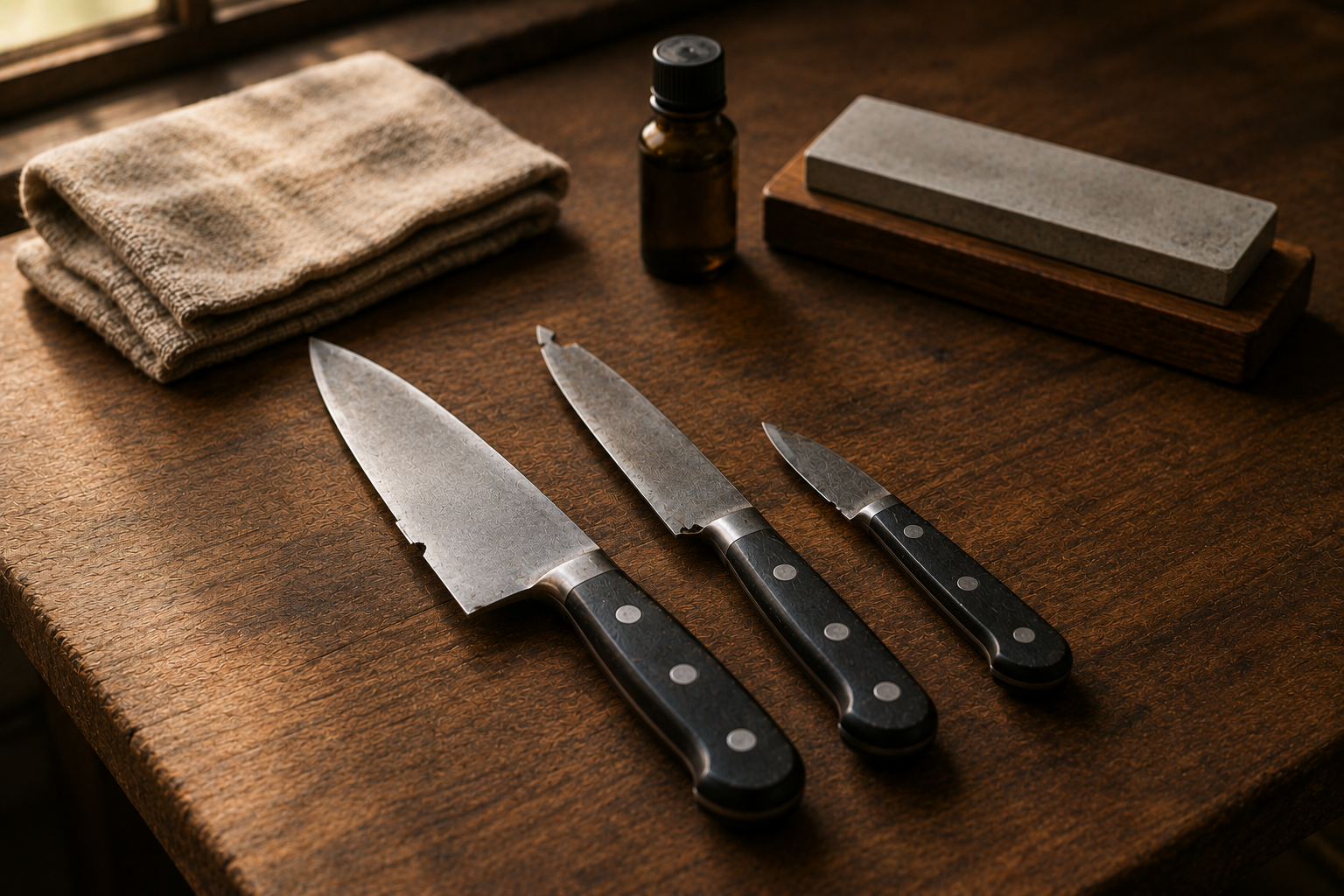
Stop and Inspect
When a knife suddenly chips, bends, loosens, rusts, or stops cutting normally, stop using it. Clean and dry it carefully, protect the edge, and inspect it under good lighting before deciding what happens next.
First Response by Problem
| Problem | First Action |
|---|---|
| Small chip or rolled edge | Stop hard use and set the knife aside for evaluation |
| Broken tip | Protect the point and avoid further contact |
| Visible crack | Remove the knife from service immediately |
| Loose or cracked handle | Do not use the knife |
| Orange rust | Clean and dry it promptly without aggressive grinding |
| Bent blade | Do not try to force it straight |
| Sudden dullness | Inspect for chips, rolls, hard-object contact, or a damaged board |
Chipped or Rolled Edges
Small chips, rolled sections, and uneven edges are common sharpening concerns.
Gibson County Knife Sharpening evaluates each knife individually. Limited chip correction may be possible when enough sound steel remains and the correction will not unreasonably change the blade.
A line extending upward from a chip may indicate a crack. Cracked blades should not return to use.
Do not continue cutting with extra pressure, strike the knife against a honing rod, or grind only the damaged spot with an uncontrolled power tool.
Broken Tips
A small or moderate broken tip can often be reshaped.
The result depends on:
• How much steel is missing.
• Whether a crack extends from the break.
• The blade’s thickness and original profile.
• Whether a useful point can be created without excessive modification.
Gibson County Knife Sharpening may perform limited tip reshaping after inspecting the knife. Major tip loss or cracked steel may make correction impractical.
Never Catch a Falling Knife
Step back and let it fall. Afterward, inspect the tip, edge, handle, and blade alignment before using it again.
Cracks, Bends, and Handle Movement
These are structural concerns, not routine sharpening problems.
Remove the knife from service when:
• A crack appears in the blade.
• The blade is sharply bent or twisted.
• The handle moves independently of the blade.
• Handle scales, rivets, or ferrules are loose.
• Corrosion appears to extend beneath the handle.
• The blade-to-handle connection feels unstable.
Gibson County Knife Sharpening does not treat sharpening as a solution for unsafe construction. Manufacturer service, a qualified handle or blade specialist, or replacement may be more appropriate.
Rust and Patina
Gray, blue, or dark coloring on carbon steel may be normal patina.
Orange, rough, powdery, or flaking corrosion is active rust.
For light rust:
• Wash and dry the knife promptly.
• Avoid aggressive sandpaper, powered grinding, or abrasive pads that may damage the finish.
• Keep the knife dry until it can be evaluated.
Deep pitting, flaking corrosion, rust at the edge, or corrosion near the handle may make the knife unsuitable for normal food use.
Sudden Dullness After One Use
A sudden loss of cutting performance usually means the edge contacted something damaging or contained a weak burr.
Possible causes include:
• Bone, pits, frozen food, or hard debris.
• Glass, stone, ceramic, or metal cutting surfaces.
• Scraping the edge sideways.
• Twisting while the blade is embedded.
• A rolled or chipped apex.
Clean the blade and inspect it under direct light. Do not test it by running a finger along the edge.
Serrated Bread Knives
Gibson County Knife Sharpening accepts serrated bread knives.
Normal dullness can often be sharpened. Bent points, deep chips, missing serrations, cracks, or severely altered patterns may limit what can be corrected.
Each serrated knife is inspected before work begins so the condition and likely result can be discussed.
What Gibson County Knife Sharpening Can Evaluate
For straight-edged kitchen knives and serrated bread knives, evaluation may include:
• Routine dullness.
• Rolled or uneven edges.
• Small chips.
• Limited broken-tip reshaping.
• Edge damage from pull-through sharpeners.
• Rust near the cutting edge.
• Raised heels or profile problems that affect board contact.
The knife is inspected as a complete tool. Work is discussed before any correction that would noticeably change its shape.
Gibson County Knife Sharpening does not currently provide blade thinning, handle replacement, crack repair, major straightening, or ceramic-knife sharpening.
Preparing a Damaged Knife for Evaluation
• Stop using it.
• Wash it carefully unless cleaning may loosen damaged parts.
• Dry it completely.
• Cover the edge and damaged tip with a proper blade guard or secure cardboard sleeve.
• Do not place a loose knife in a bag.
• Note what happened and what material the knife struck.
• Mention any previous sharpening, grinding, or attempted correction.
Service is by appointment in Medina. The condition and available options can be discussed during intake.
Key Takeaways
Stop Before Damage Grows
Continuing to use a damaged knife can enlarge chips, worsen cracks, or reduce control.
Not Every Problem Is Sharpening
Loose handles, cracks, major bends, and deep corrosion are structural or safety concerns.
Evaluation Comes First
Gibson County Knife Sharpening inspects each accepted knife individually before deciding what correction is practical.
References
The following sources were used in preparing and supporting this article.
Food Services: Kitchen Equipment
Occupational Safety and Health Administration
osha.gov
Young Worker Safety in Restaurants: Food Preparation
Occupational Safety and Health Administration
osha.gov
Sharpening Service
ZWILLING
zwilling.com