Knife Habits Every Culinary Student Should Learn
Control, safe setup, appropriate tools, edge care, cleaning, storage, and honest damage reporting are skills that should develop before speed.
Culinary students often focus first on cutting speed and technique. Professional habits begin with a stable workstation, controlled movement, appropriate tools, inspection, maintenance, cleaning, storage, and safe communication.
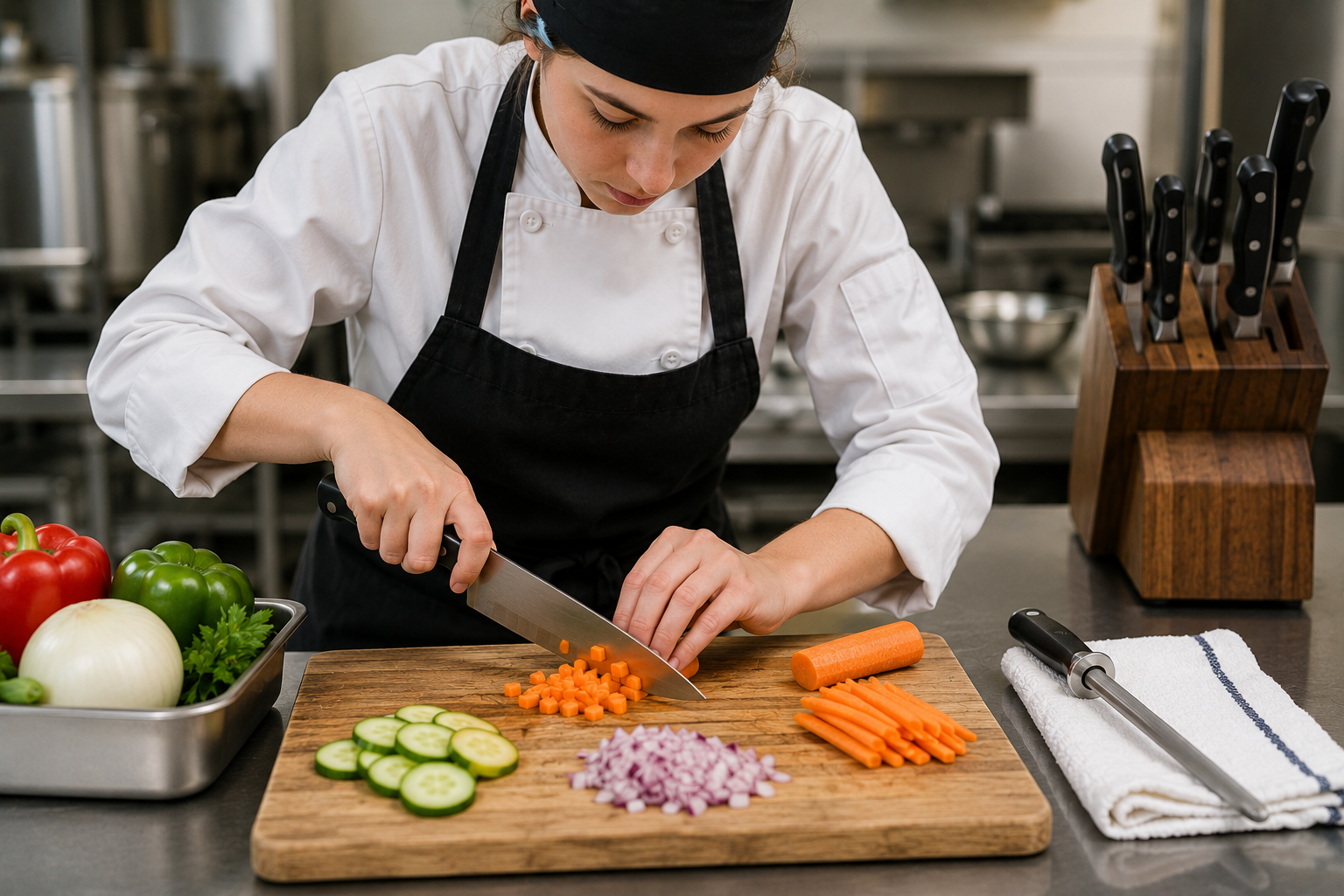
Control Comes Before Speed
Learn each movement slowly, repeat it correctly, and increase speed only after accuracy, consistency, and control are dependable.
Begin With a Stable Workstation
Safe knife work begins before the blade touches food.
• Use a clean board large enough for the task.
• Stabilize the board with a damp towel or nonslip mat when needed.
• Keep the board away from the counter edge.
• Remove packaging, utensils, bowls, and scraps from the cutting path.
• Keep the knife visible.
• Place prepared food and waste in separate locations.
A cluttered or moving workstation makes good technique harder to maintain.
Choose the Correct Tool
A skilled cook does not force one knife to perform every job.
Chef’s Knife
General vegetable preparation, slicing, chopping, and many routine kitchen tasks.
Paring Knife
Small trimming, peeling, and controlled detail work.
Bread Knife
Crusty bread, cakes, and foods that benefit from a serrated edge.
Boning Knife
Work around joints, bones, skin, and connective tissue.
Slicer or Carving Knife
Long, controlled cuts through cooked proteins.
Shears or Specialty Tools
Use only when their design matches the material and task.
Use a Secure Grip and Protect the Guiding Hand
Many cooks use a pinch grip on a chef’s knife, with the thumb and index finger controlling the blade near the handle and the remaining fingers around the handle.
The guiding hand should control the food while remaining outside the cutting path.
• Curl fingertips inward.
• Keep the thumb behind the fingers.
• Move the guiding hand backward as the ingredient becomes smaller.
• Create a flat side on round ingredients before further cutting.
• Stop when the remaining piece is too small to hold safely.
The exact grip may vary with the knife, hand size, task, and instructor guidance.
Control the Cutting Motion
Different foods and blade shapes may use rocking, push cutting, slicing, chopping, or drawing motions.
A clean cutting motion is usually more effective than a forceful one.
• Keep the wrist in a comfortable, controlled position.
• Use only enough force to complete the cut.
• Do not strike the board harder to appear faster.
• Stop when the blade becomes stuck.
• Withdraw and reposition rather than twisting the knife.
• Keep the cutting path away from hands and the body.
Speed should develop through correct repetition rather than rushing.
Do Not Scrape With the Edge
Dragging the cutting edge sideways across the board can roll, flatten, or weaken the apex. Use the spine or a bench scraper to move ingredients.
Recognize Dullness Before Force Becomes the Solution
OSHA advises using the appropriate knife for the job, cutting away from the body, and keeping fingers out of the cutting line.
A dull or damaged knife may slide, crush food, or require more pressure.
Signs that maintenance is needed include:
• The edge slides across tomato, pepper, or onion skin.
• Herbs crush instead of slicing.
• Protein tears.
• One part of the edge cuts while another does not.
• The knife requires noticeably more force.
• Appropriate honing no longer improves performance.
Do not compensate by pushing harder. Replace the knife with a dependable one and report the problem.
Honing and Sharpening Are Different
Students should understand what each process can and cannot correct.
Honing
Minor RealignmentPros
May improve a compatible knife when the edge is mildly rolled or misaligned.
Cons
Cannot replace worn steel or repair chips, broken tips, severe dullness, or corrosion.
Best For
Light maintenance performed slowly with an approved rod and correct technique.
Sharpening
Creates a New ApexPros
Removes controlled amounts of steel to restore a continuous cutting edge.
Cons
Poor technique can create uneven bevels, rounded tips, excess steel removal, and incomplete burr removal.
Best For
Worn or damaged edges serviced with proper instruction, equipment, and authorization.
Respect the Cutting Board
Cutting surfaces affect sanitation, control, and edge life.
• Use an approved board suitable for the kitchen.
• Keep it stable.
• Replace or resurface boards that are deeply grooved, cracked, warped, or no longer cleanable.
• Avoid glass, stone, ceramic, metal, plates, and serving trays.
• Wash boards and utensils, including knives, with hot soapy water after preparing each food item.
• Separate equipment used for raw meat, poultry, and seafood from ready-to-eat foods when required.
FDA guidance emphasizes cleaning food-contact surfaces and preventing cross-contamination between raw and ready-to-eat foods.
Carry and Pass Knives Deliberately
When moving through a kitchen:
• Hold the knife securely at your side with the point directed down when practical.
• Keep the blade visible.
• Announce yourself when moving behind another person.
• Do not run, gesture, or open doors while carrying a knife.
• Never throw, toss, or slide a knife.
• Place the knife on a stable surface with the handle toward the other person instead of passing it hand to hand.
• Never try to catch a falling knife.
After a drop, inspect the edge, tip, blade, and handle before further use.
Keep Knives Visible During Cleaning
OSHA advises placing dirty knives in a designated cleaning container rather than leaving them in a sink.
• Never hide a knife beneath dishwater, towels, pans, food, or utensils.
• Wash one knife at a time.
• Keep fingers away from the edge.
• Rinse the blade and handle thoroughly.
• Dry immediately.
• Return the knife directly to safe storage.
Follow the school or workplace cleaning and sanitizing procedure for food-contact utensils.
Protect the Edge During Storage and Transport
Loose drawer storage damages edges and creates hidden hazards. OSHA recommends designated storage for knives and other sharp utensils.
Appropriate options may include:
• Knife blocks.
• Magnetic racks.
• In-drawer organizers.
• Fitted blade guards.
• Designated commercial knife holders.
For knife rolls:
• Pack only clean, dry knives.
• Protect every edge.
• Secure handles so tools cannot slide out.
• Do not overfill the roll.
• Keep small sharp tools in defined compartments.
• Inspect the roll for moisture, contamination, cuts, and loose stitching.
Inspect and Report Damage
Develop a quick inspection routine before class or service.
• Check the edge for chips, rolls, rust, and flat spots.
• Inspect the tip for bends or breaks.
• Confirm that the handle is clean, secure, and free of cracks.
• Look for blade corrosion, bends, residue, or structural damage.
• Remove unreliable knives from service.
• Report damage honestly and promptly.
Shared knives should not be sharpened, modified, relocated, or removed without authorization. Hiding damage places the next user at risk and may turn a small repair into a larger problem.
Choose Comfortable, Practical Knives
Culinary students do not need a large collection of expensive specialty knives.
A small dependable set is easier to learn, maintain, transport, and replace.
Consider:
• Handle comfort and secure grip.
• Adequate knuckle clearance.
• Manageable weight.
• Balance and control.
• Blade shape suited to common tasks.
• Steel and edge geometry that can be maintained realistically.
A knife that fits one student may not suit another.
Manage Fatigue and Keep the Station Organized
Fatigue can weaken technique and encourage rushing.
• Maintain stable footing.
• Use a practical work height.
• Avoid unnecessary bending.
• Use a knife that does not require excessive pressure.
• Take permitted breaks or change tasks when fatigue develops.
• Report pain, numbness, or persistent discomfort.
During service, keep the active knife in one predictable location, remove clutter promptly, keep blades visible, and clean spills before they create slipping or contamination hazards.
Habits to Leave Behind
Rushing for Appearance
Fast movements are not skilled movements when control and consistency are missing.
Scraping With the Edge
Use the spine or a bench scraper.
Leaving Knives in Sinks
Keep every knife visible and use the designated cleaning procedure.
Using More Force
Stop and identify dullness, instability, poor technique, or the wrong tool.
Ignoring Damage
Remove chipped, cracked, loose, rusty, or unstable knives from service.
Unauthorized Sharpening
Practice under instruction and never experiment on borrowed, shared, or expensive knives.
Key Takeaways
Control Comes Before Speed
Stable setup, safe hand placement, and repeatable technique should develop before faster cutting.
Respect the Entire Tool
Edge condition, handle security, inspection, cleaning, storage, and transport all affect safe performance.
Report Problems Early
Dullness, damage, unstable handles, and unsafe storage should be corrected rather than hidden or worked around.
References
The following sources were used in preparing and supporting this article.
Young Worker Safety in Restaurants: Food Preparation
Occupational Safety and Health Administration
osha.gov
Young Worker Safety in Restaurants: Serving
Occupational Safety and Health Administration
osha.gov
Cleaning
U.S. Food and Drug Administration
fda.gov
Separating Food
U.S. Food and Drug Administration
fda.gov