Knife Sharpness and BESS Scores
A simple way to understand how sharp a knife really is.
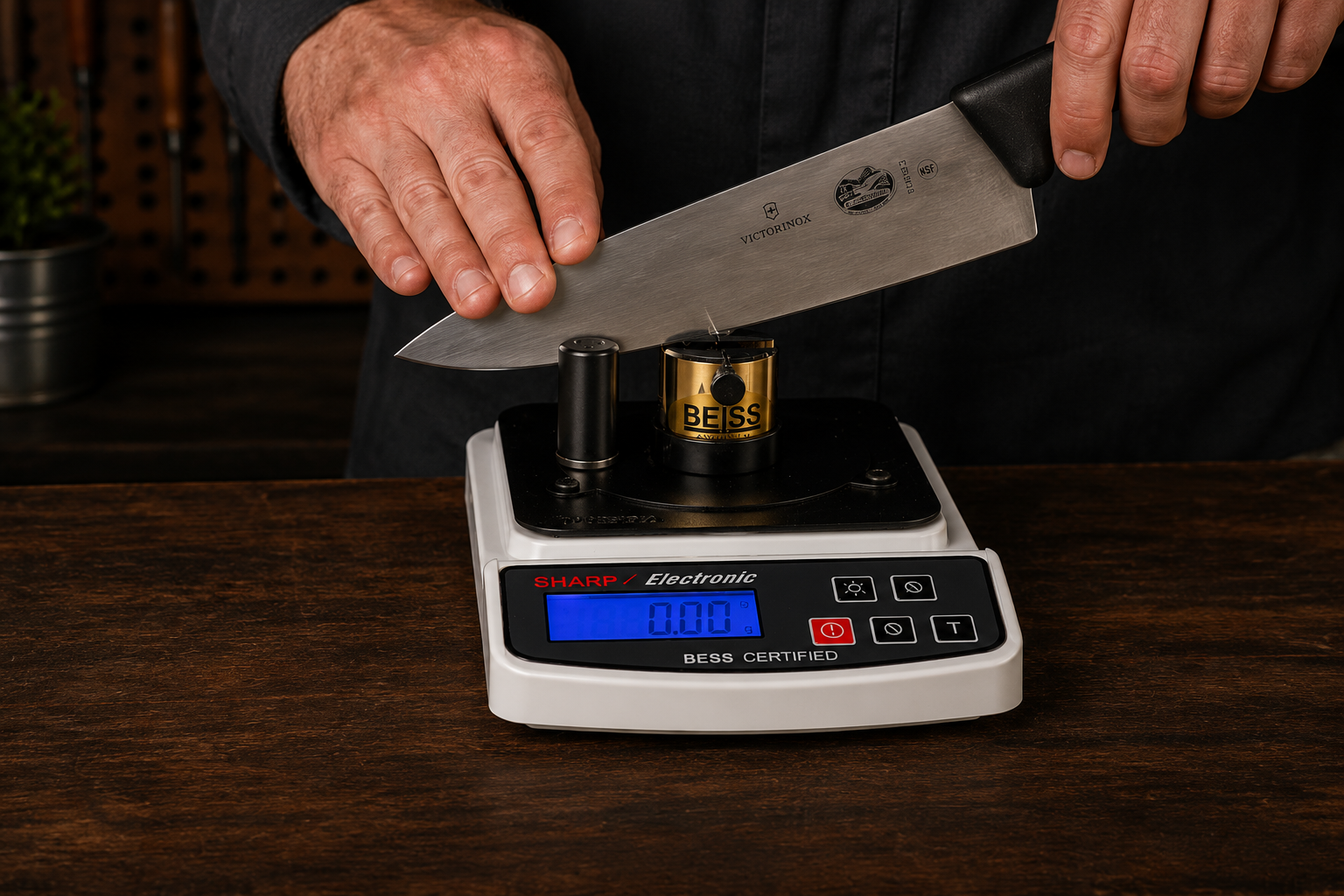
BESS stands for Brubacher Edge Sharpness Scale. It measures the force needed for a knife edge to cut standardized test media. Lower numbers indicate a sharper edge.
What is a BESS score?
A BESS score gives sharpness a number instead of relying only on words such as sharp, dull, acceptable, or razor sharp. The test measures how much force is required for the edge to cut standardized test media.
The lower the number, the less force was needed. That means the edge is sharper.
BESS score guide
These ranges provide useful everyday context. A BESS score is not the only measure of a good knife edge, but it can help show where a knife falls before and after sharpening.
| BESS Score | Sharpness Level | What It Means |
|---|---|---|
| 0–200 | Extremely Keen |
A highly refined edge that is often sharper than many new factory kitchen knives. |
| 200–400 | Professional Standard | Our target range for most kitchen knives after sharpening. |
| 400–500 | Needs Maintenance | Still usable, but cutting performance is beginning to decline. |
| 500+ | Dull |
Requires more force and may feel less controlled or predictable during normal kitchen use. |
Why measure sharpness?
Testing provides a clear before-and-after reference. It helps demonstrate whether sharpening improved the edge and gives us another way to monitor consistency over time.
A score can also be easier to understand than sharpening terminology. Instead of relying entirely on feel or appearance, the measurement provides a practical comparison point.
Our goal: Use BESS measurements whenever they provide useful, repeatable information while also evaluating the knife through visual inspection, magnification, cutting feel, edge condition, and real-world performance.
How we use BESS testing at Gibson County Knife Sharpening
Our normal practice is to perform a BESS test before and after sharpening most suitable knives. The initial measurement helps document the condition of the edge when the knife arrives. The final measurement helps confirm the improvement after sharpening.
We say most knives rather than every knife because BESS testing is one part of a hands-on sharpening service, not an automated production line. We are human, and an occasional measurement may be missed during a busy work session.
Some knives are also not practical candidates for a conventional BESS test. Serrated bread knives are a good example. Their cutting edges may contain many individual scallops, points, facets, or differently shaped serrations. Testing every part of that edge would be time-consuming, difficult to reproduce, and may not provide a meaningful single score for the knife as a whole.
What a before-and-after test can show
Starting Condition
The first test provides a numerical reference for the knife’s sharpness before work begins.
Measured Improvement
The final test helps show how much less force is required after sharpening.
Process Consistency
Repeated testing helps us compare results and maintain a consistent professional standard.
Useful Documentation
A recorded score provides more context than simply describing a knife as sharp or dull.
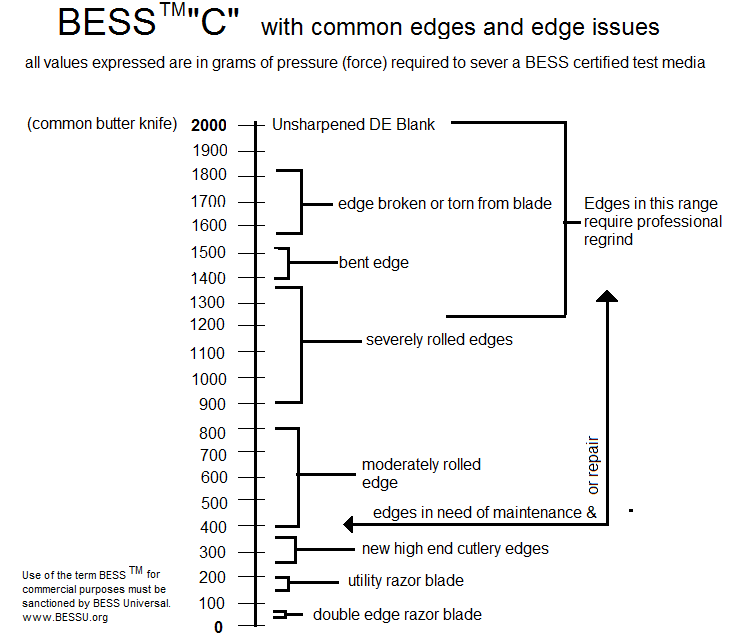
The BESS “C” scale chart
The BESS “C” scale is useful for evaluating fine cutlery edges and provides a practical reference for kitchen knives after sharpening.
Sharpness is only part of the story
A very low BESS score can be impressive, but the best kitchen edge is not always the lowest possible number. A useful edge must also match the knife’s steel, thickness, blade geometry, edge angle, durability requirements, and intended use.
A delicate slicing knife and a hard-use chef knife may need different edges. The goal is a clean, durable edge that performs well during real kitchen work—not simply the lowest number possible.
Remember: BESS measures edge sharpness. It does not replace evaluation of the entire blade.
Why two knives can have similar scores but cut differently
BESS testing measures the force needed for the edge to sever the test media. It does not measure every part of cutting performance.
Two knives can produce similar BESS scores while feeling very different in food. Blade thickness, thickness behind the edge, surface finish, blade profile, and overall geometry all affect how easily a knife moves through an ingredient after the edge begins the cut.
Key Takeaways
Lower Is Sharper
A lower BESS score means less force was required to cut the standardized test media.
Measurement Adds Context
BESS testing gives a repeatable way to compare sharpness before and after sharpening.
Sharpness Is Not Everything
The best kitchen edge balances sharpness, durability, steel, blade geometry, and intended use.
References
The following sources were used in preparing and supporting this article.
PT50 Series Edge Sharpness Testers and the BESS
Edge On Up
edgeonup.com
Knife Sharpening: How to Sharpen Your Knives
Tormek
tormek.com
Knife Sharpening Basics
Korin
korin.com
How to Sharpen Any Knife: Back to Basics
Work Sharp
worksharptools.com