The Paper Test: A Simple Way to Check Knife Sharpness
One sheet of printer paper can reveal a surprising amount about the condition of your knife's edge.
The paper test is one of the most common methods used by knife sharpeners to evaluate an edge. A properly sharpened knife should slice cleanly through paper with very little effort. While the test is quick and convenient, it should be viewed as one tool—not the only measure—of knife performance. :contentReference[oaicite:0]{index=0}
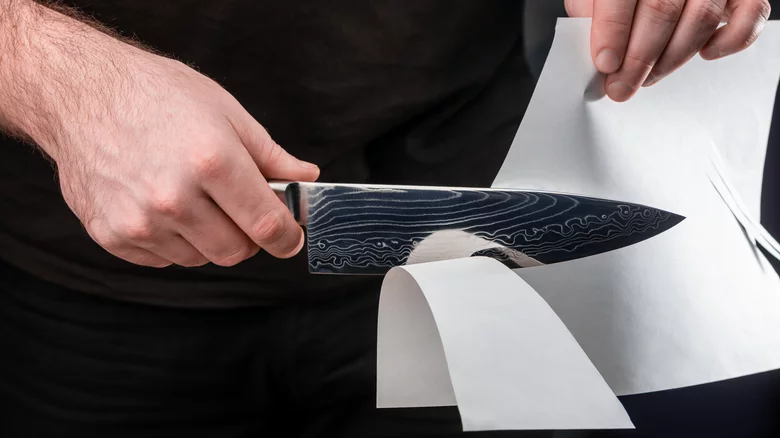
Simple rule: If the knife glides smoothly through paper from heel to tip, the edge is generally in good condition.
Why the paper test works
Paper is thin, flexible, and unforgiving. A sharp edge immediately bites into the paper and continues cutting with very little resistance. A dull edge tends to slide, snag, tear, or crumple the sheet instead of making a clean cut. :contentReference[oaicite:1]{index=1}
How to perform the paper test
• Use a clean sheet of ordinary printer paper.
• Hold the paper by one corner so it hangs freely.
• Grip the knife securely.
• Start near the heel of the blade.
• Slice downward using only light pressure.
• Continue the cut toward the tip.
• Always cut away from your body.
What a good cut looks like
Smooth Entry
The edge immediately bites into the paper without sliding.
Clean Slice
The paper separates without tearing or excessive force.
Consistent Edge
The knife cuts evenly from heel to tip.
Minimal Pressure
The knife does most of the work rather than your hand.
What problems the paper test can reveal
| Paper Behavior | Possible Cause |
|---|---|
| Slides off the paper | Dull edge. |
| Tears instead of cuts | Rounded or damaged apex. |
| Cuts partway then stops | Localized dull spot or small chip. |
| Catches near the tip | Tip needs sharpening. |
| Jagged cut | Remaining burr or inconsistent edge. |
Test the entire blade
Instead of making one short cut, try using the full length of the blade. This checks the heel, middle, and tip individually. Many knives become dull near the heel or the tip before the rest of the edge.
Important: The paper test measures sharpness—not necessarily overall cutting performance.
Paper test vs. food performance
Passing the paper test does not automatically mean a knife will perform perfectly in the kitchen. Edge geometry, blade thickness, burr removal, polish level, and the intended cutting task all influence real-world performance. :contentReference[oaicite:2]{index=2}
Other useful sharpness tests
| Test | What It Evaluates |
|---|---|
| Tomato Test | How well the edge bites into delicate skin. |
| Paper Test | General edge sharpness and consistency. |
| Paper Towel Test | Very refined edge quality. |
| BESS Test | Objective sharpness measurement. |
| Food Preparation | Real-world cutting performance. |
Should you shave arm hair?
Many sharpeners use the arm-hair test, but it is not necessary for kitchen knives. A knife can perform exceptionally well in the kitchen without shaving hair.
For most home cooks, the paper test and actual food preparation provide safer and more practical evaluations.
Can paper dull a knife?
Occasional paper testing causes very little wear on a quality kitchen knife. Using the test once or twice after sharpening is normal practice among many sharpeners. :contentReference[oaicite:3]{index=3}
Constantly cutting stacks of cardboard or heavy paper, however, will wear any edge over time.
Common mistakes
Using Too Much Force
A sharp knife should not require excessive pressure.
Testing Toward Yourself
Always cut away from your body.
Using Thick Cardboard
Printer paper gives more consistent results.
Ignoring One Bad Spot
One snag usually means that section of the edge needs attention.
When the paper test says it's time to sharpen
• The knife slides instead of biting.
• The paper tears repeatedly.
• The edge catches in one location.
• Extra force is required.
• The knife no longer feels smooth through the cut.
Bottom line: A knife that slices cleanly through paper with little effort is usually ready for kitchen work—but the best test is always how it performs on food.
The practical rule
The paper test is quick, repeatable, inexpensive, and surprisingly effective. It won't replace real kitchen use, but it provides an excellent first indication of edge quality after sharpening or between sharpenings.
Key Takeaways
The Paper Test Is Quick
A clean slice through ordinary paper is one of the easiest ways to evaluate a kitchen knife.
It Is Not the Only Test
A knife can pass the paper test and still perform poorly on food if the edge has burrs or the geometry is incorrect.
Use It Safely
Always cut away from yourself using a free-hanging sheet of paper in a controlled environment.
References
The following sources were used in preparing and supporting this article.
Is My Knife Sharp? How to Test Your Edge
Work Sharp
worksharptools.com
How to Sharpen Your Knives
ZWILLING
zwilling.com
PT50B Professional Sharpness Tester
Edge On Up / Work Sharp
worksharptools.com