Serrated Blades: Why They Stay Sharp Longer and How They're Sharpened
Bread knives and other serrated blades behave very differently from ordinary kitchen knives.
Serrated knives are designed to bite into tough crusts, slippery skins, and fibrous foods with less pressure than a straight edge. Because their geometry is different, they also wear differently—and they require a completely different sharpening process.
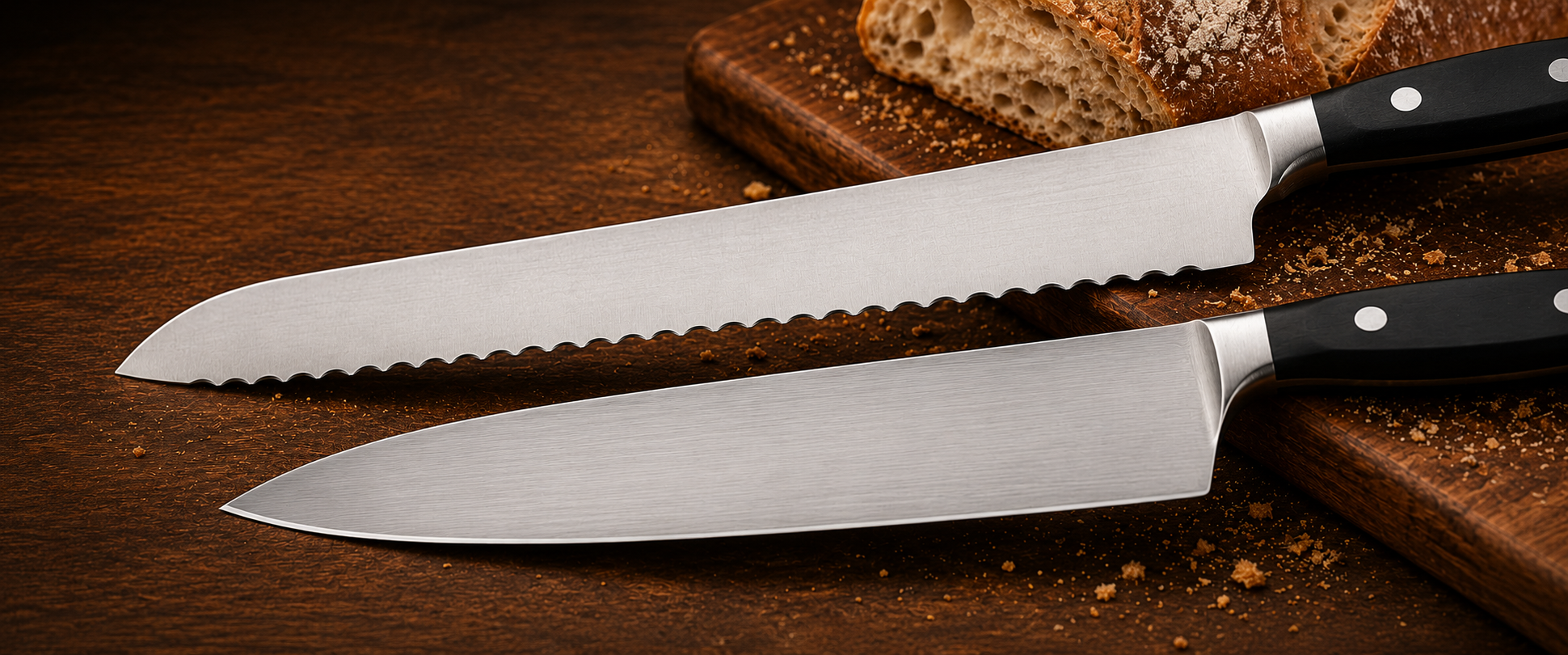
What is a serrated knife?
Instead of one continuous cutting edge, a serrated knife uses a series of teeth separated by scallops or valleys. Each point begins the cut while the recessed portions continue slicing as the knife moves through the food.
Simple explanation: A straight knife cuts with one long edge. A serrated knife cuts with dozens of tiny edges.
Why serrated knives stay sharp longer
One of the biggest misconceptions is that serrated knives are made from harder steel. That's usually not true.
They simply wear differently.
The Teeth Touch First
Only the tips of the serrations regularly contact the cutting board, protecting much of the cutting edge from wear.
More Cutting Edges
Each tooth acts as a small cutting point, distributing wear across many tiny edges.
Sawing Motion
Most serrated knives are used with a slicing motion rather than straight downward chopping.
Excellent Food Bite
The teeth continue grabbing crusts and skins long after a straight edge would begin slipping.
What foods are serrated knives best for?
| Food | Why Serrations Help |
|---|---|
| Bread | Saw through crust without crushing the loaf. |
| Tomatoes | Grab slippery skin immediately. |
| Citrus | Cut through thick peels easily. |
| Cakes | Produce clean slices with minimal compression. |
| Roasts | Helpful when cutting crusty exteriors. |
| Sandwiches | Slice crusty bread without flattening fillings. |
Are serrated knives sharper?
Not necessarily.
A high-quality straight edge is often objectively sharper than a serrated blade. The difference is that serrations concentrate cutting force onto tiny points, allowing them to penetrate difficult surfaces more easily.
Most kitchen serrated knives are single bevel
Many people don't realize that bread knives are usually ground on only one side. The opposite side is nearly flat.
This is why they require a completely different sharpening process than a chef knife.
Why whetstones don't work well
A flat whetstone contacts only the tips of the serrations. It cannot reach the curved valleys between them.
Using a flat stone across the teeth eventually rounds off the serrations and reduces cutting performance.
Important: A serrated knife should never be sharpened exactly like a chef knife.
How professionals sharpen serrated knives
• Inspect every tooth for damage.
• Select a tapered ceramic or diamond rod that closely matches the scallop size.
• Sharpen each scallop individually on the beveled side.
• Create a tiny burr.
• Lightly remove the burr from the flat side.
• Repeat across the entire blade.
Each scallop is sharpened individually rather than treating the knife as one continuous edge.
Why sharpening serrations takes longer
A straight edge can often be sharpened with continuous strokes. A serrated blade may contain 25–50 individual scallops, each requiring separate attention.
That is why sharpening a quality bread knife typically takes considerably longer than sharpening an ordinary chef knife.
Can power equipment sharpen serrations?
Yes—but only in experienced hands.
Some professional belt systems can refresh the flat side or perform specialized serration work, but restoring individual scallops still often requires hand finishing.
Common mistakes
Using a Whetstone
Rounds the teeth and misses the scallops.
Sharpening Both Sides
Most kitchen serrations are ground on only one side.
Using the Wrong Rod
The rod should closely match the size of each scallop.
Removing Too Much Steel
Large teeth cannot be replaced once they're ground away.
When should a serrated knife be sharpened?
Unlike straight-edge knives, serrated blades often remain useful for years before sharpening becomes necessary.
• It tears bread instead of slicing.
• Tomatoes require excessive pressure.
• The points feel rounded.
• The knife produces excessive crumbs.
• Cutting requires a strong sawing motion.
Repair or Replace?
Damaged serrations can sometimes be repaired, especially when the teeth are only slightly rounded, uneven, or chipped. More severe damage may require reshaping individual serrations, which can change their size or spacing.
Whether an inexpensive serrated knife is worth sharpening depends on its overall condition and replacement cost. A well-made or frequently used knife may be worth restoring, while a badly damaged low-cost knife may be more practical to replace.
The goal is not to make every serration look new. It is to restore useful cutting performance without removing more steel than necessary.
Bottom line: Serrated knives last a long time because they wear differently—not because they never become dull. When they finally do need sharpening, the process is specialized and far more detailed than sharpening a straight-edge knife.
Professional recommendation
If you own a quality bread knife, don't throw it away simply because it has become dull. Professional sharpening can restore cutting performance while preserving the original serration pattern.
Key Takeaways
Serrated Knives Stay Sharp Longer
Only the tips of the teeth regularly contact the cutting board, so the working edges wear more slowly than a straight blade.
They Can Be Sharpened
Most kitchen serrated knives are sharpened one scallop at a time using a tapered rod, then lightly deburred on the flat side.
Not Every Serrated Knife Is Worth Sharpening
Low-quality stamped serrated knives are often more economical to replace, while quality bread knives can last for decades with proper maintenance.
References
The following sources were used in preparing and supporting this article.
KS-123 Knife Angle Setter
Tormek
tormek.com
Knife Sharpening Basics
Korin
korin.com
How to Sharpen Any Knife: Back to Basics
Work Sharp
worksharptools.com