Why Pull-Through Sharpeners Can Damage a Knife
Convenient fixed-angle sharpeners can remove steel quickly, but often sacrifice control, edge geometry, and long-term performance.
Pull-through sharpeners can make a dull knife feel sharper quickly, but many use fixed angles and aggressive abrasives. This can remove excess steel, leave a rough or weakened apex, and alter the knife’s original edge geometry.
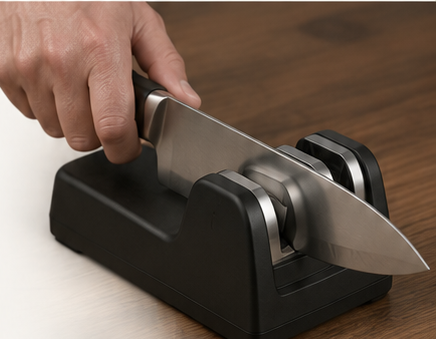
What Is a Pull-Through Sharpener?
A pull-through sharpener uses fixed abrasive wheels, carbide inserts, or ceramic rods arranged inside a slot. The knife is drawn through the slot so the abrasives contact both sides of the edge.
These sharpeners are fast and easy to use, but the fixed angle may not match the knife’s existing geometry. They also give the user very little control over pressure, steel removal, or how the heel and tip are sharpened.
Why Pull-Through Sharpeners Can Damage the Edge
Many pull-through sharpeners remove steel very aggressively. Carbide inserts can scrape or tear at the apex instead of creating a clean, controlled bevel.
Because the angle is fixed, the sharpener may cut a new bevel that does not match the knife. Repeated use can widen the edge, remove excess steel, and change the blade’s original geometry.
The heel and tip are also difficult to sharpen evenly in a slot, which can leave parts of the edge overworked while others remain dull.
Pull-Through Sharpener vs. Controlled Sharpening
The difference is not only speed. It is how much control you have over angle, pressure, and steel removal.
Pull-Through Sharpener
Fast and ConvenientPros
Quick to use with little setup.
Cons
Fixed angles, aggressive abrasives, and uneven contact can remove excess steel or distort the edge.
Best For
Occasional emergency use on low-value knives.
Controlled Sharpening
Better Edge ControlPros
Allows the angle, pressure, and amount of steel removal to match the knife.
Cons
Requires more time, skill, or professional equipment.
Best For
Routine maintenance, edge restoration, and valuable knives.
Better Options for Routine Sharpening
Sharpening Stones
Allow direct control over angle, pressure, and steel removal. Best for users willing to learn proper technique.
Guided Sharpening System
Helps maintain a repeatable angle while giving more control than a pull-through sharpener.
Professional Sharpening
A good choice for damaged, valuable, or heavily used knives when the edge needs repair or reprofiling.
Ceramic Rod for Light Touch-Ups
Can refresh a slightly dull edge with minimal steel removal when used at the correct angle.
Key Takeaways
Pull-through sharpeners trade control for convenience.
Fixed Angles May Not Match
The slot may force a new bevel that does not match the knife’s original edge geometry.
Aggressive Abrasives Remove Steel Quickly
Carbide inserts and coarse wheels can scrape away more metal than necessary.
Heel and Tip May Sharpen Unevenly
The shape of the slot can make full, even contact difficult along the entire blade.
Controlled Methods Protect the Edge
Stones, guided systems, ceramic rods, and professional sharpening provide better control over angle and pressure.
Convenience Has a Cost
A pull-through sharpener may create a quick improvement, but repeated use can shorten the useful life of the knife.
References
The following sources were used in preparing and supporting this article.
Knife Safety and Responsible Knife Ownership
American Knife and Tool Institute
akti.org
Six Tips to Sharpen and Maintain Your Knives
Work Sharp
worksharptools.com
Safe Food Handling
U.S. Food and Drug Administration
fda.gov