Reading Knife Reviews and Marketing Claims
Translate vague promises into practical information about geometry, steel, comfort, maintenance, and long-term use.
Knife reviews become useful when they describe the exact model, the reviewer’s experience, how the knife was used, and what happened over time. Marketing terms should be supported by named materials, measurements, construction details, and realistic care requirements.
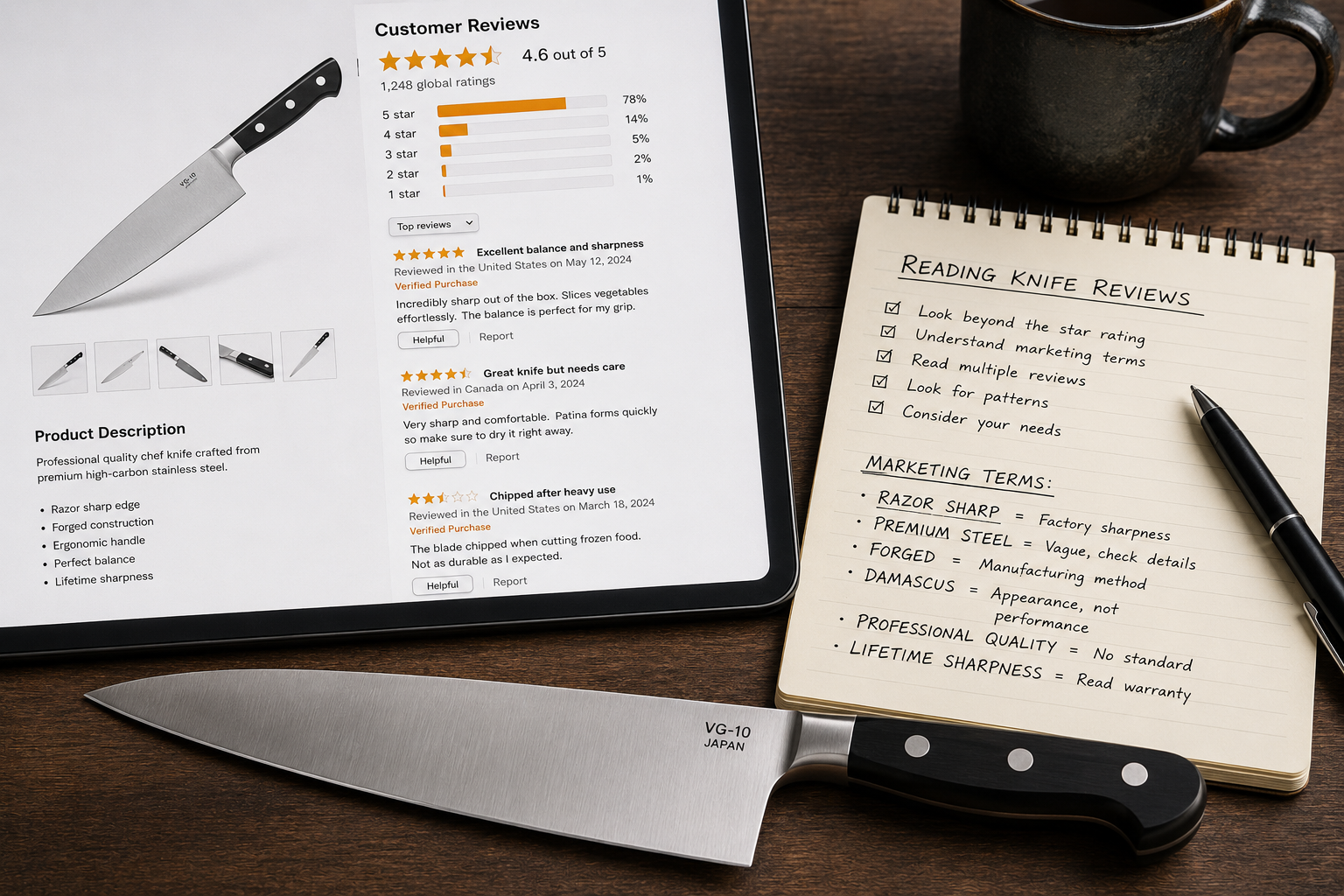
Use Reviews as Evidence, Not Instructions
A review becomes useful only when you understand who used the knife, which exact model was tested, how it was used, and what the reviewer expected. The goal is not to find the most praise. It is to find information that applies to your hand, cooking style, maintenance habits, and budget.
Look Beyond the Star Rating
Average ratings may reflect packaging, delivery, appearance, initial sharpness, price, or brand reputation rather than long-term performance. Low ratings may involve shipping damage, counterfeit products, dishwasher use, hard cutting surfaces, or unrealistic expectations.
Read several positive and critical reviews. Confirm the exact model, size, set, seller, and review date because manufacturers may change factories, materials, construction, or quality control without changing the product name.
Give more weight to reviews that describe weeks or months of normal use. Unboxing reviews can identify visible defects and first impressions, but they cannot establish edge retention, durability, corrosion resistance, or ease of maintenance.
What Makes a Review Useful?
Specific observations are more valuable than broad praise or criticism.
Reviewer Context
Look for hand size, grip style, experience level, normal foods, cutting motion, and comparison knives.
Use Conditions
Useful reviews mention the cutting board, cleaning method, frequency of use, and whether the knife contacted bone or frozen food.
Measurements
Blade length, height, thickness, weight, hardness, and handle dimensions are more useful than words such as light, thin, or balanced.
Long-Term Results
Look for edge behavior, corrosion, comfort, sharpening, handle condition, and quality-control issues after regular use.
Common Marketing Terms
| Term | What It May Mean | What to Verify |
|---|---|---|
| Razor sharp | The factory edge feels sharper than the buyer’s previous knife. | Edge durability, geometry behind the edge, and ease of resharpening. |
| Premium steel | A recognized alloy or ordinary steel described with impressive language. | Exact alloy, hardness, heat treatment, toughness, corrosion resistance, and intended use. |
| High-carbon stainless | A broad category of stainless steel capable of hardening. | Exact grade and the balance of hardness, toughness, corrosion resistance, and edge retention. |
| German or Japanese steel | Steel origin, design tradition, knife style, or marketing language. | Actual alloy, manufacturing location, hardness, geometry, and construction. |
| Forged or hand forged | Steel shaped with heat and pressure, with varying amounts of individual handwork. | Who made it, production method, heat treatment, grinding, finishing, and final geometry. |
| Damascus | Pattern-welded steel, layered cladding, etched decoration, or a surface pattern. | The steel forming the cutting edge and whether the pattern is structural or decorative. |
| Full tang | The blade steel extends through most or all of the handle. | Handle fit, security, gaps, comfort, balance, and overall construction. |
| Professional or restaurant grade | Marketing toward frequent or commercial use. | Durability, cleanability, replacement cost, corrosion resistance, comfort, and warranty. |
Comfort and Cutting Claims
Balanced does not identify a universal ideal. Some cooks prefer blade-forward knives, while others prefer neutral or handle-heavy designs. Reviews are useful when they describe where the balance point falls and how the knife feels during a particular grip.
Ergonomic is equally personal. Look for handle circumference, length, texture, corners, taper, weight, spine comfort, choil finishing, and performance with wet hands.
Nonstick blades may use dimples, scallops, hammered surfaces, coatings, or texture. These features can reduce contact in some foods but cannot eliminate sticking. Blade geometry, surface finish, technique, moisture, and ingredient shape still matter.
Sharpness, Edge Retention, and Sharpening Claims
No knife truly sharpens itself. Self-sharpening blocks contain hidden abrasives that contact the edge during insertion or removal. They may refresh an edge, but they can also remove steel unnecessarily, impose a fixed angle, and create uneven wear.
Every edge eventually changes through wear, rolling, chipping, corrosion, or impact. Claims such as never needs sharpening or lifetime sharpness may refer to serrations, replacement programs, warranties, or sharpening services. Read the terms for fees, exclusions, service limits, and original-owner requirements.
Easy to sharpen depends on steel wear resistance, hardness, damage, bevel width, abrasive choice, and skill. Holds an edge forever is equally subjective because users accept different levels of declining sharpness.
Care and Corrosion Claims
Dishwasher safe may mean the materials survive dishwasher exposure without immediate failure. It does not mean the dishwasher is ideal. Heat, detergents, prolonged moisture, and contact with other utensils can damage edges, stain steel, loosen handles, and accelerate corrosion.
Rust resistant does not mean rust proof. Stainless steel can still stain or rust when exposed to salt, acids, humidity, damaged surfaces, prolonged moisture, or improper storage.
Hand washing with mild soap followed by immediate drying remains the safer routine for most quality kitchen knives.
Look for Repeated Patterns
One complaint may reflect misuse or shipping damage. Repeated reports can reveal a meaningful problem.
Repeated Chipping
May point to brittle heat treatment, very thin geometry, misuse, or inconsistent quality control.
Repeated Wedging
May indicate excessive thickness behind the edge or abrupt grind shoulders.
Repeated Warping or Uneven Grinds
May indicate manufacturing, grinding, or heat-treatment problems.
Repeated Handle Problems
Gaps, loose rivets, cracks, and sharp transitions may reveal assembly or finishing weaknesses.
Repeated Rust Reports
May indicate limited corrosion resistance, inaccurate expectations, or a common care problem.
Repeated Comfort Complaints
May reveal bulky bolsters, narrow handles, sharp spine edges, poor balance, or slippery surfaces.
Sponsored and Marketplace Reviews
A sponsored review is not automatically dishonest, but the relationship should be disclosed clearly. Consider whether the product was purchased, loaned, or supplied free; whether affiliate links are used; and whether the reviewer discusses weaknesses as clearly as strengths.
Large marketplaces may combine reviews from different sellers, sizes, sets, revisions, or products. Counterfeits, returned merchandise, shipping damage, and unauthorized sellers can distort the record. Confirm that the review applies to the exact model and seller you are considering.
Customer photographs can reveal handle gaps, blade warping, grind irregularities, corrosion, actual size, and packaging damage. Lighting, camera angle, fingerprints, sharpening marks, and poor care can also make photographs misleading.
Product-Listing Red Flags
No Steel Identification
The listing relies on premium, surgical, or high-carbon language without naming the alloy.
Impossible Claims
The knife is described as permanently sharp, unbreakable, rust proof, or maintenance free.
Contradictory Specifications
Weight, dimensions, hardness, materials, or country of origin differ across the page.
Copied Descriptions
Multiple sellers repeat identical vague language without reliable manufacturer details.
Unclear Origin
The listing implies a manufacturing location without making a direct, verifiable statement.
Only Rendered Images
The page lacks photographs of the actual blade, handle, packaging, markings, and model identification.
Review-Reading Checklist
Confirm the exact model, size, seller, and review date. Identify how long the knife was used. Note the reviewer’s hand size, grip, experience, and comparison knives. Check what foods, cutting board, and cleaning method were used. Determine whether the knife was sharpened or modified before review. Look for named steel, measurements, construction details, and care instructions. Read both positive and critical reviews. Look for repeated patterns rather than one extreme opinion. Check whether sponsorship, free products, or affiliate links are disclosed. Decide whether the praised qualities matter in your own kitchen.
Key Takeaways
Context Makes Reviews Useful
The reviewer’s experience, use, maintenance, and expectations determine how relevant the opinion is to you.
Translate Marketing Into Facts
Named materials, measurements, construction details, care requirements, and warranty terms matter more than impressive phrases.
Patterns Matter Most
Repeated reports about geometry, comfort, corrosion, chipping, and quality control are more useful than one glowing or angry review.
References
The following sources were used in preparing and supporting this article.
Endorsements, Influencers, and Reviews
Federal Trade Commission
ftc.gov
All About How We Make Our Knives
ZWILLING
zwilling.com
Knife Steels Rated by a Metallurgist: Toughness, Edge Retention, and Corrosion Resistance
Knife Steel Nerds
knifesteelnerds.com
How to Clean Your WÜSTHOF Knives
WÜSTHOF
wusthof.com