Cleavers Are Not All the Same
Broad rectangular blades may look similar, but thin vegetable knives, general-purpose Chinese chef’s knives, and heavy meat cleavers are built for very different work.
The word cleaver describes several very different knives. Blade thickness, weight, edge geometry, bevel style, and intended use matter more than the broad rectangular outline.
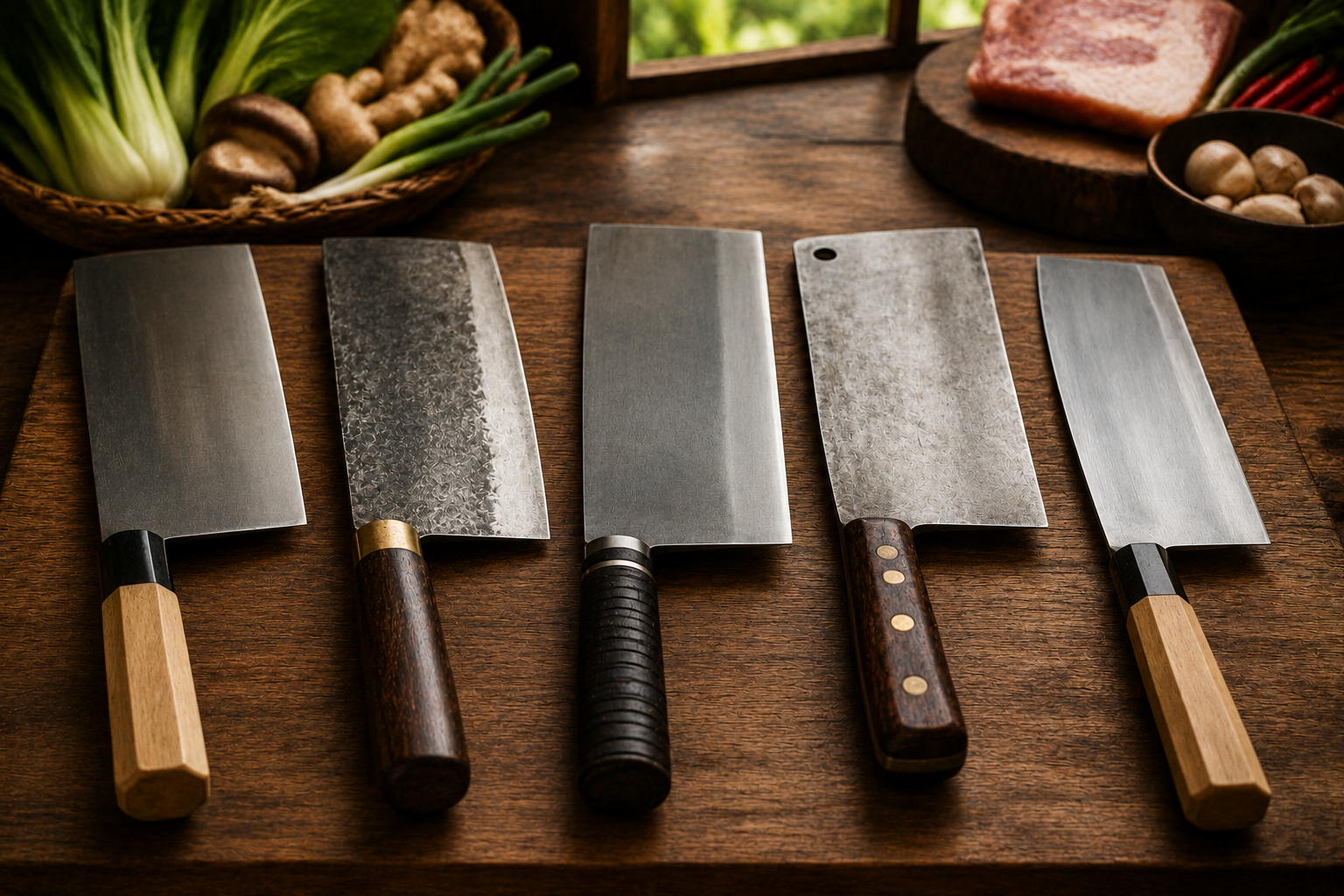
Shape Does Not Determine the Job
A broad rectangular blade may be a thin vegetable slicer, a general-purpose kitchen knife, or a heavy impact tool. Thickness, weight, grind, edge geometry, construction, and manufacturer guidance reveal far more than appearance.
Why These Knives Are Confused
The word “cleaver” often suggests a thick butcher’s tool designed to strike bone. That description fits some knives but not many broad-bladed kitchen knives.
Chinese chef’s knives and Japanese vegetable knives may share a tall rectangular outline with meat cleavers while remaining much thinner and more precise.
Using a thin slicing knife as a bone cleaver can chip, roll, bend, or crack the edge.
A Practical Comparison
| Knife Style | Typical Construction | Primary Work |
|---|---|---|
| Chinese chef’s knife or cai dao | Tall and generally thin to moderately thin | Vegetables, herbs, boneless meat, slicing, chopping, and food transfer |
| Japanese nakiri | Thin, light-to-moderate, usually double bevel | Vegetable slicing, chopping, and push cutting |
| Japanese usuba | Thin traditional vegetable knife, commonly single bevel | Specialized and presentation-focused vegetable work |
| Western meat cleaver | Thick, heavy, and strongly supported behind the edge | Manufacturer-approved heavy chopping, joints, ribs, and suitable bones |
| Heavy bone cleaver | Very thick and impact-oriented | Specific butchery tasks within the tool’s stated limits |
Chinese Chef’s Knives
A Chinese chef’s knife is often a versatile kitchen tool rather than a bone cleaver.
The tall blade provides knuckle clearance and a broad surface for transferring prepared food. Depending on the exact knife, it may handle vegetables, herbs, aromatics, and boneless proteins.
WÜSTHOF describes its Chinese chef’s knife as suitable for work ranging from chopping cabbage to producing thin tomato slices and transferring prepared ingredients.
Individual Chinese-style knives still vary. Some are fine slicers, while others are thicker choppers. The manufacturer’s description and blade construction should guide use.
The Japanese Nakiri
A nakiri is a Japanese-style vegetable knife with a tall profile and a relatively straight cutting edge.
ZWILLING describes the nakiri as a vegetable knife intended for chopping, slicing, dicing, and push cutting. Its thin geometry and broad blade support clean board work rather than heavy impact.
A nakiri may resemble a small cleaver, but it should not be used on bones, frozen food, or other hard materials unless the manufacturer specifically approves that use.
The Japanese Usuba
The usuba is also associated with vegetable preparation, but it is not simply another name for a nakiri.
Traditional usuba knives commonly use single-bevel geometry. That construction affects how the knife cuts, steers, and must be sharpened.
Korin’s traditional Japanese knife material identifies the usuba among single-edged knives and classifies its sharpening as advanced.
The usuba is best understood as a specialized vegetable knife rather than a general-purpose household cleaver.
Western Meat Cleavers
Western meat cleavers typically emphasize weight, blade thickness, and durable edge support.
WÜSTHOF describes its heavy cleaver as a tool for demanding work that can include ribs, racks, bones, and hard-skinned foods.
That does not mean every heavy-looking knife can perform those tasks. Use only materials and techniques approved for the specific model.
Very large or dense bones may require a meat saw or guarded commercial equipment rather than repeated striking with a hand tool.
What Actually Changes Performance
Blade Thickness
- Thin blades reduce wedging during slicing
- thick blades provide more support for demanding work.
Thickness Behind the Edge
This strongly affects cutting resistance and resistance to rolling or chipping.
Edge Angle
- Acute edges favor cutting efficiency
- wider edges provide greater support.
Blade Weight
Extra mass may assist controlled chopping but can increase fatigue and reduce finesse.
Steel and Heat Treatment
These influence toughness, hardness, corrosion resistance, and edge behavior.
Bevel Style
Double-bevel and single-bevel knives behave and sharpen differently.
Edge Geometry Must Match the Work
Knife Steel Nerds testing and analysis emphasizes that edge geometry strongly affects cutting ability and resistance to chipping or rolling. A fine slicing edge and an impact-oriented cleaver edge should not be treated as interchangeable.
Use the Knife Within Its Limits
• Confirm the manufacturer’s intended use.
• Use a large, stable cutting surface.
• Keep the supporting hand outside the blade path.
• Use controlled movement rather than an uncontrolled swing.
• Do not twist the blade while it is embedded.
• Do not scrape the cutting edge sideways across the board.
• Do not strike frozen food, dense bone, metal, or other hard material with an unapproved knife.
• Stop when unusual force is required.
• Never try to catch a falling cleaver.
Sharpening Must Preserve the Intended Geometry
Thin vegetable and general-purpose cleavers usually need a fine, controlled edge that preserves slicing ability.
Heavy meat cleavers need stronger supporting geometry appropriate to their intended impact.
Sharpening should consider:
• Existing bevel angle and symmetry.
• Blade thickness and thickness behind the edge.
• Straight or gently curved edge profile.
• Heel contact with the cutting board.
• Chips, rolls, and weakened steel.
• Complete burr removal.
• Single-bevel construction when present.
A heavy cleaver should not automatically receive a thin chef’s-knife edge, and a thin slicer should not be converted into a heavy chopping tool.
Care and Storage
• Hand wash with mild soap.
• Dry the blade and handle immediately.
• Remove acidic and salty residue promptly.
• Protect reactive carbon steel appropriately.
• Inspect the blade and handle for cracks, corrosion, or looseness.
• Store the edge where it cannot strike other utensils.
• Use a cutting board suitable for the knife and task.
Glass, stone, ceramic, and metal surfaces can quickly damage both thin slicing edges and heavy cleaver edges.
Questions to Ask Before Choosing One
• What foods will it cut most often?
• Is it intended for slicing, general preparation, joints, or bone?
• How thick is the blade and the area behind the edge?
• Is the edge single bevel or double bevel?
• Does the manufacturer approve impact work?
• Is the weight comfortable and controllable?
• Can the knife be sharpened and maintained correctly?
Choose around the actual work rather than the most dramatic appearance.
Key Takeaways
Similar Shape, Different Tools
Chinese chef’s knives, nakiri, usuba, and meat cleavers can share a broad outline while serving different purposes.
Geometry Matters Most
Thickness, edge support, bevel style, weight, and construction reveal how the knife should be used.
Follow Intended Use
Do not strike bone or frozen food unless the specific knife is designed and approved for it.
References
The following sources were used in preparing and supporting this article.
7-Inch Chinese Chef’s Knife
WÜSTHOF
wusthof.com
Nakiri Knives
ZWILLING
zwilling.com
Traditional Japanese Knife Catalog
Korin
korin.com
Classic 6-Inch Cleaver
WÜSTHOF
wusthof.com
Knife Steels Rated by a Metallurgist: Toughness, Edge Retention, and Corrosion Resistance
Knife Steel Nerds
knifesteelnerds.com