What Sharpening Reveals About Knife Steel
The way a knife abrades, forms and releases a burr, supports an apex, and responds to testing provides practical clues about its steel, heat treatment, and geometry.
A steel name describes composition, but sharpening reveals how the actual knife behaves. Abrasion resistance, burr behavior, edge stability, toughness, carbide structure, heat treatment, geometry, and previous use all influence the finished edge.
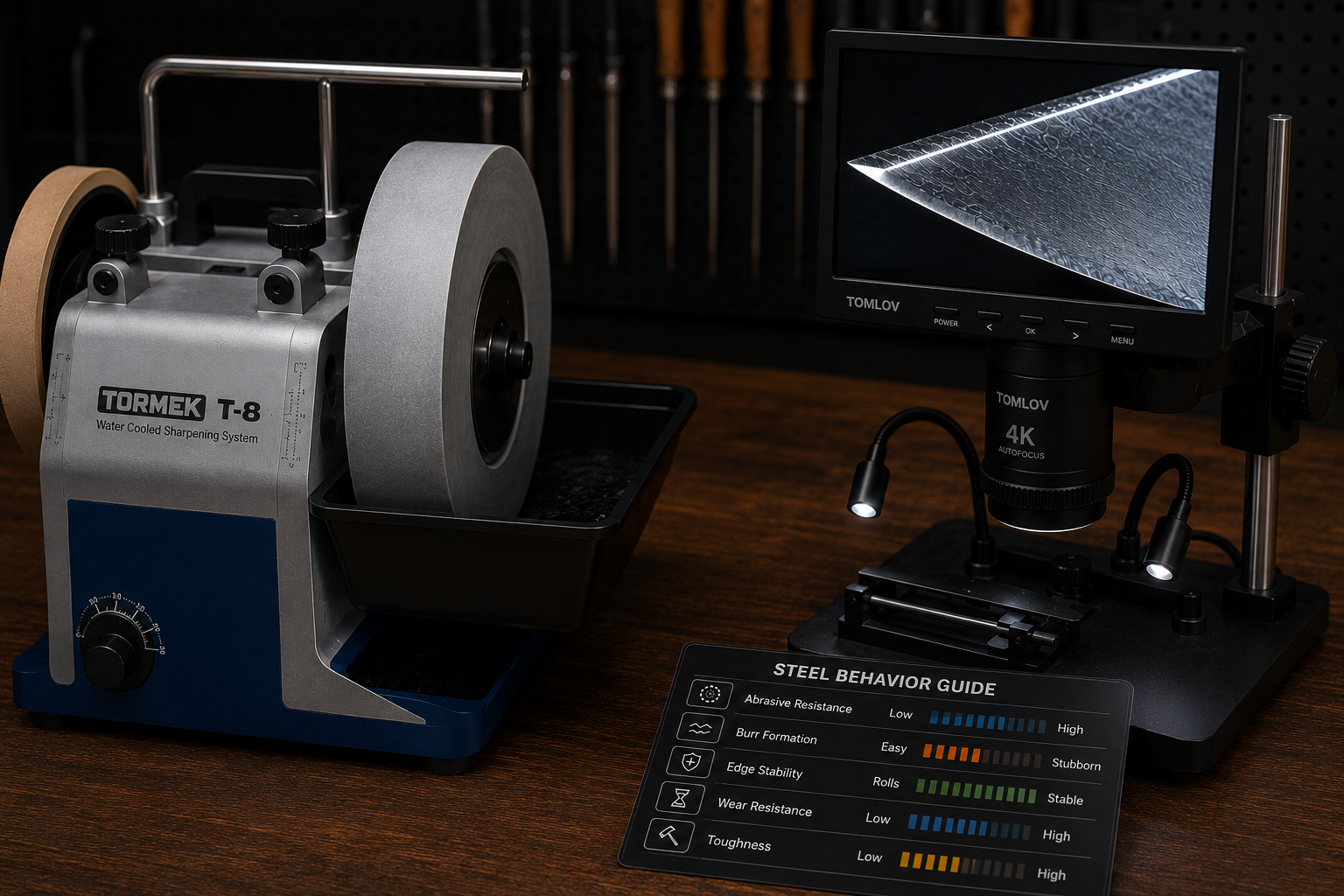
The Important Lesson
Steel type matters, but the finished knife is the result of alloy, heat treatment, blade geometry, sharpening, maintenance, and real-world use working together.
Sharpening Is a Practical Steel Test
A steel designation provides useful information, but the sharpening process shows how the actual knife behaves.
Two blades made from the same named steel may sharpen and perform differently because of heat treatment, hardness, blade thickness, edge angle, manufacturing quality, prior damage, and use.
During sharpening, the sharpener observes how efficiently the abrasive removes steel, how the burr develops and releases, whether the apex rolls or chips, how the edge accepts refinement, and how it performs during testing.
What the Process Can Reveal
Abrasion Resistance
Some steels grind readily, while others resist abrasive wear and require more time or more suitable abrasives.
Burr Behavior
The burr may form easily, remain stubborn, break away cleanly, fragment, or continue flipping between sides.
Edge Stability
The steel may support a fine apex or begin rolling, chipping, or crumbling when the geometry becomes too delicate.
Refinement
Some steels accept a highly refined finish readily, while others perform better with a practical working texture.
Damage Tendency
Rolling suggests deformation, while chipping suggests fracture, although geometry and use also matter.
Possible Heat-Treatment Concerns
Unexpected softness, brittleness, or uneven behavior may suggest a heat-treatment or prior-overheating problem.
Steel Name and Heat Treatment
A steel designation identifies a composition or composition range. It does not guarantee identical hardness, toughness, carbide structure, corrosion resistance, edge retention, or sharpening behavior in every knife.
Heat treatment develops the working structure of the steel. The maker’s choices can influence hardness, toughness, grain size, carbide behavior, corrosion resistance, and how well the apex remains stable.
Sharpening cannot fully diagnose metallurgy, but the edge can provide practical evidence about how successfully the steel and heat treatment work in that particular knife.
Hardness, Wear Resistance, and Toughness
These properties interact; improving one does not automatically improve every aspect of the knife.
Hardness
Resistance to DeformationPros
Can help support a finer apex and resist rolling when the steel and geometry are appropriate.
Cons
Higher hardness can reduce tolerance for impact, twisting, hard surfaces, and poor technique.
Best For
Supporting stable cutting geometry—not simply achieving the highest possible number.
Wear Resistance
Resistance to AbrasionPros
Can improve slicing edge retention under suitable conditions.
Cons
May require more effective abrasives and more time when sharpening is finally needed.
Best For
Longer service between sharpenings when balanced with geometry and toughness.
Toughness
Resistance to FracturePros
Helps the blade tolerate impact, deformation, and lateral stress without chipping.
Cons
A tough steel can still roll when the apex is too thin or the hardness is too low.
Best For
Knives exposed to demanding use, impact, or less-controlled technique.
Abrasive Response
The abrasive must cut the steel rather than merely rub against it. An ineffective abrasive encourages extra pressure, friction, heat, wasted time, and uneven results.
The workshop selects from water-cooled grinding, abrasive belts, ceramic or other fine abrasives, leather and felt finishing surfaces, and compounds suited to the steel and stage of work.
Highly wear-resistant steels may require harder or more efficient abrasive materials. The goal is not to use the most aggressive option available, but the least aggressive tool that completes the work effectively.
What Burr Behavior Tells Us
A burr is weakened metal displaced from the apex as sharpening reaches the cutting edge.
A large flexible burr may occur in softer or more ductile steel, particularly when pressure is excessive. A small crisp burr may appear on a harder, stable edge when the abrasive is cutting efficiently. Some burrs remain stubborn and flip repeatedly; others fracture into fragments.
Burr behavior is influenced by steel properties, but technique matters just as much. Abrasive choice, pressure, angle control, burr size, and the deburring sequence can change what the sharpener observes.
Carbides, Grain Structure, and Edge Refinement
Carbides are hard particles formed from carbon and alloying elements within the steel. Their type, size, quantity, and distribution affect wear resistance, sharpening response, and how the apex behaves.
Higher carbide volume can increase wear resistance but may require more effective abrasives. Fine, evenly distributed carbides can support a more refined edge than larger or more widely spaced carbides.
A fine, well-controlled grain structure can also help a steel support a clean apex. Ordinary sharpening cannot confirm the exact internal structure, but repeated edge behavior can provide useful clues.
Broad Steel Categories During Sharpening
| Steel or Construction | Common Sharpening Characteristics | Important Qualification |
|---|---|---|
| Simple carbon steel | Often abrades readily, gives clear feedback, and can accept a fine edge. | Lower corrosion resistance requires prompt cleaning and drying. |
| Common kitchen stainless steel | May sharpen easily and form a relatively flexible burr. | Stainless steels vary widely in hardness, wear resistance, and toughness. |
| High-wear stainless or tool steel | Can resist abrasion and require more efficient abrasive materials. | High wear resistance does not automatically mean high toughness. |
| Powder-metallurgy steel | May offer high wear resistance and more uniform carbide distribution. | Performance still depends heavily on alloy choice, heat treatment, and geometry. |
| Clad or laminated blade | The cutting edge is formed mainly from the core steel. | Thinning and broad surface work may affect both the core and cladding. |
Edge Angle and Stability
A steel may sharpen successfully at a narrow angle yet fail quickly during use. Another steel may remain stable at the same angle because of different hardness, toughness, carbide structure, heat treatment, blade thickness, or use conditions.
Lower angles can reduce cutting resistance, but they also leave less steel supporting the apex. The best angle is the narrowest practical angle that remains stable for the knife’s intended work.
A microbevel can strengthen the apex with a very narrow secondary bevel while preserving thinner geometry behind it.
Edge Finish and Stropping Response
Different steels respond differently to coarse, medium, fine, and highly refined finishes.
A polished bevel may look impressive, but many kitchen tasks benefit from a moderately toothy edge that bites into tomato skin, peppers, meat, and fibrous foods.
Controlled stropping can remove burr remnants and improve consistency. Repeated burr flipping, rapid rounding, or microchipping may indicate that the burr is too large, the pressure or angle is wrong, the finishing surface is too flexible, or the edge geometry is too delicate.
Previous Overheating and Damaged Steel
Dry powered sharpening can generate heat rapidly at the thin apex. Excessive temperature may soften or otherwise damage steel near the edge.
Visible blue, purple, or brown discoloration is a warning, but harmful temperatures may occur before dramatic color appears.
Heat-damaged or otherwise weakened steel may need to be removed before a stable apex can be formed. The affected depth is not always visible and may become clear only through sharpening, inspection, and testing.
Inspection, Photography, and Sharpness Testing
Direct-light inspection and Canon macro photography can document burrs, rolls, microchips, corrosion, scratch patterns, and apex consistency. These observations do not identify the alloy or measure hardness directly.
BESS stands for Brubacher Edge Sharpness Scale. A BESS test measures the force, expressed in grams, required for an edge to cut standardized test media. A lower Brubacher Edge Sharpness Scale score means less force was required at the tested point.
The score documents sharpness, but it does not identify the steel, predict edge life, measure blade thickness, or describe performance through food.
What Repeated Service Teaches
A single sharpening shows how a knife behaved during one service. Repeated service creates a more useful history of edge damage, sharpening response, burr behavior, maintenance interval, geometry changes, and whether the selected angle and finish are working well.
Key Takeaways
Steel Names Are Only the Starting Point
Heat treatment, hardness, carbides, geometry, manufacturing quality, and use determine how the actual knife behaves.
Sharpening Provides Practical Evidence
Abrasion rate, burr behavior, edge stability, damage patterns, and testing reveal how the knife responds in practice.
The Best Edge Is Balanced
Sharpness, durability, geometry, abrasive choice, finish, and intended use must work together.
References
The following sources were used in preparing and supporting this article.
Knife Steels Rated by a Metallurgist: Toughness, Edge Retention, and Corrosion Resistance
Knife Steel Nerds
knifesteelnerds.com
Testing the Edge Retention of 48 Knife Steels
Knife Steel Nerds
knifesteelnerds.com
What Is Edge Stability?
Knife Steel Nerds
knifesteelnerds.com
Introduction to Knife Steel Heat Treating from a Metallurgist
Knife Steel Nerds
knifesteelnerds.com
PT50 Series Edge Sharpness Testers and the BESS
Edge On Up
edgeonup.com