Hardness vs. Toughness: Why Steel Composition Matters
A harder blade is not automatically a better blade.
Knife steel has to do several jobs at once. It must hold a sharp edge, resist damage, survive normal kitchen use, and still be practical to sharpen. Hardness and toughness are two of the most important properties, but they are not the same thing.
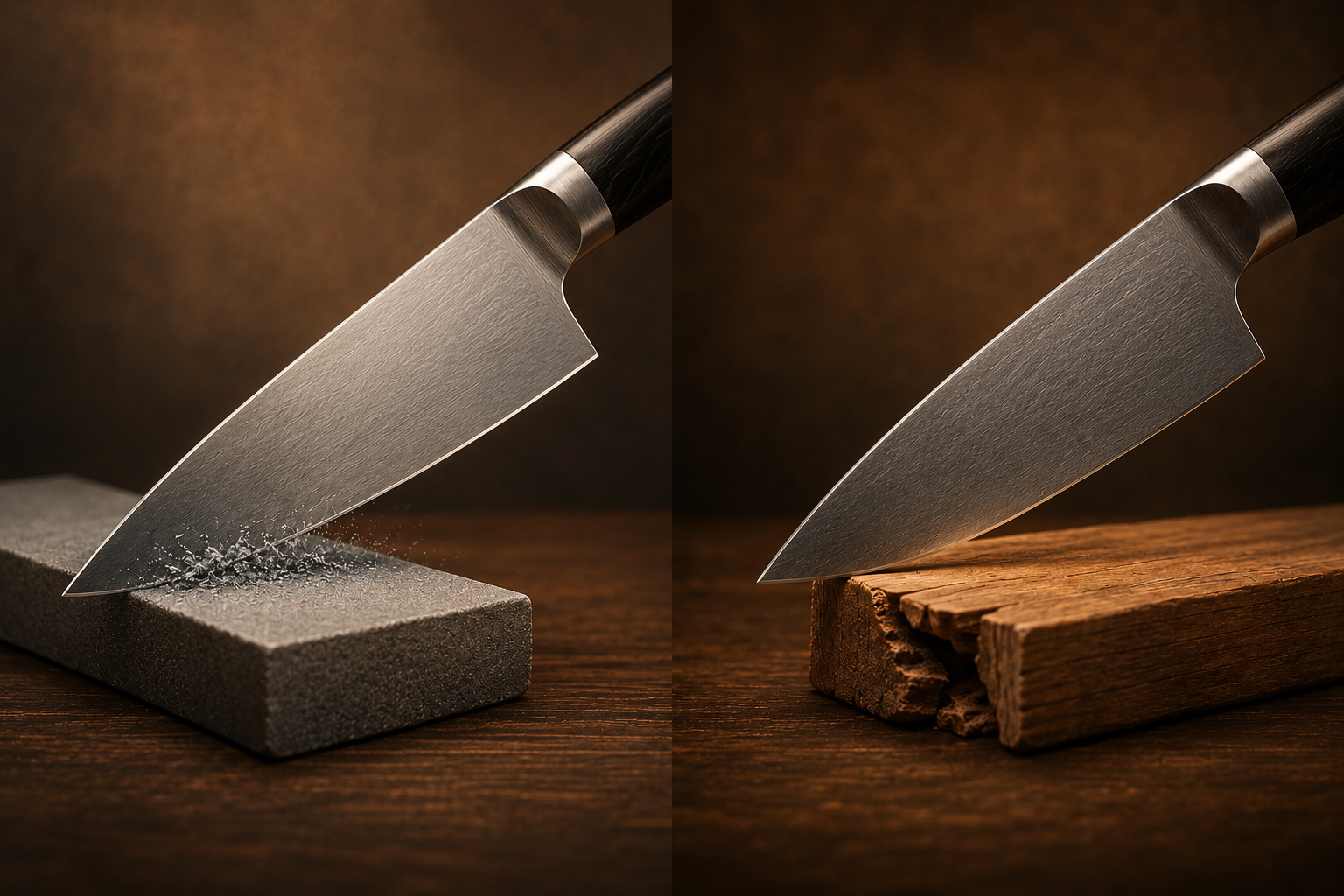
Simple version: Hardness helps the edge resist wearing down or rolling out of shape.
What is hardness?
Hardness describes how well steel resists deformation, wear, and indentation. In practical knife terms, harder steel can often support a thinner edge and may stay sharp longer during normal cutting.
Hardness is commonly expressed using the Rockwell C scale, or HRC. A higher HRC number generally means the steel is harder.
Simple version: Toughness helps the blade survive shock and abuse without breaking.
What is toughness?
Toughness describes how well steel absorbs stress without cracking or chipping. A tough blade can better tolerate impact, twisting, and accidental misuse.
Toughness does not mean softness. A knife can be both reasonably hard and tough, but manufacturers usually have to balance the two properties carefully.
Hardness and toughness compared
| Property | Hardness | Toughness |
|---|---|---|
| Main benefit | Helps the edge resist wear and deformation. | Helps the blade resist chips, cracks, and impact damage. |
| Typical advantage | Longer edge retention. | Greater durability and forgiveness. |
| Typical tradeoff | May become more brittle if pushed too far. | May require more frequent sharpening if the steel is softer. |
| Common failure | Chipping or cracking. | Rolling, bending, or faster dulling. |
| Often favored in | Fine slicing knives and high-performance cutlery. | Heavy-use knives, outdoor knives, and forgiving kitchen tools. |
Why harder steel can hold an edge longer
As a knife cuts, the edge is exposed to repeated friction and pressure. Harder steel generally resists that wear more effectively, allowing the edge to remain crisp for a longer period.
Harder steels may also support lower edge angles and thinner geometry. That can produce excellent cutting performance when the knife is used carefully.
Common mistake: Using a thin, hard Japanese-style knife for bone, frozen food, or prying work.
Why harder steel may chip
Hardness can come with reduced flexibility. When a very hard, thin edge hits bone, frozen food, glass, ceramic, or stone, it may chip instead of bending.
Twisting the knife while it is buried in dense food can also place sideways stress on the edge. That type of force is especially risky for thin, hard blades.
Why softer steel often rolls instead
Softer or tougher steel may deform before it breaks. Instead of losing a small chip, the edge can bend or roll slightly to one side.
A rolled edge may feel dull even though very little steel has been lost. In some cases, light honing can improve it. Once the edge is worn or damaged more deeply, sharpening is required.
Can a knife be both hard and tough?
Yes, but achieving both requires good steel selection, careful heat treatment, and appropriate blade geometry. Modern steels can offer excellent combinations of hardness and toughness, but no steel eliminates tradeoffs completely.
The same steel can perform differently depending on how it was heat treated. Two knives made from the same named steel may not behave the same in use.
Steel composition affects the balance
Elements added to steel influence wear resistance, corrosion resistance, carbide formation, toughness, and sharpening difficulty.
Carbon
Carbon helps steel become hard enough to hold a cutting edge.
Chromium
Chromium improves corrosion resistance and can also affect wear resistance.
Vanadium
Vanadium can form very hard carbides that improve wear resistance and edge retention.
Molybdenum
Molybdenum can improve strength, toughness, and performance during heat treatment.
Heat treatment matters as much as the steel name
Heat treatment determines how the steel's internal structure develops. Hardening, quenching, and tempering all influence the final balance of hardness and toughness.
A well-known premium steel can perform poorly if it is heat treated badly. A modest steel with excellent heat treatment can perform extremely well.
Blade geometry changes the equation
Steel properties do not work alone. Edge angle, blade thickness, grind, and thickness behind the edge all affect durability.
A tough steel ground too thin can still fail. A hard steel with a sensible edge angle may perform reliably for years.
This is why sharpening should match the knife rather than applying the same angle to every blade.
Real-world kitchen examples
| Knife Type | Typical Priority | Why |
|---|---|---|
| Thin Japanese gyuto | Hardness and edge retention | Designed for precise slicing with careful technique. |
| German-style chef knife | Balanced hardness and toughness | Built for forgiving everyday kitchen use. |
| Meat cleaver | Toughness | Needs to tolerate impact and heavy chopping. |
| Boning knife | Toughness and flexibility | May experience bending and contact near joints or bones. |
| Fine slicer | Hardness and thin geometry | Prioritizes clean, low-resistance cuts. |
Why sharpeners care about hardness and toughness
These properties affect how the edge responds to abrasives, how quickly a burr forms, how easily the burr releases, and what finish is appropriate.
Very wear-resistant steel may require more effective abrasives and more time. Softer steel may sharpen quickly but form a stubborn burr that needs careful removal.
The final edge angle must also fit the steel and intended use. A low angle may suit a fine slicer, while a wider angle may be more reliable for a heavy-use knife.
Common misconceptions
Higher HRC Always Means Better
Higher hardness may improve edge retention, but it does not guarantee better toughness, geometry, heat treatment, or overall performance.
Chipping Means the Steel Is Bad
Chipping may result from misuse, an overly thin edge, a hard cutting surface, or an unsuitable sharpening angle.
Softer Steel Is Low Quality
Softer steel can be practical, tough, easy to sharpen, and well suited to demanding kitchen work.
Which balance is right for you?
Favor Hardness If...
Favor Toughness If...
Key Takeaways
Hardness and Toughness Are Different
Hardness helps a knife resist wear and hold an edge, while toughness helps it resist chips, cracks, and impact damage.
Higher Hardness Is Not Always Better
A very hard blade may hold an edge longer, but it can also be less forgiving if the knife is twisted, dropped, or used on hard materials.
Balance Matters Most
The best knife steel balances hardness, toughness, corrosion resistance, edge retention, and ease of sharpening for its intended use.
References
The following sources were used in preparing and supporting this article.
Knife Steels Rated by a Metallurgist
Knife Steel Nerds
knifesteelnerds.com
Testing the Edge Retention of 48 Knife Steels
Knife Steel Nerds
knifesteelnerds.com
What Is Edge Stability?
Knife Steel Nerds
knifesteelnerds.com