Steel Types Explained: Carbon, Stainless, and Damascus Compared
The steel name matters, but it never tells the whole story.
Knife steel affects corrosion resistance, edge retention, toughness, sharpening difficulty, and maintenance. Understanding the major steel families makes it easier to choose a knife that fits how you actually cook.
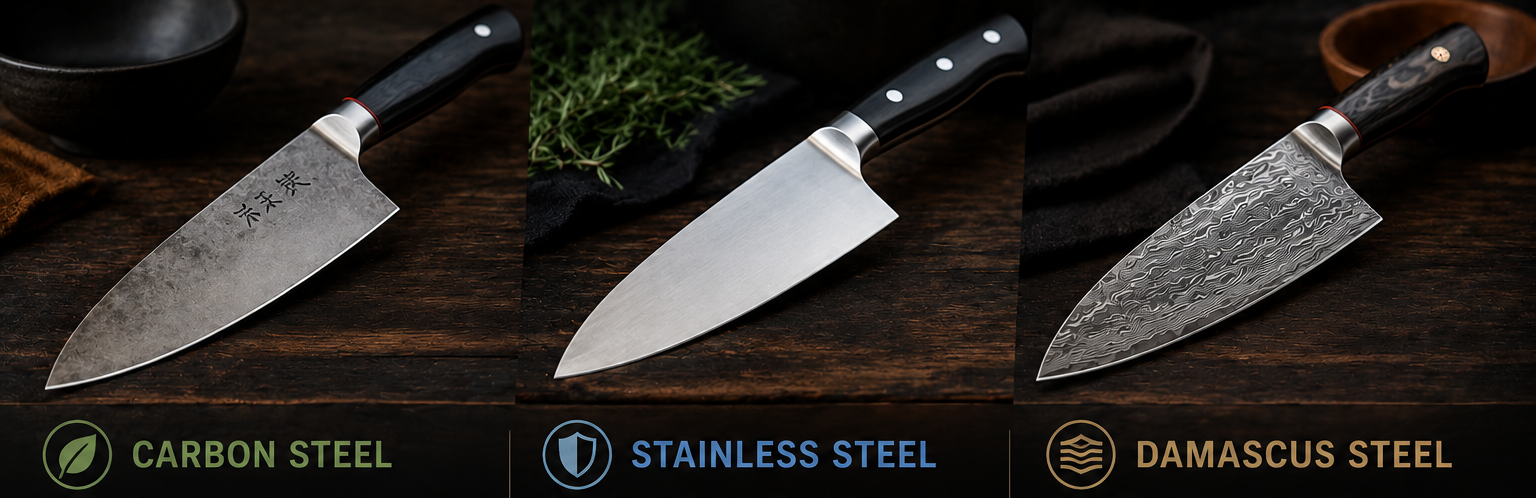
What determines how knife steel performs?
A steel name is only the starting point. The same alloy can perform very differently depending on how the knife was made.
Heat treatment and hardness affect edge retention, toughness, and sharpening difficulty. Blade geometry affects how easily the knife moves through food. The intended use also matters—a thin slicing knife and a heavy-duty outdoor knife need different qualities.
When comparing knives, consider the steel, heat treatment, blade geometry, maintenance needs, and how you plan to use the knife.
Core steel categories
| Steel Category | Edge Retention | Rust Resistance | Sharpening Difficulty | Best For |
|---|---|---|---|---|
| Carbon Steel | Good to excellent | Low | Usually easy to moderate | Cooks who value sharpness and do not mind extra care |
| Stainless Steel | Fair to excellent | Good to excellent | Easy to difficult, depending on alloy | Everyday kitchens and lower-maintenance use |
| Powdered Steel | Excellent | Usually very good | Moderate to difficult | Users who want long edge retention and premium performance |
What Damascus really means
Damascus is not a single type of steel. It usually refers to layered construction or a visible patterned finish.
The knife’s cutting performance still depends mainly on the core steel, heat treatment, hardness, and blade geometry. A Damascus pattern can be attractive, but it does not automatically mean the knife is sharper, tougher, or better made.
Common steel myths
Damascus Is Always Better
The pattern may be beautiful, but the core steel and construction determine performance.
Stainless Never Rusts
Stainless steel resists corrosion, but it can still stain or rust if neglected.
Carbon Steel Is Always Sharper
Carbon steel often sharpens beautifully, but stainless steels can also take extremely fine edges.
Premium Steel Guarantees a Premium Knife
Heat treatment, blade geometry, grind, handle construction, and sharpening all matter.
Common knife steels and abbreviations
| Steel / Abbreviation | Category | Typical Characteristics |
|---|---|---|
| VG-10 | Stainless steel | Popular Japanese stainless steel with good edge retention, corrosion resistance, and moderate sharpening difficulty |
| AUS-8 | Stainless steel | Tough, corrosion-resistant, and generally easy to sharpen, but usually offers more modest edge retention |
| X50CrMoV15 | Stainless steel | Common European kitchen-knife steel known for toughness, corrosion resistance, and easy maintenance |
| 14C28N | Stainless steel | Fine-grained stainless steel with a good balance of sharpness, toughness, corrosion resistance, and ease of sharpening |
| SG2 / R2 | Powdered stainless steel | Premium powdered steel with high hardness, strong edge retention, and greater sharpening difficulty |
| Aogami / Blue Steel | Carbon steel | Japanese carbon steel known for excellent sharpness and edge retention but requiring careful maintenance |
| Shirogami / White Steel | Carbon steel | Very pure Japanese carbon steel that sharpens easily and takes a keen edge but rusts readily |
| SK4 | Carbon steel | Practical carbon steel with good toughness and sharpening response, often used in traditional or utility blades |
What a sharpener notices
During sharpening, different steels respond differently to abrasives. Some form a burr quickly. Some require more time. Some release the burr cleanly, while others need careful finishing.
The steel type helps guide abrasive choice, pressure, angle, finishing method, and how aggressively damage should be repaired.
Key Takeaways
Every Steel Has Tradeoffs
Carbon steel, stainless steel, and modern powdered steels balance edge retention, toughness, corrosion resistance, and sharpening differently.
Damascus Describes Construction
Damascus usually refers to a layered or patterned construction, not one specific type or grade of steel.
Heat Treatment Still Matters
The steel name alone cannot guarantee performance. Heat treatment, blade geometry, and sharpening are just as important.
References
The following sources were used in preparing and supporting this article.
Knife Steels Rated by a Metallurgist
Knife Steel Nerds
knifesteelnerds.com
Testing the Edge Retention of 48 Knife Steels
Knife Steel Nerds
knifesteelnerds.com
What Is Edge Stability?
Knife Steel Nerds
knifesteelnerds.com