Why We Triage Knives Before Sharpening
Every knife is inspected before service so the sharpening process matches its condition, construction, intended use, and safety.
Knife triage identifies routine dullness, damage, geometry problems, corrosion, handle concerns, and specialty construction before sharpening begins. It also determines when repair approval is needed or when a knife should be declined.
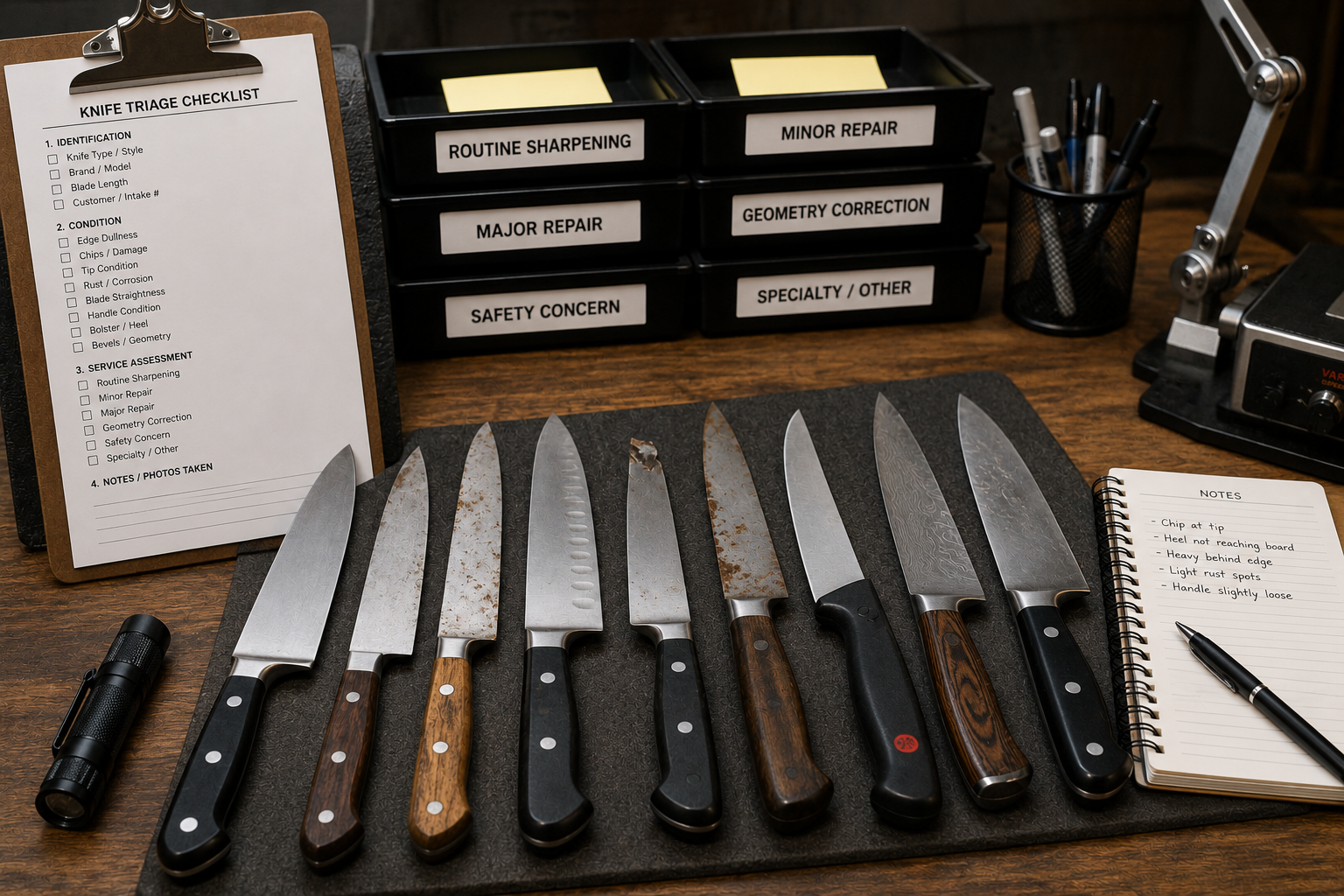
The Question Triage Answers
What does this particular knife need to become safe, sharp, and useful again without removing unnecessary steel?
What Knife Triage Means
Triage is the evaluation completed before the knife touches a sharpening wheel, belt, ceramic abrasive, leather wheel, or other finishing surface.
The knife is identified, inspected, and assigned to the appropriate type of service. Triage separates routine sharpening from repair, geometry correction, specialty work, and safety concerns.
Two knives that appear equally dull may require very different treatment because their steel, geometry, prior sharpening, damage, and intended use differ.
The Basic Triage Categories
| Category | Typical Condition | Likely Next Step |
|---|---|---|
| Routine sharpening | Worn but generally continuous edge with usable geometry. | Restore the bevels, form a new apex, deburr, and test. |
| Minor repair | Small chips, light rolls, slight tip damage, or limited corrosion. | Correct during sharpening when the change will be minor. |
| Major repair | Large chips, broken tips, deep corrosion, severe recurve, or major profile damage. | Estimate added work and obtain approval when needed. |
| Geometry correction | Sharp apex but excessive thickness, wedging, steering, or bolster interference. | Evaluate thinning, profile correction, or bolster reduction. |
| Specialty evaluation | Serrated, asymmetrical, flexible, custom, collectible, or unusual construction. | Confirm that the available equipment and process are appropriate. |
| Declined service | Unsafe, impractical, unsupported, or outside current service capabilities. | Explain the concern and return the knife without sharpening. |
What Is Inspected
Cutting Edge
Dullness, rolls, chips, flat spots, corrosion, and uneven wear from heel to tip.
Tip and Profile
Bending, flattening, missing steel, recurves, waves, and board-contact problems.
Blade Straightness
Sideways bends, twists, warping, cracks, and possible heat damage.
Existing Bevels
Angle, width, asymmetry, scratch patterns, recurves, and previous sharpening.
Handle and Bolster
Cracks, looseness, gaps, raised rivets, ferrule damage, and heel interference.
Blade Surface
Patina, active rust, pitting, scratches, coatings, and decorative finishes.
Direct Light and Close Photography
Strong direct light can reveal rounded areas, rolls, chips, and flat spots as bright reflections along the apex.
When more detail is useful, a Canon camera with a macro lens may be used to document chips, corrosion, scratches, bevel condition, tip damage, and other concerns.
No digital microscope or scope is used. Close photographs support inspection and documentation, but the apparent size of a feature must be interpreted carefully.
Damage Changes the Work
A chip is missing steel. Repair lowers and blends the surrounding cutting line until the damaged section is removed.
A broken tip must be recreated from the steel that remains. Material may be removed from the spine, edge, or both.
A rolled edge is bent rather than missing. Weakened folded steel may need to be removed instead of repeatedly pushed back.
The deeper or larger the damage, the more likely the repair will change blade height, profile, bevel width, appearance, service time, and cost.
Geometry Can Be the Real Problem
A knife may pass a paper test and still cut poorly because the blade is too thick directly above the edge.
Common signs include wedging in dense food, unusually wide bevels, steering, high cutting resistance, and poor food release.
Sharpening restores the apex. Thinning changes the geometry above it. Bolster reduction may also be needed when the heel no longer reaches the cutting board.
Construction and Previous Sharpening Matter
Some knives are intentionally asymmetrical. Making both sides look identical can change steering, food release, and cutting behavior.
Previous sharpening may have created several angles, uneven bevels, recurves, incomplete heel contact, rounded tips, or excessive thickness.
Coated, polished, etched, hammered, patterned, flexible, serrated, and custom knives may require added protection or a different process.
The Intended Use Guides the Edge
A thin slicing knife, everyday home knife, shared kitchen knife, and heavier utility blade should not automatically receive the same angle or finish.
The decision considers steel, blade thickness, previous edge behavior, cutting board, storage, cleaning, technique, and the foods being prepared.
Damage patterns can also provide clues. Repeated microchips may suggest impact, twisting, bone, frozen food, or an edge that is too delicate. Rolling may suggest softer steel, scraping, or lateral pressure.
When Customer Approval Is Needed
Approval is requested when:
• Repair will noticeably change the blade profile.
• A large chip requires substantial blade-height reduction.
• Broken-tip repair will shorten or reshape the knife.
• Thinning or bolster reduction is recommended.
• Deep corrosion may prevent a clean or durable result.
• The expected price differs from routine sharpening.
• The knife is custom, collectible, sentimental, or difficult to replace.
• The handle or blade may be unsafe.
When Sharpening May Be Declined
Declining work can be the safest and most responsible decision.
Ceramic Knife
Ceramic knives are not accepted. Contact the original manufacturer for approved sharpening, repair, warranty, or replacement options.
Cracked Blade
A structural crack may spread and cause the blade to fail during use.
Unsafe Handle
Severe looseness, cracking, separation, or poor control may make service unsafe.
Extreme Corrosion
Deep pitting may leave too little sound steel for safe or practical restoration.
Major Distortion
A severe bend, twist, or unsafe modification may not be safely reversible.
Unsupported Construction
A specialty grind, material, or repair may require equipment or expertise outside current service capabilities.
Triage Prevents Unnecessary Steel Removal
Every sharpening removes steel. The starting abrasive and method should match the actual amount of work required.
Beginning too coarse removes more metal than necessary. Beginning too fine can waste time and encourage excess pressure while failing to remove real damage.
A knife needing only routine edge restoration should not receive repair-level grinding. A damaged knife should not be polished repeatedly while the defect remains.
Sets Are Still Evaluated One Knife at a Time
Knives arriving together may share the same cutting boards, storage, cleaning habits, and users, but their condition can vary significantly.
One knife may need routine sharpening, another may require chip repair, and another may have a handle or corrosion concern.
Each knife is inspected and assigned its own service category before sharpening begins.
Simplified Triage Checklist
• Confirm the knife and owner.
• Record the requested service and intended use.
• Inspect the edge from heel to tip.
• Check the tip, profile, spine, handle, heel, and bolster.
• Look for chips, rolls, corrosion, bends, cracks, and previous sharpening damage.
• Evaluate bevels, asymmetry, thickness, and board contact.
• Use Canon macro photography when detailed documentation is useful.
• Decide whether the knife needs routine sharpening, repair, geometry correction, specialty evaluation, or declined service.
• Obtain approval before major permanent changes.
• Select the least aggressive effective process.
Key Takeaways
Inspection Comes Before Equipment
The actual knife determines the angle, abrasive, repair plan, and finishing method.
Triage Prevents Surprises
Damage, safety concerns, cost changes, and permanent profile changes are identified before work begins.
Some Knives Should Be Declined
Ceramic knives, unsafe blades, severe structural damage, and unsupported work are not accepted.
References
The following sources were used in preparing and supporting this article.
Knife Sharpening
Tormek
tormek.com
How to Sharpen a Knife: Back to Basics
Work Sharp
worksharptools.com
Ceramic Knife Sharpening Service
Kyocera
cutlery.kyocera.com