Sharpen or Retire?
The decision depends on safety, remaining blade geometry, practical value, and whether sharpening can produce a useful knife.
Gibson County Knife Sharpening first determines whether a knife is safe and whether sharpening or limited correction can leave it useful. Some knives are good candidates for service; others should be replaced or sent to a specialist.
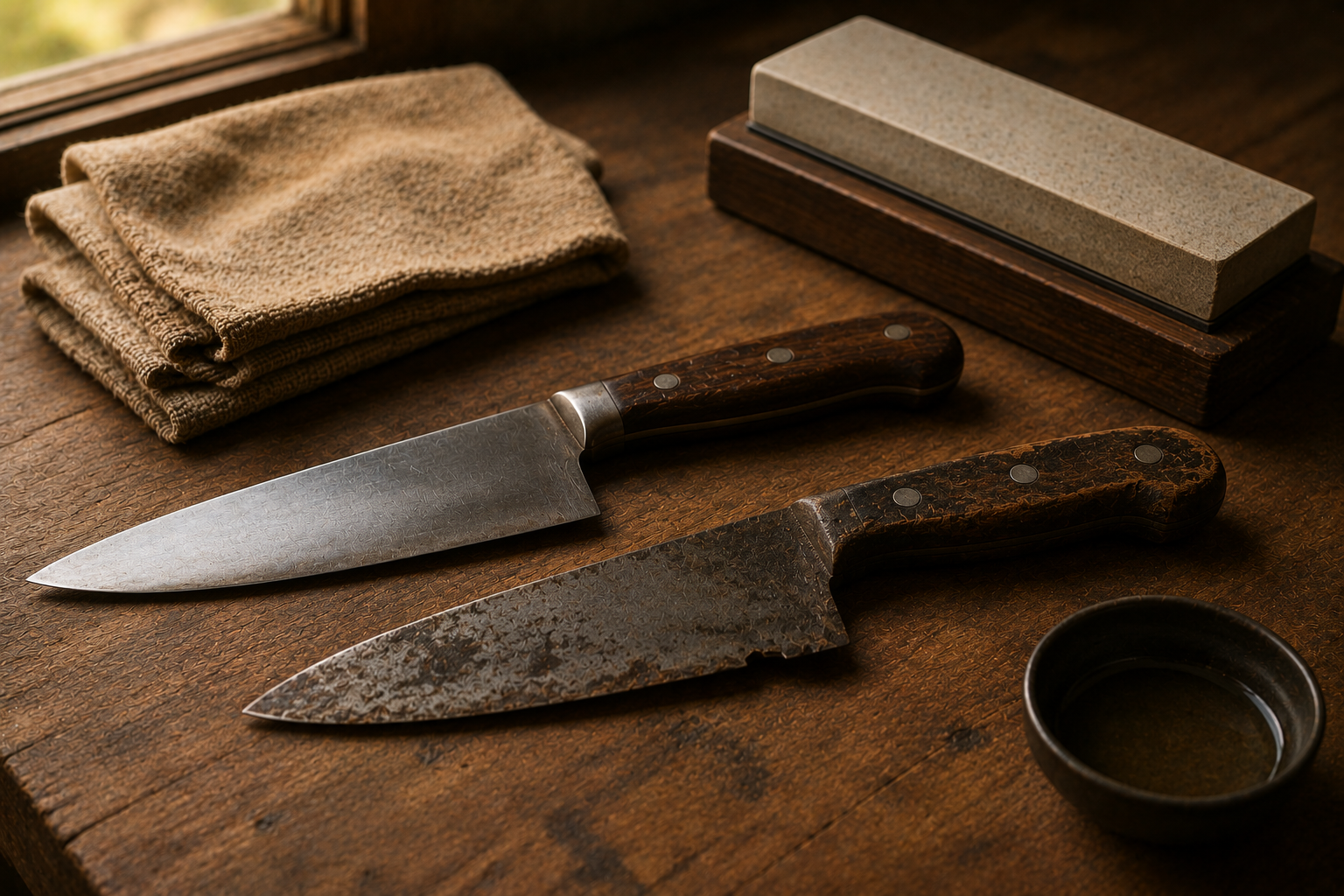
A Sharp Edge Does Not Make an Unsafe Knife Safe
Sharpening can restore a worn edge. It cannot restore structural integrity to a cracked blade, unstable handle, or severely corroded tang.
Sharpen, Evaluate, or Retire
| Condition | Likely Direction |
|---|---|
| Routine dullness | Sharpen |
| Small chips or rolled edge | Evaluate for corrective sharpening |
| Minor broken tip | Evaluate for limited reshaping |
| Light surface rust | Evaluate condition and remaining steel |
| Large chip or major profile loss | Compare the likely result with replacement |
| Loose handle, crack, severe bend, or deep corrosion | Remove from use; specialist service or replacement may be needed |
When Sharpening Makes Sense
Sharpening is usually worthwhile when the knife:
• Is structurally sound.
• Fits the user comfortably.
• Performs a useful kitchen task.
• Has enough blade height and sound steel remaining.
• Needs routine sharpening or limited edge correction.
Price alone does not decide the question. An affordable knife that works well may be worth maintaining.
When the Result May No Longer Be Practical
Correction may be possible but still leave an unsatisfactory knife when:
• Too much blade height would be lost.
• The tip would require major reshaping.
• The edge has moved into very thick steel.
• The profile would no longer contact the board properly.
• The cost or permanent change would exceed the knife’s practical value.
Gibson County Knife Sharpening discusses noticeable changes before proceeding.
When Retirement Is the Safer Choice
A knife should not return to normal use when it has an unresolved structural or sanitation concern.
Examples include:
• A blade crack.
• An unstable handle.
• Severe bending or twisting.
• Deep pitting near the edge or tang.
• Widespread flaking corrosion.
• Too little useful blade remaining.
The manufacturer or another qualified specialist may be appropriate when the problem is outside sharpening.
Sentimental Knives
A family or sentimental knife may be worth preserving even when it should no longer be used for food preparation.
Sharpening, polishing, or reshaping can permanently alter markings, patina, profile, and historical appearance. Preservation and active kitchen use are not always the same goal.
How GCKS Approaches the Decision
Gibson County Knife Sharpening evaluates each accepted straight-edged kitchen knife and serrated bread knife individually.
The decision considers:
• Safety.
• Edge and tip condition.
• Remaining geometry.
• Intended use.
• Likely result.
• Whether the requested work is within current services.
GCKS does not currently provide thinning, handle replacement, crack repair, major blade straightening, or ceramic-knife sharpening.
Key Takeaways
Dullness Is Usually Fixable
A sound knife can often be sharpened many times during its working life.
Useful Geometry Must Remain
Correction should leave a knife that still performs its intended task.
Safety Overrides Sentiment
A meaningful knife can be preserved without returning an unsafe blade to kitchen use.
References
The following sources were used in preparing and supporting this article.
Food Services: Kitchen Equipment
Occupational Safety and Health Administration
osha.gov
Sharpening Service
ZWILLING
zwilling.com