How Sharpening Can Reduce Food Waste
A sharp knife cannot prevent food waste by itself, but better control and cleaner cuts can help preserve more usable food during preparation.
Sharp knives support accurate trimming, consistent portions, cleaner preparation, and easier use of leftovers. Those benefits can help reduce avoidable food damage while working alongside meal planning, safe storage, and thoughtful cooking.
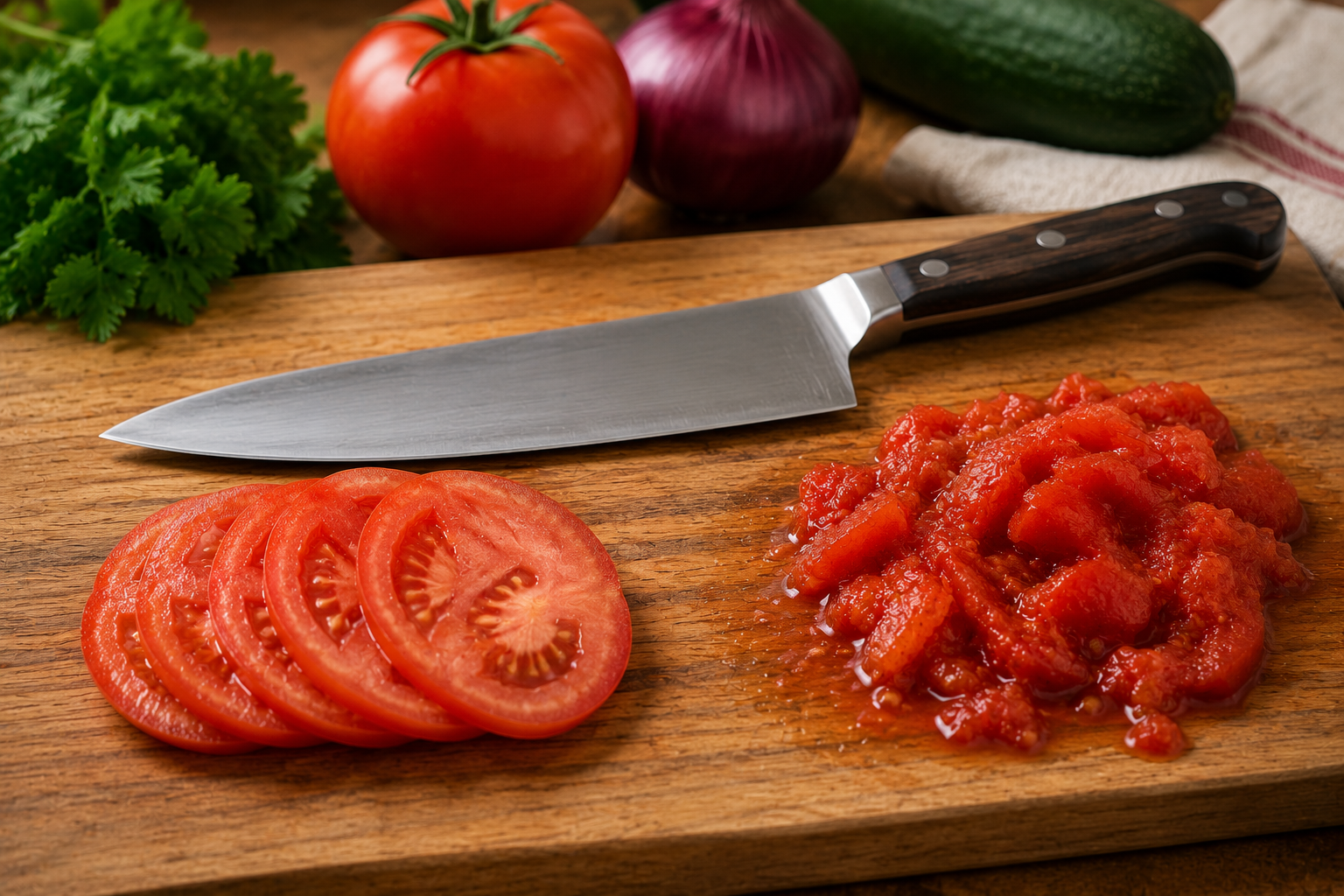
A Supporting Role
Sharpening does not eliminate food waste by itself. It supports more accurate preparation by giving the cook better control over where and how each cut is made.
Cleaner Cuts Can Preserve More Food
A dull knife may slip, crush, tear, or require repeated sawing motions. That makes it harder to remove only what needs to be removed.
A sharp knife can help preserve usable portions when:
• Trimming stems, roots, bruised areas, skin, fat, or connective tissue.
• Slicing soft produce without crushing it.
• Cutting herbs without excessive bruising or tearing.
• Portioning meat, fish, bread, cheese, fruit, or vegetables.
• Preparing small or irregular leftovers for another meal.
Where Cutting Performance Matters
| Ingredient or Task | Problem With Poor Cutting Performance | Benefit of Better Control |
|---|---|---|
| Tomatoes and soft fruit | Pressure can crush flesh and release juice. | A clean slice preserves shape and usable food. |
| Onions and vegetables | Slipping or rough cuts may remove unnecessary layers or sections. | Controlled trimming removes less edible material. |
| Fresh herbs | Leaves may bruise, tear, or darken. | Clean cuts preserve texture and appearance. |
| Meat and fish | Sawing can tear tissue and leave edible meat on unwanted portions. | A suitable sharp knife follows seams more accurately. |
| Bread and baked goods | Excess pressure may compress or tear portions. | A suitable serrated knife produces cleaner servings. |
| Leftovers | Small or irregular pieces may be difficult to prepare. | Accurate trimming and portioning can make reuse easier. |
Precision Reduces Over-Trimming
Many ingredients need only a small amount removed.
A sharp knife makes it easier to cut close to a bruised spot, peel thinly, remove a narrow stem end, follow a seam in meat, or trim around a damaged section.
The goal is not to save food that is spoiled or unsafe. It is to avoid discarding sound food simply because the cut could not be controlled.
Consistent Pieces Cook More Predictably
Uniform pieces tend to cook at a similar rate.
More consistent cutting can reduce:
• Burned edges with undercooked centers.
• Vegetables that cook unevenly.
• Meat portions with widely different thicknesses.
• Food rejected because the texture or appearance is inconsistent.
Better cutting does not guarantee that every dish will be used, but it can remove one avoidable source of poor results.
Sharp Knives Can Make Leftovers Easier to Use
Soups and Stews
Small amounts of vegetables or cooked meat can be trimmed and cut into usable pieces.
Sandwiches and Wraps
Leftover proteins and vegetables can be sliced thinly and divided among additional servings.
Skillets and Stir-Fries
Several small leftover ingredients can be prepared consistently and combined.
Smoothies and Baking
Usable portions of ripe fruit can be separated from damaged areas before further spoilage.
Portioning Can Support Better Planning
A sharp knife can help divide food into practical portions before cooking or serving.
That may make it easier to:
• Cook only the amount needed.
• Freeze uncooked portions separately.
• Keep part of a fruit or vegetable intact for later.
• Prepare consistent servings.
• Store leftovers in useful amounts.
EPA identifies preventing wasted food before it occurs as the most environmentally beneficial option. Buying, preparing, and serving only what is needed remain more important than any single kitchen tool.
Use the Correct Knife
Sharpness is only part of cutting performance.
A chef’s knife, paring knife, boning knife, and serrated bread knife are shaped for different work. Using the wrong knife may reduce control even when the edge is sharp.
The cutting board also matters. Stable, knife-friendly surfaces support controlled cuts, while glass, stone, ceramic, and metal can damage an edge quickly.
Sharpen When Performance Declines
A knife does not need to become completely dull before sharpening.
Watch for:
• Slipping on tomato, pepper, or onion skin.
• Crushing soft produce.
• Tearing herbs or protein.
• Uneven cutting from heel to tip.
• Repeated sawing motions.
• Noticeably more pressure during normal work.
OSHA recommends keeping knives sharpened and in good condition because dull knives tend to slip.
Food Safety Still Comes First
Reducing waste does not mean keeping food that may be unsafe.
FDA and USDA guidance emphasizes proper refrigeration, safe storage times, and prompt handling of leftovers.
• Refrigerate or freeze perishable leftovers promptly.
• Discard food that has been held unsafely.
• Remove spoiled or contaminated portions appropriately.
• Clean knives, boards, and food-contact surfaces between tasks.
• Keep raw meat, poultry, and seafood separate from ready-to-eat foods.
A precise knife can preserve sound food, but it cannot make spoiled food safe.
A Practical Low-Waste Preparation Routine
• Inspect ingredients before cutting.
• Identify what actually needs to be removed.
• Use the correct sharp knife.
• Make the smallest controlled cut necessary.
• Prepare pieces of similar size when even cooking matters.
• Portion only what is needed.
• Store usable ingredients and leftovers safely.
• Sharpen when cutting performance declines.
• Protect the edge with suitable boards, cleaning, and storage.
Key Takeaways
Better Control Preserves Food
Clean, accurate cuts can reduce crushing, tearing, and unnecessary trimming.
Sharpness Is One Part
Planning, portioning, storage, leftovers, food safety, technique, and the correct knife also matter.
Maintain Performance
Sharpen when cutting quality declines and protect the edge between services.
References
The following sources were used in preparing and supporting this article.
Prevent Wasted Food Through Source Reduction
U.S. Environmental Protection Agency
epa.gov
Tips to Reduce Food Waste
U.S. Food and Drug Administration
fda.gov
How to Cut Food Waste and Maintain Food Safety
U.S. Food and Drug Administration
fda.gov
Leftovers and Food Safety
USDA Food Safety and Inspection Service
fsis.usda.gov
Food Services: Kitchen Equipment
Occupational Safety and Health Administration
osha.gov