You Found an Older Kitchen Knife. What Now?
Inspect and document it before sharpening, polishing, sanding, or removing its original finish.
An inherited or secondhand kitchen knife may be a useful tool, a family keepsake, or a collectible object. Begin with documentation and a safety inspection before deciding whether it should be sharpened, preserved, or evaluated elsewhere.
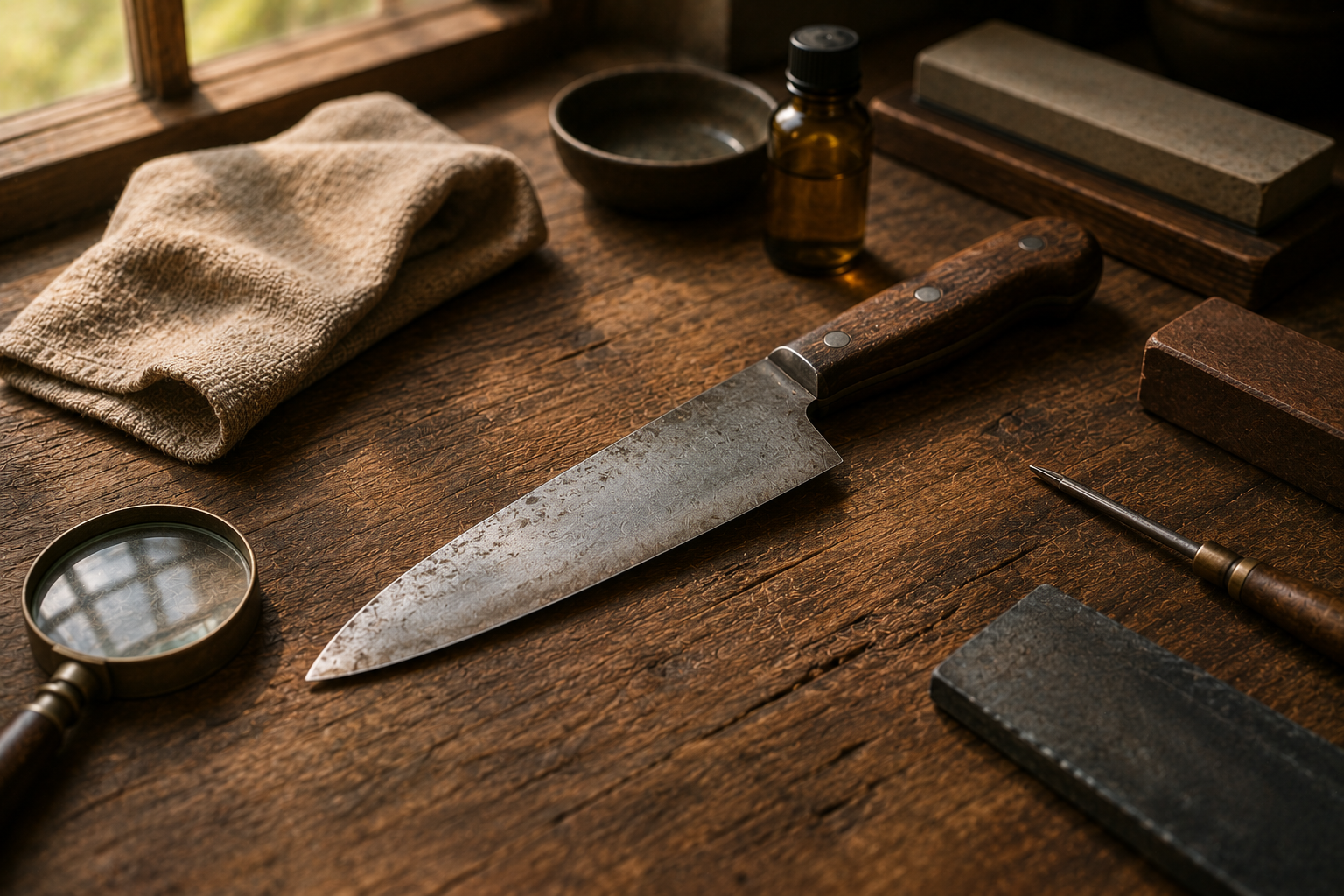
Do Not Remove History Too Quickly
Dirt and light rust may be removable. Original steel, markings, patina, and finish removed by sanding or polishing cannot be put back.
Document It First
Before cleaning or sharpening:
• Photograph both sides of the blade.
• Photograph maker marks, logos, numbers, and engravings.
• Record blade and overall length.
• Photograph the handle, rivets, bolster, spine, heel, and tip.
• Note where it came from and who owned it.
Canon macro photography can help preserve faint markings and condition details.
Inspect Safety Before Sharpness
Look for:
• Blade cracks.
• Deep pitting or flaking corrosion.
• Severe bends or twists.
• Loose handle scales, rivets, ferrules, or tang movement.
• Gaps that may trap moisture and food.
• Major profile loss from earlier sharpening.
Do not flex an old blade to test it. A structurally unsafe knife should not be sharpened back into kitchen use.
Patina, Rust, and Damage
| Condition | General Meaning |
|---|---|
| Smooth gray, blue, or dark coloring | Often stable patina |
| Light orange surface spots | Active rust that should be addressed carefully |
| Rough pits | Permanent steel loss requiring evaluation |
| Flaking corrosion | Advanced damage; do not return to food use without evaluation |
| Visible crack | Structural concern; remove from use |
Clean Gently
Begin with mild dish soap, warm water, a soft cloth, and a non-abrasive brush.
• Do not soak wooden or hidden-tang handles.
• Do not use a dishwasher.
• Dry the knife immediately.
• Avoid steel wool, aggressive sandpaper, powered polishing, or strong chemicals until the knife’s importance is understood.
• Stop if markings or the original finish begin to disappear.
Decide What the Knife Is Meant to Be
An older knife may be:
• A working kitchen knife.
• A family keepsake.
• A display piece.
• A collectible object.
• A knife requiring manufacturer or specialist attention.
The best treatment depends on that goal. A working knife may benefit from careful sharpening. A collectible or meaningful knife may be better preserved with minimal alteration.
What GCKS Can Evaluate
Gibson County Knife Sharpening can evaluate accepted straight-edged kitchen knives and serrated bread knives for:
• Routine dullness.
• Small chips and rolled edges.
• Limited tip reshaping.
• Rust near the cutting edge.
• Uneven prior sharpening.
• Whether the knife appears suitable for normal sharpening.
GCKS does not appraise collectible value and does not currently provide handle restoration, crack repair, major straightening, blade thinning, or complete cosmetic refinishing.
Preserve Before You Improve
When historical, collectible, or sentimental value is possible, document the knife and seek appropriate expertise before making irreversible changes.
Key Takeaways
Document First
Photographs and measurements preserve information before cleaning or sharpening changes the knife.
Safety Before Use
Cracks, unstable handles, severe corrosion, and major bends can make an old knife unsuitable for kitchen work.
Choose the Goal
Sharpening a working knife and preserving a keepsake are different decisions.
References
The following sources were used in preparing and supporting this article.
Museum Handbook Part I: Museum Collections
U.S. National Park Service
nps.gov
Food Services: Kitchen Equipment
Occupational Safety and Health Administration
osha.gov