How the Chef Knife Became the Kitchen Standard
The modern chef knife developed gradually from practical food-preparation tools, European cutlery traditions, professional kitchens, industrial production, and Japanese interpretation.
The chef knife was not invented in one moment. Its broad blade, pointed tip, useful length, and balanced design developed through European cutlery, restaurant work, industrial manufacturing, stainless steel, and the rise of the Japanese gyuto.
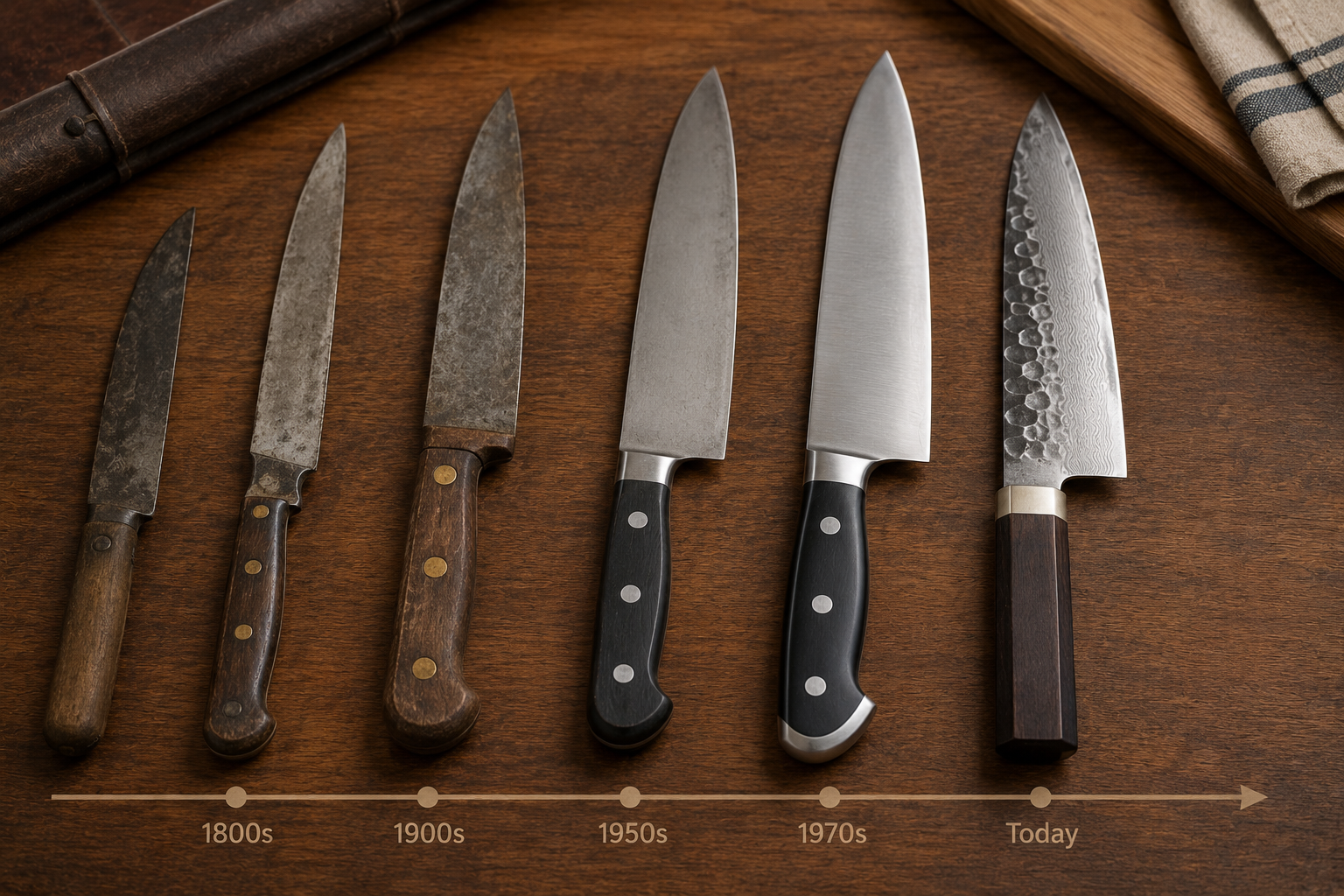
A Design Refined Over Time
The chef knife was not invented by one person or company. It developed as cooks, cutlers, manufacturers, and professional kitchens refined a versatile blade for everyday food preparation.
Before the Modern Chef Knife
Early cooks used locally made utility, butchery, carving, and chopping knives.
Blade shapes reflected regional foods, available steel, and the work expected of the tool. There was no single standardized “chef knife.”
Over time, useful features began to come together:
• Enough blade length for efficient slicing.
• A broad heel for knuckle clearance.
• A pointed tip for detailed work.
• A profile that could chop, slice, and mince.
• A handle suitable for repeated use.
European Cutlery Centers Encouraged Standardization
Cities such as Solingen, Thiers, and Sheffield became major cutlery centers.
Specialized forging, grinding, polishing, handle fitting, and larger-scale trade made knife production more consistent.
ZWILLING traces its Solingen history to 1731, while WÜSTHOF began there in 1814. Companies such as these helped turn regional knife-making traditions into recognizable commercial kitchen-knife patterns.
French and German Traditions
These are broad tendencies rather than rigid rules.
French-Style Profile
Flatter EdgePros
A relatively straight working edge supports push cutting, slicing, and consistent board contact.
Cons
May feel less natural to cooks who strongly prefer a rocking motion.
Best For
Controlled slicing, push cutting, and efficient board work.
German-Style Profile
More Curved BellyPros
A more pronounced curve supports rocking cuts and broad general-purpose use.
Cons
Traditional examples may be heavier and may include a full bolster that complicates long-term sharpening.
Best For
Rocking, chopping, and cooks who prefer substantial construction.
Why the Broad Blade Endured
The chef knife’s broad blade is central to its usefulness.
• It provides knuckle clearance.
• It supports a guiding-hand technique.
• It gives the blade strength near the heel.
• It provides enough surface to move prepared ingredients.
• It allows the same knife to perform slicing, chopping, mincing, and limited detail work.
The combination of a broad heel, long edge, and pointed tip made the knife unusually versatile.
Professional Kitchens Reinforced the Design
Restaurants, hotels, institutions, and culinary schools needed dependable tools that could handle repeated preparation.
A chef knife reduced the need to change tools constantly during routine work with vegetables, herbs, fruit, and boneless proteins.
Professional use encouraged attention to:
• Efficient cutting length.
• Balance and handle comfort.
• Edge durability.
• Ease of sharpening.
• Consistent manufacturing.
• Sanitary, maintainable construction.
Industrial Production Changed Availability
Forged knives were long associated with substantial construction and traditional cutlery.
Industrial production later made stamped and precision-cut blades widely available. These methods reduced cost and improved consistency.
Forged does not automatically mean better, and stamped does not automatically mean inferior.
Cutting performance depends more directly on:
• Steel quality.
• Heat treatment.
• Blade geometry.
• Edge geometry.
• Grinding and finishing.
• Overall construction.
Stainless Steel Simplified Daily Care
Earlier kitchen knives commonly used carbon steel. It can take a fine edge but may discolor or rust when neglected.
The wider adoption of stainless steel reduced corrosion concerns and made chef knives more practical for busy professional and home kitchens.
Modern chef knives now use carbon steel, conventional stainless steel, high-alloy stainless steel, and powder-metallurgy steels.
The steel name alone does not determine quality. Heat treatment and geometry remain essential.
Japan Reinterpreted the Western Chef Knife
As Western-style cooking expanded in Japan, makers produced Western-style kitchen knives for meat, fish, vegetables, and general preparation.
The gyuto became Japan’s best-known interpretation of the chef knife.
Korin describes the gyuto as a versatile double-bevel knife suitable for Western-style preparation.
Many gyuto are relatively thin, light, and hard compared with traditional heavy European knives, although modern designs now overlap considerably.
The Modern Global Chef Knife
| Design Tendency | Common Characteristic | Typical Appeal |
|---|---|---|
| Traditional German | Curved profile, substantial handle, durable geometry | Familiar rocking motion and robust general use |
| French profile | Flatter edge with a gradual rise toward the tip | Push cutting and controlled board contact |
| Japanese gyuto | Often thinner, lighter, and harder | Efficient slicing and precise cutting |
| Commercial kitchen knife | Practical stainless steel and synthetic handle | Affordability, sanitation, and frequent use |
| Modern hybrid | Mixed profiles, steels, handles, and construction | Performance tailored to individual preference |
Handles and Bolsters Also Evolved
Traditional Western chef knives often use full-tang construction with riveted handle scales.
Japanese wa handles are usually lighter and fitted over a hidden tang.
Modern knives use both traditions and many hybrids.
Bolsters also vary:
• Full bolsters can add weight but may interfere with sharpening near the heel.
• Half bolsters preserve a traditional transition while allowing better heel access.
• Bolsterless designs simplify full-edge sharpening.
Comfort, control, condition, and maintenance matter more than any one handle style.
Why the Eight-Inch Knife Became Common
Chef knives are produced in many lengths, but approximately eight inches became a common household size because it balances control, cutting length, storage, and board space.
Smaller knives may feel easier to control. Longer knives can improve efficiency with large ingredients or frequent preparation.
There is no historically correct size for every cook. The useful size depends on the user, workspace, cutting style, and foods prepared.
A Brief Timeline
| Period | Development |
|---|---|
| Early food preparation | Regional utility, butchery, carving, and chopping knives served local needs |
| European cutlery growth | Specialized centers produced more consistent commercial knife patterns |
| Professional kitchen expansion | The versatile cook’s knife became central to repeated preparation |
| Industrial manufacturing | Forged, stamped, and precision-cut knives became widely available |
| Stainless-steel adoption | Improved corrosion resistance simplified daily care |
| Japanese Western-style knives | The gyuto reinterpreted the chef knife with Japanese steels and geometry |
| Modern era | Global styles increasingly overlap and combine |
What Has Remained Consistent
Despite changing steels, handles, factories, and regional styles, the chef knife still aims to perform a large share of routine kitchen work.
Its enduring features are practical:
• A broad blade.
• A useful pointed tip.
• Enough length for efficient slicing.
• Knuckle clearance.
• A controllable handle.
• An edge that can be maintained.
The chef knife survived because the basic design remained useful.
Key Takeaways
It Evolved Gradually
The chef knife grew from practical working knives rather than one invention or single national tradition.
Professional Work Shaped It
Versatility, efficiency, comfort, sharpening, and maintainability made the design useful in professional kitchens.
Modern Designs Are Global
French, German, Japanese, commercial, and hybrid knives now share and exchange features.
References
The following sources were used in preparing and supporting this article.
Company History
ZWILLING
zwilling.com
Our History
WÜSTHOF
wusthof.com
Why Are Japanese Knives Best? A Chef’s Guide
Korin
korin.com
Gourmet 6-Inch Cook’s Knife
WÜSTHOF
wusthof.com