Convex Edges: Strength Without Excess Bulk
A convex edge curves smoothly toward the apex, combining efficient cutting with strong support behind the edge.
A convex edge uses a gradual curve rather than a clearly defined flat bevel. When matched to the knife and its intended use, this geometry can provide strong edge support, smooth cutting, and good durability.
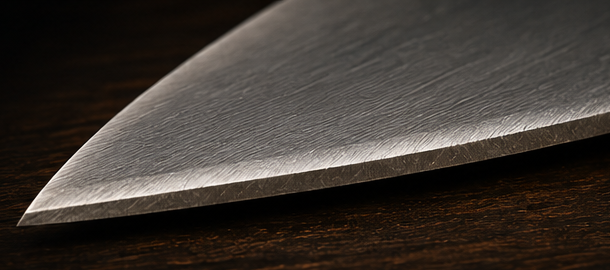
What Is a Convex Edge?
A convex edge curves gradually toward the apex instead of using a flat bevel with a clearly defined shoulder. The transition is smooth, so more steel remains behind the cutting edge without creating an abrupt change in geometry.
This shape can provide a useful balance of cutting ability and durability. The edge can still be thin at the apex while receiving stronger support from the curved bevel behind it.
Convex edges are common on outdoor, hunting, and heavy-use knives, but they can also work well on kitchen knives when the geometry suits the blade and its intended use.
Convex Edge vs. Flat Bevel
Both edge styles can perform well. The difference is how the steel supports the apex and how the knife moves through material.
Convex Edge
Curved SupportPros
Leaves more steel behind the apex while maintaining a smooth transition through the bevel.
Cons
More difficult to reproduce consistently without the right technique or equipment.
Best For
Outdoor knives, heavy-use blades, and selected kitchen knives.
Flat Bevel
Defined GeometryPros
Easier to measure, sharpen, and reproduce with stones or guided systems.
Cons
The shoulder can create more resistance if the bevel becomes too thick.
Best For
General kitchen knives and routine sharpening.
Where Convex Edges Work Best
Convex geometry is most useful when the edge needs both cutting efficiency and added support.
Outdoor and Hunting Knives
The curved bevel supports the apex during demanding cutting, carving, and field use.
Heavy-Use Kitchen Knives
Convex geometry can add durability to knives used for dense foods, repeated prep, or tougher cutting tasks.
Thin Kitchen Knives
A subtle convex finish can smooth the transition behind the edge without making the blade feel bulky.
How Convex Edges Are Sharpened
A convex edge is created by blending the bevel into a smooth curve rather than holding one fixed angle from shoulder to apex. This can be done with a slack belt, a flexible abrasive surface, or controlled freehand strokes that gradually change the blade angle.
The apex still needs to be formed cleanly and evenly along the full edge. Too much pressure or excessive flexibility can round the apex instead of sharpening it.
The goal is a gentle, controlled curve—not a thick, rounded edge.
Maintaining a Convex Edge
Convex edges usually respond well to light, frequent maintenance. A strop, fine abrasive belt, or flexible sharpening surface can refresh the apex without rebuilding the entire bevel.
Use minimal pressure and avoid concentrating too many passes at the very edge. Excessive pressure can round the apex and make the knife feel dull even when the bevel looks polished.
When the edge becomes damaged or noticeably thick, a more complete sharpening may be needed to restore the curve and remove fatigued steel.
Key Takeaways
convex edge curves gradually toward the apex instead of forming a flat, sharply defined bevel.
Its main advantage is strong support behind the cutting edge without an abrupt shoulder.
Convex geometry can work well on outdoor knives, heavy-use blades, and selected kitchen knives.
Sharpening and maintenance require light pressure so the apex is refined rather than rounded.
A convex edge is useful when it suits the knife and its intended use; it is not automatically better than a flat bevel.
References
The following sources were used in preparing and supporting this article.
PT50 Series Edge Sharpness Testers and the BESS
Edge On Up
edgeonup.com
KS-123 Knife Angle Setter
Tormek
tormek.com
Knife Sharpening Basics
Korin
korin.com
How to Sharpen Any Knife: Back to Basics
Work Sharp
worksharptools.com