How the Pocket Knife Evolved
A simple folding blade became a compact everyday tool through better steel, stronger locks, multi-tool designs, pocket clips, and precision manufacturing.
Pocket knives have changed from simple friction folders into slip-joint knives, multi-tools, locking folders, and modern everyday-carry tools. Their enduring advantage is compact, portable cutting utility.
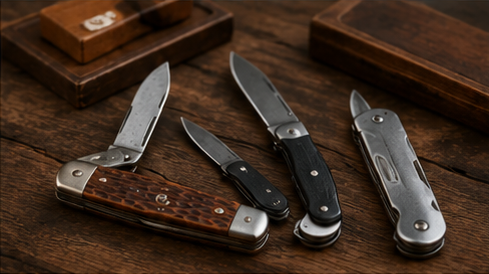
The Basic Idea Has Endured
A pocket knife places a usable cutting edge inside a compact handle. Materials and mechanisms have changed, but portability remains its defining advantage.
Early Folding Knives
Early folding knives used a blade rotating around a simple pivot. Many relied on friction and the user’s grip rather than a spring or lock.
They were compact tools for ordinary cutting tasks, but the blade could close when pressure was applied to its spine.
Slip Joints Improved Blade Retention
The slip joint added a backspring that presses against the blade tang and helps hold the blade open or closed.
It is not a true lock. A slip-joint blade can still close when enough force is applied.
Traditional multi-blade patterns used this system to place several useful blade shapes in one handle.
Industrial Production Expanded Access
Improved steelmaking, powered grinding, standardized components, and larger cutlery factories made pocket knives more consistent and affordable.
Regional working patterns were produced for farmers, tradespeople, hunters, travelers, soldiers, and households.
The knife became both a practical tool and a recognizable personal item.
Multi-Tool Knives Broadened the Purpose
Victorinox records that Karl Elsener supplied soldier’s knives to the Swiss Army in 1891 and patented the Officer’s and Sports Knife in 1897.
Combining blades with openers, screwdrivers, awls, saws, scissors, and other tools turned the folding knife into a compact toolkit.
Locking Folders Changed Expectations
Locking mechanisms improved resistance to accidental closure during appropriate cutting.
Buck introduced the Model 110 Folding Hunter in 1964. Its success helped establish the lockback as a major American folding-knife design.
No lock is indestructible. Reliable operation still depends on correct engagement, clean components, sound construction, and use within the knife’s limits.
Modern Carry and Opening
Late twentieth-century folders increasingly used one-hand opening and pocket clips.
Spyderco introduced its first production folding knife with a pocket clip and round opening hole in 1981. Those features helped define the modern folding knife by making it easier to carry near the top of a pocket and open manually with one hand.
Modern knives may also use thumb studs, flippers, reversible clips, washers, bushings, or bearings.
Traditional and Modern Pocket Knives
| Feature | Traditional Folder | Modern Folder |
|---|---|---|
| Opening | Usually two-handed with a nail nick | Often one-handed with a hole, stud, or flipper |
| Blade retention | Friction or slip joint | Frequently uses a mechanical lock |
| Carry | Loose in a pocket or pouch | Often uses a pocket clip |
| Blade count | Often two or more blades | Frequently one specialized blade |
| Construction | Pinned assembly | Often screw construction with adjustable pivots |
| Materials | Carbon steel and natural handles | Wide range of stainless steels, tool steels, metals, and composites |
Maintenance Still Matters
• Keep the blade clean and dry.
• Remove lint and grit from the pivot and lock.
• Use only a small amount of suitable lubricant when needed.
• Check for blade play, loose screws, poor centering, or incomplete lock engagement.
• Sharpen according to the existing edge geometry.
• Do not use the knife as a pry bar, screwdriver, chisel, or impact tool.
• Verify current local rules before carrying a pocket knife.
Key Takeaways
Portability Drove the Design
The folding blade made a useful cutting tool easier to carry and store.
Mechanisms Added Capability
Springs, locks, multi-tools, one-hand opening, and pocket clips changed how pocket knives were used.
The Purpose Remains Simple
Despite modern materials and precision manufacturing, the pocket knife remains a compact everyday cutting tool.
References
The following sources were used in preparing and supporting this article.
Our History
Victorinox
victorinox.com
Choosing the Size of a Pocket Knife
Opinel
opinel.com
The History of Buck Knives
Buck Knives
buckknives.com
Why the Clip?
Spyderco
spyderco.com