Cutting Boards and Knife Edges
The surface beneath the blade affects sharpness, durability, safety, and maintenance.
Every cut ends with the knife contacting the board. Wood, rubber, and suitable plastic are generally kinder to an edge, while glass, stone, ceramic, and metal can accelerate dulling or cause damage.
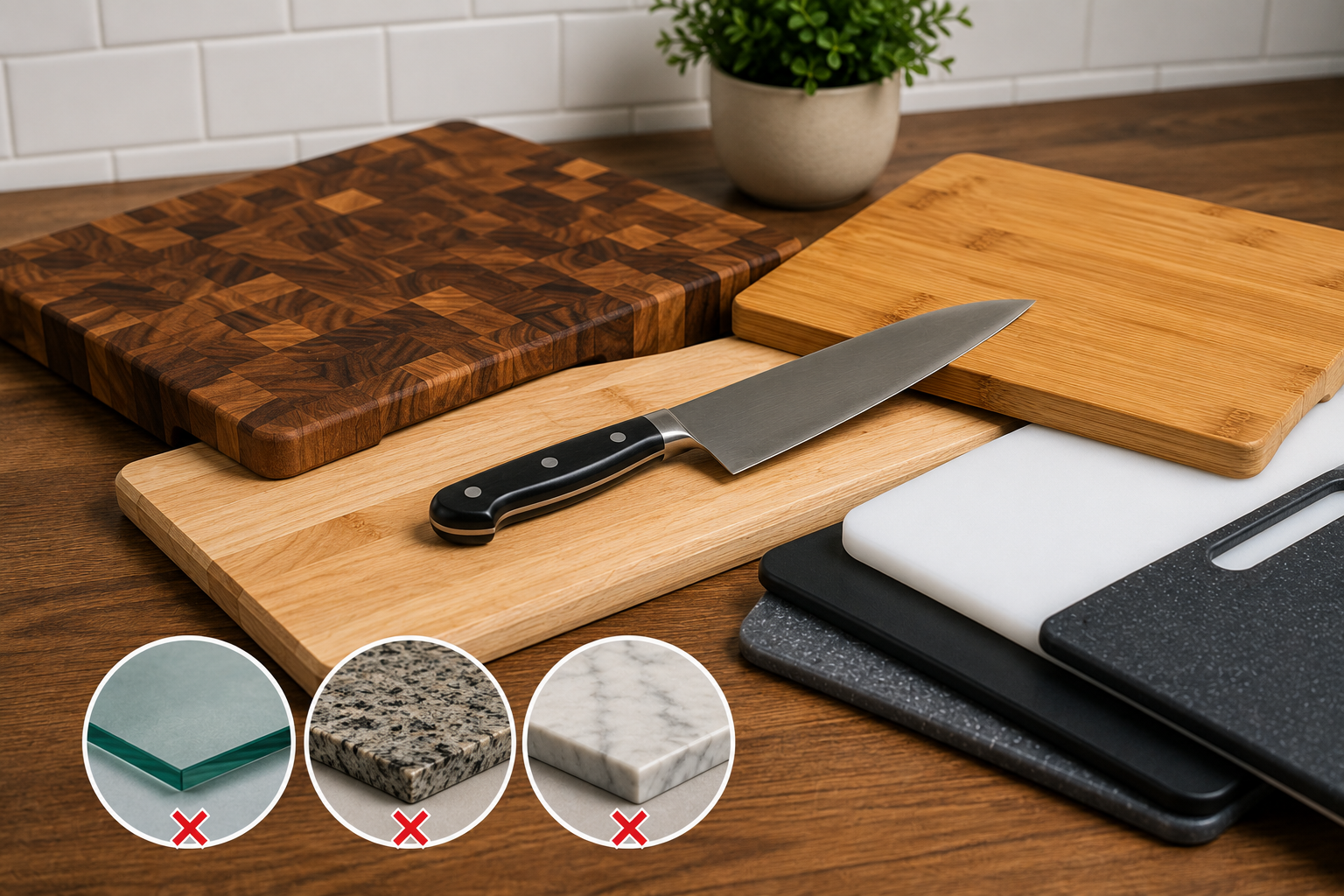
How a Cutting Board Affects the Edge
Every cut ends with the knife contacting the board. A forgiving surface allows the edge to enter slightly, while a very hard surface concentrates impact directly on the thin apex.
Repeated contact with glass, stone, ceramic, or metal can flatten, roll, or chip an edge. Wood, rubber, and suitable plastic generally reduce that impact and help a knife stay useful longer.
The board should also remain stable, cleanable, and appropriate for the food being prepared.
Cutting-Board Materials at a Glance
No material is perfect. The best choice balances edge protection, sanitation, durability, weight, noise, and maintenance.
Wood
Excellent ChoicePros
Gentle on knife edges, quiet, stable, and available in many sizes and constructions.
Cons
Requires hand washing, thorough drying, and occasional conditioning.
Best For
A primary everyday cutting board in most home kitchens.
Rubber
Excellent ChoicePros
Very gentle on edges, quiet, stable, and resistant to slipping.
Cons
Can be expensive, heavy, or less widely available than wood and plastic.
Best For
Maximum edge preservation and thin or hard kitchen knives.
Plastic
Good Secondary BoardPros
Affordable, lightweight, easy to sanitize, and often dishwasher safe.
Cons
Can warp, stain, retain odors, and develop grooves that become difficult to clean.
Best For
Raw proteins, food separation, and convenient sanitation.
Bamboo
Fair ChoicePros
Affordable, lightweight, renewable, and widely available.
Cons
Usually harder on edges than quality hardwood and may contain many glue joints.
Best For
An economical board when weight and storage matter more than maximum edge protection.
Composite
Fair ChoicePros
Thin, durable, stain resistant, and easy to clean.
Cons
Often harder and louder than wood or rubber and may slide without a nonslip mat.
Best For
Light-duty preparation and compact storage.
Glass, Stone, or Ceramic
AvoidPros
Nonporous, decorative, and easy to wipe clean.
Cons
Extremely hard, loud, slippery, and damaging to knife edges.
Best For
Serving or display—not routine knife work.
Metal
AvoidPros
Durable, nonporous, and resistant to stains and odors.
Cons
Very harsh on edges, noisy, and often slippery during cutting.
Best For
Not recommended as a primary cutting surface.
Practical recommendation: Use a quality wood or rubber board for most cutting. Keep a suitable plastic board as a convenient secondary surface for raw meat, poultry, or seafood.
End Grain vs. Edge Grain
| Feature | End Grain | Edge Grain |
|---|---|---|
| Edge protection | Excellent | Very good |
| Visible knife marks | Often less noticeable | Usually more visible |
| Weight | Often heavier | Usually lighter |
| Cost | Usually higher | Usually lower |
| Maintenance | Requires careful washing, drying, and conditioning | Requires similar care and is often easier to handle |
Cleaning, Stability, and Replacement
Wash the board after use according to the manufacturer’s instructions, then dry it thoroughly. Avoid soaking wood or bamboo, and do not place a board in the dishwasher unless it is specifically dishwasher safe.
A board should sit flat and remain stable during cutting. Use nonslip feet, a mat, or a damp towel underneath when needed.
Replace any board that is deeply grooved, cracked, warped, separating at glue joints, or no longer easy to clean.
Key Takeaways
A good cutting board protects the knife while supporting safe, sanitary food preparation.
Choose a Forgiving Surface
Wood, rubber, and suitable plastic are generally kinder to knife edges.
Avoid Very Hard Boards
Glass, stone, ceramic, and metal accelerate dulling and may chip or roll the edge.
Keep the Board Stable
A board that slides or rocks reduces control and increases the risk of injury.
Replace Worn Boards
Deep grooves, cracks, warping, and damaged glue joints can create sanitation and safety problems.
References
The following sources were used in preparing and supporting this article.
Cutting Boards
USDA Food Safety and Inspection Service
fsis.usda.gov
Best Cutting Board? Wood, Plastic, Bamboo…Titanium?!
Prudent Reviews Prudent Reviews
youtube.com
Safe Food Handling
U.S. Food and Drug Administration
fda.gov
Preserve Your Fingers: Vegetable Cutting Knife Safety
Utah State University Extension
extension.usu.edu