Knife Intake and Triage
Every knife is identified, counted, inspected, photographed when needed, and assigned the correct service before sharpening begins.
Knife intake creates a clear record of ownership, requested work, existing condition, and any repair decisions that require approval. Careful triage separates routine sharpening from damage repair, geometry correction, specialty work, and safety concerns.
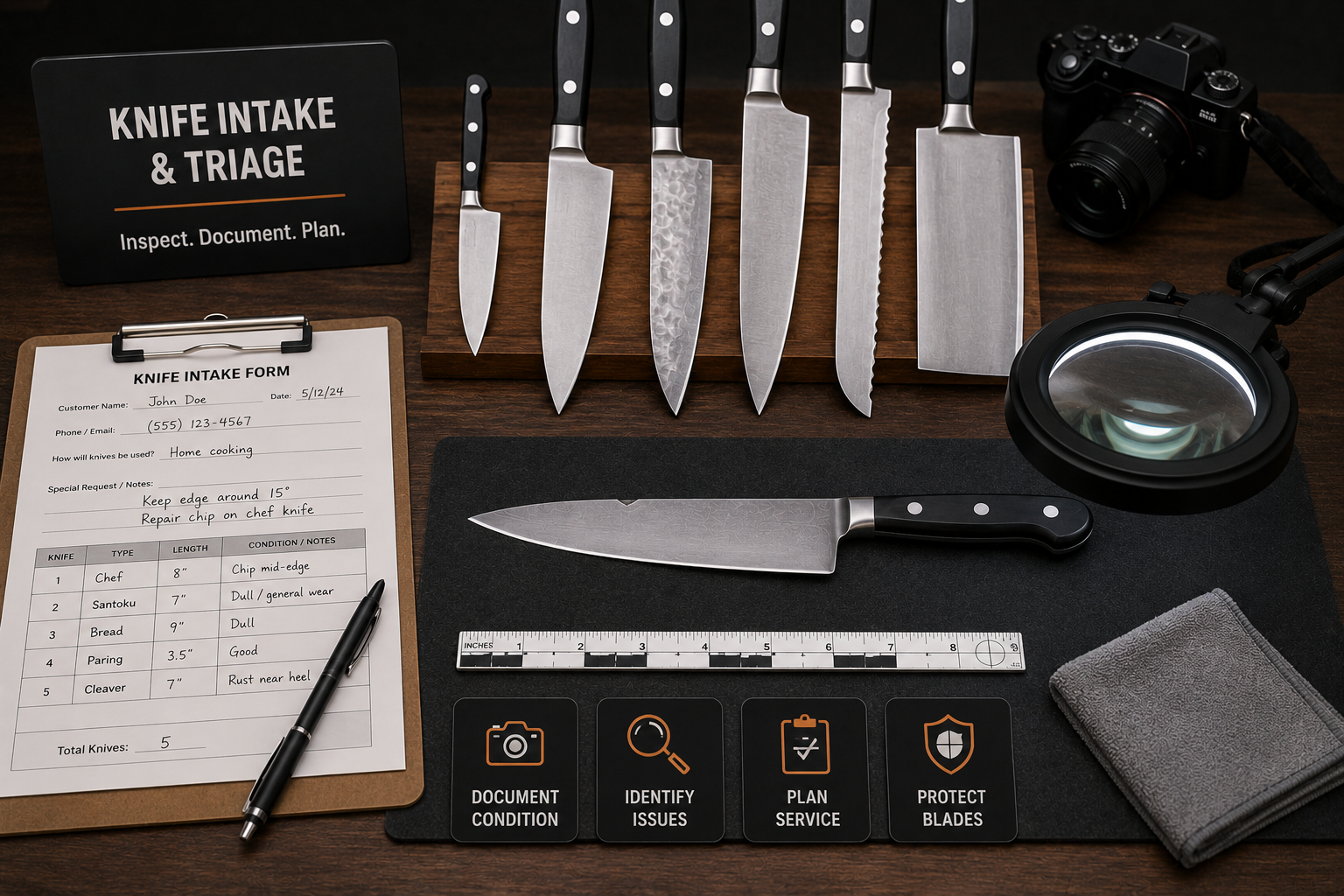
The Purpose of Intake
Intake keeps every knife connected to the correct customer, documents its starting condition, records the requested work, and determines whether routine sharpening can proceed or additional evaluation is needed.
Why Intake Matters
Professional sharpening begins before a knife touches a stone, wheel, belt, or strop. The intake record establishes ownership, condition, expectations, and the number of knives received.
This is especially important when several customers leave similar knives or when one order includes multiple chef’s knives, paring knives, utility knives, and specialty blades.
The intake count, service count, and pickup count should always match.
What Is Recorded
Customer Information
Name, phone number, email address, and preferred contact method allow questions and approvals to be handled without delay.
Knife Identification
Knife type, brand, model, blade length, identifying marks, and order position keep similar knives separated.
Requested Service
Routine sharpening, chip evaluation, tip repair, geometry concerns, corrosion, and special edge requests are recorded.
Intended Use
Home, restaurant, delicate slicing, heavy prep, and other uses help determine an appropriate edge.
Questions That Help During Intake
Useful questions include:
• What is the knife used for most often?
• Is it used at home or in a commercial kitchen?
• Has it been sharpened previously?
• Does it slip, crush, wedge, steer, or tear food?
• Has it chipped, rolled, or been dropped?
• Has it contacted bone, frozen food, hard pits, glass, or stone?
• What cutting board and maintenance tools are normally used?
• Is the knife custom, collectible, sentimental, or difficult to replace?
• Are visible profile or finish changes acceptable if repair is required?
The Initial Inspection
Each knife is examined under strong direct light before entering the service queue.
Cutting Edge
Checked from heel to tip for dullness, chips, rolls, flat spots, corrosion, and uneven wear.
Tip and Profile
Checked for bending, rounding, missing steel, recurves, waves, and incomplete board contact.
Blade Face and Spine
Checked for rust, pitting, scratches, coatings, bends, twists, cracks, and previous sharpening damage.
Heel and Bolster
Checked for recurve, board-contact problems, sharpening access, and bolster interference.
Handle
Checked for looseness, cracks, gaps, movement, damaged ferrules, and raised rivets.
Geometry
Bevel width, asymmetry, steering, wedging, and thickness behind the edge are considered.
Photography and Close Inspection
Direct light often reveals dull or damaged areas as bright reflections along the edge.
When more detail is useful, close-up photographs may be made with a Canon camera and macro lens. Macro photographs can document small chips, rolls, corrosion, scratch patterns, unusual geometry, valuable finishes, and conditions that may change during repair.
Magnified images make tiny features appear dramatic, so they are interpreted together with the knife’s actual size, cutting performance, and visible condition. A digital microscope is not part of the current intake process.
How Knives Are Triaged
| Category | Typical Condition | Likely Next Step |
|---|---|---|
| Routine sharpening | Dull but mostly intact edge, usable tip, stable handle, and acceptable geometry. | Proceed with the normal sharpening process. |
| Minor repair | Small chips, light rolls, slight tip flattening, minor heel irregularity, or limited edge corrosion. | Correct during sharpening when no major visible change is expected. |
| Major repair | Large chip, broken tip, severe recurve, heavy corrosion, extensive steel loss, or major bevel correction. | Estimate added work and obtain approval when needed. |
| Geometry correction | Sharp apex but excessive thickness, wedging, steering, or very wide bevels. | Evaluate thinning or broader blade work. |
| Specialty service | Single bevel, serrated, flexible, recurved, convex, custom, or collectible knife. | Select tools and methods suited to the construction. |
| Safety hold | Crack, severe bend, unstable handle, deep corrosion, or another structural concern. | Stop normal processing until the knife is evaluated. |
When Customer Approval Is Needed
Approval may be needed when repair will substantially reduce blade height, change the tip or profile, require thinning or bolster reduction, alter the finish, increase the estimated cost, or involve a knife that may be unsafe or impractical to repair. Major permanent changes should be understood before steel is removed.
Keeping Orders Separated
After intake, each order remains labeled, grouped, protected, and stored in a designated area away from unrelated tools and other customers’ knives.
Edges and tips are covered so the knives cannot strike one another. The count is verified at intake, after service, and again before pickup.
Commercial batches may be grouped by location, station, employee, or knife type, but every knife is still inspected and triaged individually.
Custom, Collectible, and Sentimental Knives
Knives with sentimental, handmade, collectible, or high replacement value may require more detailed documentation.
The maker, model, identifying marks, finish, scratches, corrosion, chips, handle condition, and existing geometry may be photographed and recorded. The owner’s preference for preservation, repair, minimal intervention, and acceptable cosmetic change should be clarified before work begins.
Preparing Knives for Drop-Off
Clean and Dry
Remove food, grease, tape, and heavy residue, then dry the blade and handle completely.
Protect Every Blade
Use fitted guards, secure cardboard sleeves, or another firm cover over every edge and tip.
Use a Secure Container
Place protected knives in a stable box, case, or tote where they cannot shift.
Count Before Leaving
Know how many knives are being delivered and confirm the count during intake.
Identify Concerns
Point out chips, rust, tip damage, handle problems, unusual value, and previous sharpening issues.
Schedule the Appointment
Confirm the drop-off time and mention any deadline or turnaround requirement.
Unsafe Transportation
Do not bring knives loose in a bag or box, wrapped only in a towel, or carried together by their handles. Blades can shift, collide, puncture packaging, and injure anyone handling the container.
Common Intake Misunderstandings
“All Dull Knives Need the Same Service”
Steel, geometry, damage, intended use, and prior sharpening can change the process.
“Sharpening Includes Every Repair”
Major chips, broken tips, thinning, corrosion treatment, and refinishing may be separate work.
“A Quick Look Is Enough”
Small chips, rolls, cracks, and geometry problems can be subtle.
“The Original Shape Can Always Be Restored”
- Missing steel cannot be replaced
- the remaining blade must be reshaped.
“Every Knife Gets the Same Angle”
The edge should suit the knife, steel, intended work, and durability needs.
“Sharpening Removes Cosmetic Wear”
Edge work does not automatically restore scratches, coatings, etching, or the complete blade surface.
Workshop Intake Checklist
Confirm customer contact information. Count the knives with the customer. Identify each knife clearly. Record the requested service and intended use. Inspect the edge, tip, spine, blade face, heel, bolster, and handle. Document chips, corrosion, scratches, bends, and existing damage. Use macro photography when detailed documentation is useful. Assign the correct triage category. Clarify repair work and approval requirements. Protect, label, and separate the order. Verify the count again before pickup.
Key Takeaways
Every Knife Is Documented
Intake connects each knife to the correct owner, requested service, starting condition, and special instructions.
Triage Determines the Work
Inspection separates routine dullness from repair, geometry correction, specialty service, and safety concerns.
Communication Prevents Surprises
Changes to price, blade height, profile, finish, or safe use are discussed before permanent work begins.
References
The following sources were used in preparing and supporting this article.
Knife Sharpening
Tormek
tormek.com
Knife Sharpening Basics
Korin
korin.com
How to Sharpen a Knife: Back to Basics
Work Sharp
worksharptools.com