The Truth About “Rust-Proof” Steel: No Blade Is Invincible
Stainless steel resists corrosion. It does not eliminate it.
Knife makers often use terms like stainless, corrosion resistant, or rust-proof. Those labels can be helpful, but they are easy to misunderstand. Every knife can stain, pit, or rust under the wrong conditions.
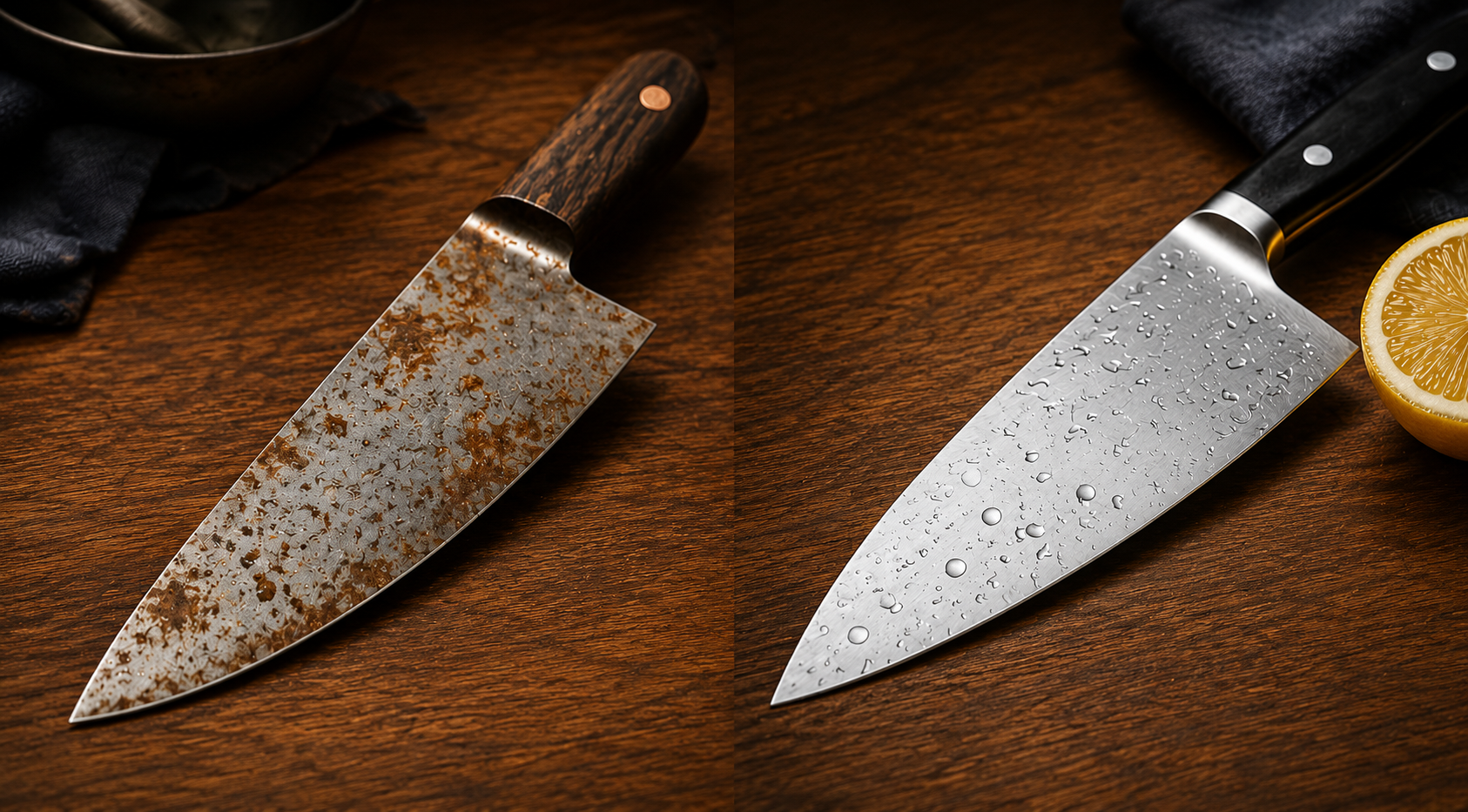
Is any knife steel truly rust-proof?
No ordinary kitchen knife steel is completely immune to corrosion. Some steels resist rust extremely well, but enough moisture, salt, acid, heat, or neglect can still damage the surface.
The phrase “rust-proof” is usually marketing shorthand for highly corrosion resistant. It should not be taken literally.
Simple version: Stainless means stain resistant, not stain impossible.
Why steel rusts
Rust forms when iron reacts with oxygen and moisture. Because knife steel contains iron, corrosion is always possible.
Salt, acids, food residue, humidity, and poor storage can speed up the reaction. Even fingerprints can leave behind moisture and salts that cause spotting over time.
What makes stainless steel resistant?
Stainless steel contains enough chromium to form a thin protective oxide layer on the surface. This layer helps slow corrosion and can repair itself when exposed to oxygen.
That protective layer is very thin. It can be weakened by salt, harsh chemicals, scratches, prolonged moisture, or contamination from other metals.
Carbon steel vs. stainless steel
| Feature | Carbon Steel | Stainless Steel |
|---|---|---|
| Corrosion resistance | Low to moderate | Moderate to excellent |
| Daily care | Requires prompt washing and drying | More forgiving, but still needs basic care |
| Patina | Common and often expected | Usually minimal or absent |
| Rust risk | High if neglected | Lower, but never zero |
| Typical maintenance | May benefit from oiling | Usually does not need regular oiling |
What causes stainless steel to rust?
Salt
Salt is highly corrosive and can attack even good stainless steel if left on the blade.
Acidic Foods
Citrus, tomatoes, vinegar, onions, and other acidic foods can stain or pit neglected steel.
Standing Moisture
Water trapped in a sheath, drawer, block, or handle seam can cause hidden corrosion.
Dishwashers
Heat, chemicals, moisture, and contact with other utensils create an aggressive environment.
Metal Contamination
Tiny particles from ordinary steel wool or carbon-steel tools can rust on a stainless blade.
High Humidity
Humid kitchens, garages, and storage areas increase the chance of surface corrosion.
Patina is not the same as rust
Carbon steel often develops a patina, which is a stable gray, blue, brown, or dark surface layer caused by normal chemical reactions with food and air.
A patina can help slow further corrosion. Rust is different. Active rust is usually orange, reddish-brown, flaky, rough, or powdery and should be removed.
| Surface Change | Typical Appearance | What It Means |
|---|---|---|
| Patina | Gray, blue, brown, or dark and usually smooth | Normal protective reaction on carbon steel |
| Light staining | Cloudy, dark, or spotted discoloration | Often cosmetic, but worth monitoring |
| Active rust | Orange, red, rough, flaky, or powdery | Corrosion that should be removed promptly |
| Pitting | Small dark holes or craters | Permanent metal loss caused by corrosion |
Why pitting matters
Pitting is more serious than surface staining. It creates small cavities in the steel and represents actual metal loss.
Pits near the edge can weaken the cutting surface, trap food residue, and complicate sharpening. Deep pitting may not be fully removable without removing a large amount of steel.
Can rust damage the cutting edge?
Yes. The edge is extremely thin, so even minor corrosion can degrade sharpness quickly.
Rust may create microscopic pits, weaken the apex, or leave rough spots that make the knife feel dull or inconsistent.
How to prevent rust
Wash Promptly
Do not leave food residue, especially salt or acids, on the blade.
Dry Thoroughly
Dry the blade, handle, bolster, and heel before storage.
Store Dry
Avoid damp blocks, leather sheaths, wet towels, and sealed humid containers.
Use Food-Safe Oil
Carbon steel or rarely used knives may benefit from a very thin coat of food-safe mineral oil.
Avoid the Dishwasher
Hand washing protects both the steel and the handle.
Inspect Regularly
Catching a small rust spot early is much easier than repairing deep pitting later.
Should stainless knives be oiled?
Most stainless kitchen knives do not need routine oiling if they are washed, dried, and stored properly.
Oiling can still help with long-term storage, high humidity, saltwater exposure, or knives with carbon-steel cores or exposed reactive layers.
Stainless-clad carbon steel
Some knives use a carbon-steel cutting core wrapped in stainless cladding. Most of the blade is corrosion resistant, but the exposed core near the edge can still rust.
These knives offer easier maintenance than fully reactive carbon steel, but they still require prompt drying.
Damascus knives can rust too
Damascus describes layered or patterned construction. It does not guarantee corrosion resistance.
Some Damascus knives use stainless layers. Others use reactive carbon steels. The core steel and cladding determine how much care is required.
Powdered steels and corrosion resistance
Some modern powdered steels offer excellent corrosion resistance, but they are still not invincible.
High chromium content, careful heat treatment, and clean manufacturing can improve resistance, but salt, acids, and prolonged moisture can still cause damage.
How to remove light surface rust
Very light rust can often be removed with a mild metal polish, rust eraser, fine abrasive pad, or a baking-soda paste.
Work gently and follow the blade finish. Aggressive scrubbing can scratch polished surfaces, erase markings, or alter the appearance of Damascus patterns.
Use caution: Never scrub toward the cutting edge, and protect your hands while working.
When professional restoration makes sense
Professional help may be appropriate when rust is widespread, pitting reaches the edge, the blade has valuable markings, or the finish could be damaged by home repair.
Restoration can improve appearance and function, but deep pits may remain visible because removing them completely would require excessive steel removal.
Can sharpening remove rust?
Sharpening removes corrosion directly at the cutting bevel, but it does not clean the entire blade.
Rust on the blade face, spine, heel, bolster, or tang requires separate restoration work. Deep edge pitting may also require reshaping before a stable edge can be created.
Common corrosion myths
Stainless Steel Never Rusts
Stainless steel resists corrosion but can still rust under harsh conditions.
Patina Means the Knife Is Damaged
A smooth patina is normal on carbon steel and may provide some protection.
Dishwashers Are Safe for Stainless
Dishwasher chemicals, heat, and trapped moisture can damage both blade and handle.
Damascus Cannot Corrode
Damascus corrosion resistance depends on the steels used in the layers and core.
Which steel is best for a humid environment?
In humid kitchens or storage areas, a corrosion-resistant stainless steel is usually the easiest choice.
Carbon steel can still work well, but it requires more attention, faster drying, and sometimes protective oil.
Which steel is best for low-maintenance use?
A well-made stainless knife is usually best for households where several people use the knives, cleanup is not always immediate, or the user wants minimal maintenance.
Even then, hand washing and drying remain the best habits.
What a sharpener notices
Corrosion can reveal how a knife has been stored and maintained. Rust at the heel, bolster, handle seam, or edge often indicates trapped moisture or incomplete drying.
Pitting can also affect how much steel must be removed to restore a stable edge. Early treatment usually preserves more of the blade.
Key Takeaways
Stainless Is Not Rust-Proof
Stainless steel resists corrosion better than carbon steel, but moisture, salt, acids, and neglect can still cause rust or staining.
Care Still Matters
Prompt washing, thorough drying, proper storage, and occasional oiling can greatly reduce corrosion risk.
Corrosion Resistance Is Only One Trait
A steel can resist rust well and still differ greatly in toughness, edge retention, hardness, and sharpening difficulty.
References
The following sources were used in preparing and supporting this article.
Knife Steels Rated by a Metallurgist
Knife Steel Nerds
knifesteelnerds.com
Testing the Edge Retention of 48 Knife Steels
Knife Steel Nerds
knifesteelnerds.com
What Is Edge Stability?
Knife Steel Nerds
knifesteelnerds.com