How Dull Knives Affect Restaurant Work
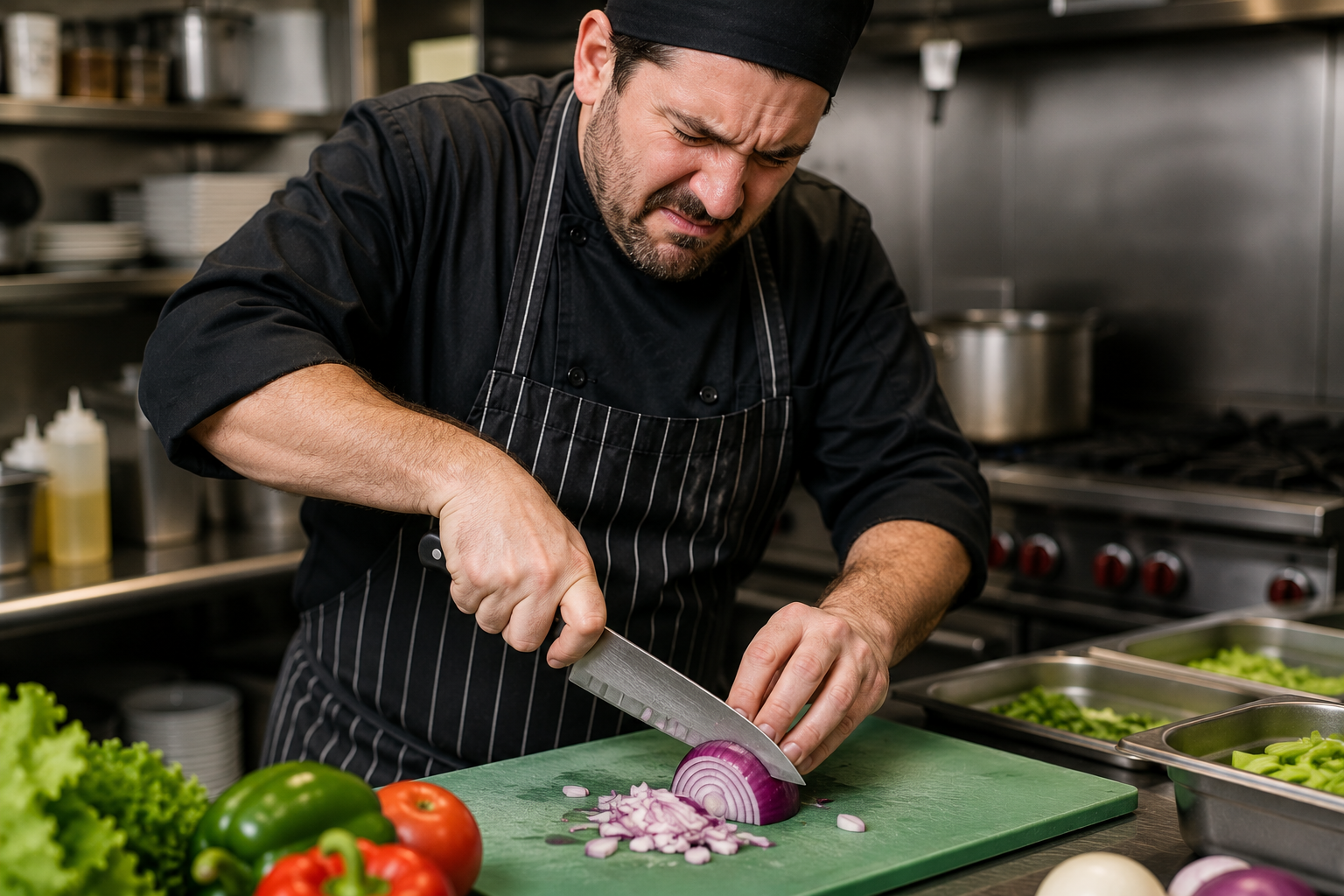
Dull knives may slow preparation, require more force, damage ingredients, increase fatigue, and turn routine sharpening into larger repair work.
The effects of dull knives are spread across preparation time, ingredient quality, employee effort, safety, repairs, and replacement. The exact financial impact varies by restaurant, but poor knife performance should not be treated as a sharpening issue alone.
The Practical Point
The exact financial effect of dull knives varies by restaurant. What can be observed is that poor cutting performance often means more force, more strokes, damaged ingredients, greater fatigue, and more difficult repair work.
The Costs Are Usually Indirect
Sharpening appears as a clear invoice. The effects of dull knives are spread across daily work and may be harder to recognize.
A few extra seconds or strokes during one task may seem minor. Repeated across many ingredients, employees, and shifts, the difference can become operationally meaningful.
Gibson County Knife Sharpening cannot calculate a restaurant’s labor, food, insurance, or injury costs. We can explain the knife-related conditions that may contribute to slower or less consistent work.
Where Poor Knife Performance May Appear
Longer Preparation
More strokes, greater pressure, and repeated cuts can slow ordinary prep work.
Ingredient Damage
Produce may crush or bruise, while proteins may tear instead of cutting cleanly.
Inconsistent Portions
Uneven slices and trimming can affect portion size, presentation, and cooking time.
Employee Fatigue
Greater grip pressure, force, and repetition can make cutting more tiring.
Safety Concerns
A dull edge may skid and encourage forceful or awkward cutting techniques.
Larger Repairs
Continued use may turn small rolls, chips, or flat spots into more involved work.
Preparation Can Become Slower
A properly sharpened knife generally enters food more easily and requires less force.
A dull knife may slide, wedge, crush, or require repeated sawing. This can slow preparation and make it harder to maintain a consistent rhythm.
The exact labor impact depends on the menu, workload, staffing, knife condition, and technique. It should be measured by the restaurant rather than estimated by the sharpener.
Food Quality May Be Affected
A worn edge can crush delicate produce, bruise herbs, tear meat or fish, and make accurate trimming more difficult.
Uneven pieces may also cook at different rates. This can affect texture, doneness, presentation, seasoning, and portion consistency.
Knife condition is only one factor in food quality, but it is a factor the kitchen can inspect and correct.
Greater Force Can Increase Fatigue
OSHA identifies repetitive cutting, forceful exertion, and awkward wrist position as ergonomic concerns in food preparation.
A dull knife may encourage harder gripping, greater downward force, extra strokes, and awkward attempts to complete the cut.
A sharp knife does not eliminate repetitive-work risks, but appropriate cutting performance can reduce the need to compensate for a poorly functioning edge.
Sharp Does Not Mean Harmless
A properly sharpened knife can cause a serious injury and must be handled carefully. The advantage is that it generally cuts more predictably and with less force than a dull knife.
Dull Knives May Be Harder to Control
OSHA advises keeping knives sharpened and in good condition because dull knives tend to slip.
When an edge will not begin the cut cleanly, a worker may push harder, change the angle, twist the blade, or saw aggressively.
If the blade then slips or breaks through unexpectedly, the extra force can carry it beyond the intended cutting path.
Routine Sharpening and Larger Repair Work
Waiting longer does not always mean the knife will need only the same service later.
Routine Sharpening
Normal WearPros
Restores a worn apex while removing only the steel needed for useful cutting performance.
Cons
Still requires inspection because every knife wears differently.
Best For
An intact knife with ordinary dullness and no major damage.
Repair or Correction
Damage or NeglectPros
May correct chips, broken tips, flat spots, profile problems, or excessive thickness.
Cons
Usually requires more work and more steel removal than normal sharpening.
Best For
Knives with actual damage, severe wear, or geometry problems.
Dull Does Not Automatically Mean Worn Out
A knife that no longer cuts well may still be structurally sound and suitable for restoration.
Sharpening may return many dull knives to useful service. Replacement becomes more appropriate when the blade is cracked, severely corroded, badly bent, excessively worn, or attached to an unsafe handle.
Gibson County Knife Sharpening evaluates each knife individually rather than assuming every dull restaurant knife should be sharpened or replaced.
Cutting Surfaces and Habits May Be the Underlying Problem
Frequent sharpening will not solve rapid dulling when knives repeatedly contact unsuitable surfaces or are used incorrectly.
• Glass, stone, ceramic, metal, and very hard composite surfaces can wear edges quickly.
• Scraping sideways with the edge can roll or weaken it.
• Cutting frozen food or bone with an unsuitable knife can cause chips or broken tips.
• Twisting and prying can damage the edge, blade, or handle.
• Loose drawer storage allows knives to strike other utensils.
• Dishwasher use can expose knives to heat, detergent, moisture, and impacts.
• Delayed damage reporting can turn a small problem into a larger one.
What a Restaurant Can Observe
A restaurant that wants to understand the operational effect of knife condition can track its own observations.
• Which knives require excessive pressure or repeated cuts?
• Which ingredients are frequently crushed, torn, or recut?
• Which knives develop repeated chips, rolls, or tip damage?
• How often are knives replaced because they appear unusable?
• Are dull or damaged knives removed promptly?
• Which boards and tasks are associated with rapid edge loss?
• How long does useful performance last after sharpening?
These observations are more reliable than applying a generic dollar estimate to every kitchen.
Contact Us About the Knives
Gibson County Knife Sharpening does not analyze restaurant finances or operations. We can inspect the knives, explain their condition, identify maintenance or repair needs, and discuss practical service options.
Key Takeaways
The Impact Varies
Each restaurant must measure its own labor, food, safety, and replacement costs.
Poor Performance Has Consequences
Dull knives may require more force, slow preparation, damage food, and increase fatigue.
GCKS Evaluates the Knife
We identify sharpening, repair, maintenance, and replacement concerns without telling a restaurant how to run its operation.
References
The following sources were used in preparing and supporting this article.
Food Services: Kitchen Equipment
Occupational Safety and Health Administration
osha.gov
Young Worker Safety in Restaurants: Food Preparation
Occupational Safety and Health Administration
osha.gov
Food Services: Work-Related Musculoskeletal Disorders
Occupational Safety and Health Administration
osha.gov
Ergonomics: Identify Problems
Occupational Safety and Health Administration
osha.gov