Sharpen Before You Replace
A dull or lightly damaged knife may still have years of useful life. Sharpening and appropriate edge correction can often restore practical cutting performance.
Dullness does not automatically mean a kitchen knife is worn out. When the blade and handle remain sound, sharpening or limited edge correction may keep a familiar, useful knife working and delay unnecessary replacement.
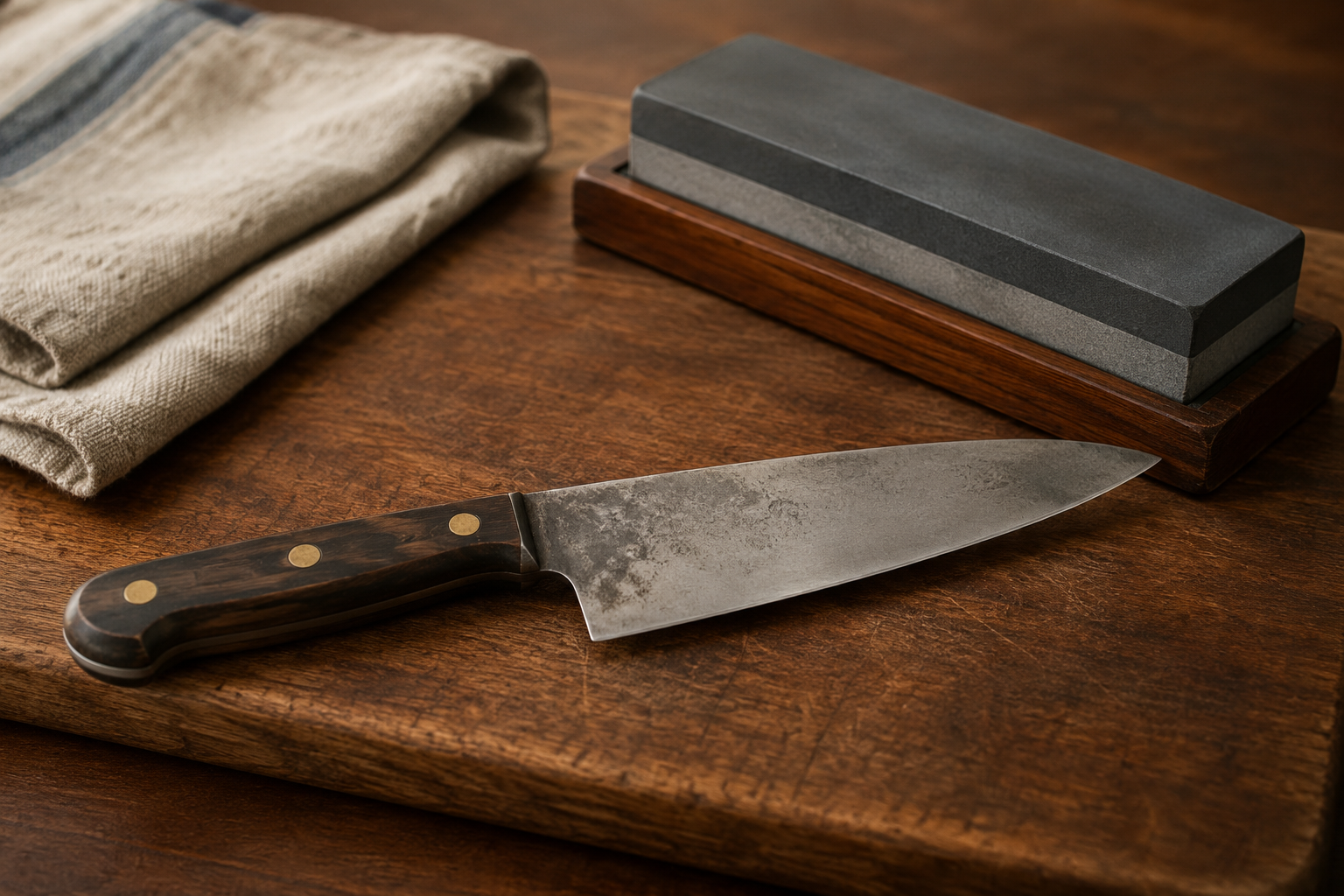
Dull Does Not Mean Worn Out
Ordinary dullness is a maintenance condition. When the blade and handle remain structurally sound, sharpening may restore useful performance without replacing the entire knife.
Most Dull Knives Still Have Useful Life
Kitchen knives gradually lose cutting performance as the apex wears, rounds, rolls, or develops small areas of damage.
That change normally affects only a tiny portion of the knife.
Sharpening removes a controlled amount of steel near the edge to create a new apex while preserving the blade, handle, and familiar shape of the tool.
Keeping an Existing Knife Preserves More Than Steel
Every knife represents raw materials, manufacturing, heat treatment, grinding, assembly, packaging, transportation, and labor.
EPA describes sustainable materials management as using and reusing materials more productively throughout their life cycles.
Continuing to use a safe, useful knife preserves the materials and work already invested in it and delays the need to manufacture and distribute a replacement.
What May Be Corrected
| Knife Condition | Possible Work | Likely Result |
|---|---|---|
| Dull but otherwise sound | Routine sharpening | A fresh, continuous cutting edge. |
| Small chips near the edge | Chip correction and sharpening | Damaged steel is removed and the edge is re-established. |
| Minor tip damage | Tip reshaping | A functional point may be created with a small profile change. |
| Rolled or flattened edge | Edge correction and sharpening | Deformed steel is removed and replaced by a stable apex. |
| Uneven bevels | Careful bevel correction | The edge may become more consistent while preserving useful geometry. |
| Light surface corrosion | Cleaning and evaluation | Superficial corrosion may be removed before the edge is sharpened. |
Correction May Change the Knife Slightly
Removing a chip, reshaping a tip, or correcting an uneven edge may modify the blade profile. The goal is a safe, useful result—not making the knife look exactly as it did when new.
Timely Sharpening Usually Requires Less Correction
A knife does not need to become extremely dull before sharpening.
Waiting until the edge is heavily worn or damaged may require more steel removal to establish a continuous apex.
Watch for:
• Slipping on tomato, pepper, or onion skin.
• Crushing herbs or soft produce.
• Tearing protein.
• Uneven cutting from heel to tip.
• Repeated sawing motions.
• Noticeably more pressure during ordinary use.
OSHA recommends keeping knives sharpened and in good condition because dull knives tend to slip.
Protect the Knife Between Sharpenings
Use a Suitable Board
Wood and quality plastic are generally easier on edges than glass, stone, ceramic, or metal.
Wash and Dry Promptly
Hand washing and immediate drying help limit corrosion and handle damage.
Store the Edge Safely
Use a suitable block, rack, guard, roll, or organizer rather than loose drawer storage.
Avoid Sideways Force
Do not pry, twist, scrape with the edge, or force ordinary kitchen knives through bones or frozen food.
A Modest Knife May Still Be Worth Sharpening
Purchase price alone does not determine whether sharpening makes sense.
A modest knife may have:
• A comfortable handle.
• A useful blade shape.
• Serviceable steel.
• Familiar balance.
• A regular role in the kitchen.
A structurally sound knife that is comfortable and frequently used may provide excellent value after sharpening.
When Replacement May Be Safer
| Condition | Why It Matters | Practical Direction |
|---|---|---|
| Crack extending into the blade | The blade may fail unexpectedly. | Retire the knife. |
| Loose, cracked, or separating handle | The user may lose control. | Do not use unless the handle can be made secure by an appropriate specialist. |
| Deep corrosion or pitting | Removing all affected steel may substantially alter or weaken the blade. | Have the knife evaluated. |
| Severely bent blade | Straightening may not be safe or successful. | Replacement may be more practical. |
| Very little blade height remains | Knuckle clearance and cutting geometry may no longer be useful. | Compare the remaining knife with a suitable replacement. |
| Correction would leave poor geometry | Removing the damage may produce a knife that no longer performs its intended task. | Replacement may provide the better result. |
Questions to Ask Before Replacing a Knife
• Is the blade structurally sound?
• Is the handle secure?
• Is the problem ordinary dullness, minor edge damage, or a serious structural issue?
• Can correction leave useful blade geometry?
• Is the knife comfortable and regularly used?
• Would sharpening restore the performance actually needed?
• Would a suitable replacement offer a meaningfully better or safer result?
The decision should be based on the expected result, not simply on whether the knife looks old.
Dispose of Unsafe Knives Carefully
An unsafe knife should not be donated or placed loose in household trash.
• Cover the full blade with thick cardboard or another puncture-resistant material.
• Tape the covering securely.
• Label the package as containing a sharp object.
• Check whether a local recycling or scrap-metal facility accepts kitchen knives.
• Follow local disposal requirements.
Protect anyone who may handle the knife after it leaves your possession.
Key Takeaways
Sharpen Before Replacing
Ordinary dullness usually affects only the cutting edge, not the entire knife.
Correction Has Limits
Small chips, tip damage, and uneven edges may be corrected, but serious structural problems require a different decision.
Preserve Useful Tools
Maintaining a safe, familiar knife keeps existing materials and manufacturing effort in service longer.
References
The following sources were used in preparing and supporting this article.
Sustainable Materials Management Basics
U.S. Environmental Protection Agency
epa.gov
Sustainable Materials Management: Non-Hazardous Materials and Waste Management Hierarchy
U.S. Environmental Protection Agency
epa.gov
How to Sharpen Your Knives
ZWILLING
zwilling.com
How to Clean and Care for Your Knife
ZWILLING
zwilling.com
Food Services: Kitchen Equipment
Occupational Safety and Health Administration
osha.gov