Can Freezing a Knife Make It Sharper?
A household freezer cannot restore a worn edge. Cold treatment has a legitimate role during carefully controlled steel heat treatment, but it is not a sharpening or maintenance method for a finished knife.
Freezing a finished kitchen knife does not rebuild its apex, remove damaged steel, or restore cutting performance. Subzero and cryogenic treatments are manufacturing-stage processes used immediately after quenching for selected steels.
The Practical Answer
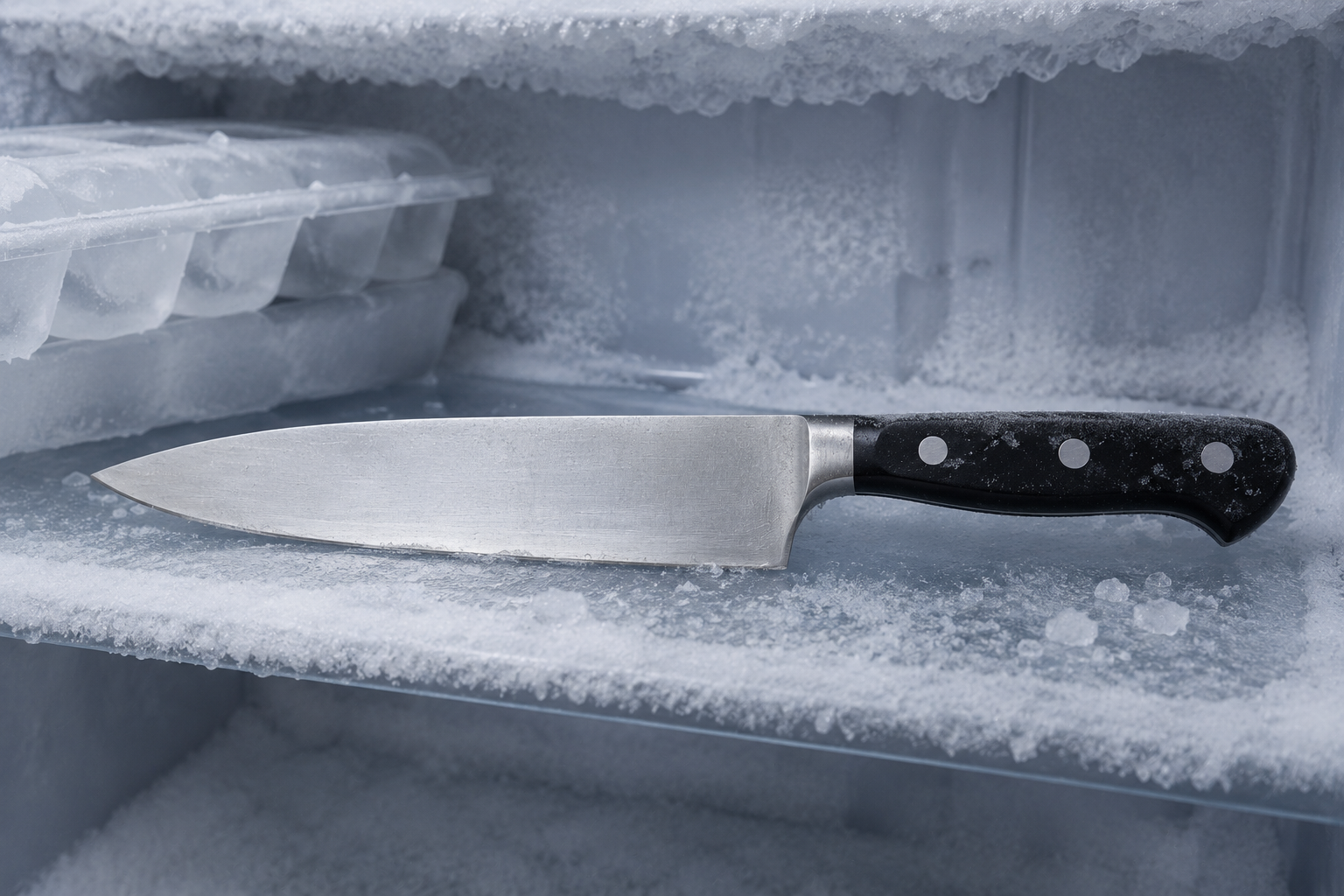
Putting a finished kitchen knife in a household freezer will not sharpen it, rebuild its edge, or restore normal cutting performance.
Why the Myth Sounds Believable
Steel properties are influenced by carefully controlled heating and cooling. During manufacturing, some knife steels may be austenitized, quenched, cold treated, and tempered according to a specific heat-treatment recipe.
That real metallurgical process is the source of the myth. The missing detail is timing: cold treatment is performed as part of hardening, usually soon after the hot steel is quenched.
Placing a completed knife in a freezer months or years later does not repeat the original heat treatment.
Household Freezing and Heat-Treatment Cold Processing
| Process | When It Occurs | Purpose |
|---|---|---|
| Finished knife placed in a freezer | After manufacturing and normal use | No useful sharpening effect; the worn edge remains physically unchanged. |
| Subzero treatment | During heat treatment, soon after quenching | May transform some retained austenite in a suitable steel. |
| Cryogenic treatment | During a planned heat-treatment sequence | Uses much lower temperatures to continue transformation and influence final properties. |
Cold Cannot Repair a Worn Edge
A knife becomes dull because the cutting apex changes shape. It may round over, roll, chip, deform, or wear away.
Cooling the knife does not remove weakened steel or bring the bevels back together.
A rounded or worn edge must be sharpened until the bevels meet at a new apex. A rolled edge may sometimes respond to suitable maintenance, while chips require controlled steel removal until the damaged section is gone.
Why a Cold Knife May Seem Different
A chilled knife may feel different in the hand, and cold food may become firmer. Those temporary changes can alter cutting feel without making the edge sharper.
A knife removed from a freezer may also collect condensation as warm, humid air contacts the cold surface. The moisture should be removed promptly to reduce staining or corrosion risk.
Problems With Freezer Storage
Condensation
Moisture can form when the cold blade returns to warmer air.
Cut Hazard
A knife stored loose among frozen items can be difficult to see and handle safely.
Handle Exposure
Repeated temperature and moisture changes are unnecessary for wood, adhesive, and layered handles.
Delayed Maintenance
Believing the edge improved may postpone the sharpening the knife actually needs.
Frozen Food Is the Greater Risk
Do not twist, pry, or force an ordinary kitchen knife through solid frozen food. Hard frozen material can chip the edge, damage the tip, bend the blade, or cause the knife to slip.
What Actually Improves Edge Performance
• Sharpening at an appropriate and consistent angle.
• Removing the burr completely.
• Matching the edge geometry and finish to the knife’s intended use.
• Using wood or quality plastic cutting boards.
• Avoiding bone, frozen food, hard pits, prying, twisting, and scraping with the edge.
• Washing by hand and drying promptly.
• Storing the edge so it cannot strike other knives or utensils.
• Sharpening again when cutting performance declines.
Cold Treatment Belongs to Manufacturing
When a manufacturer or knifemaker uses subzero or cryogenic treatment, it is part of a planned recipe for a particular steel.
Its effectiveness depends on the steel composition, austenitizing temperature, quench, delay before cold treatment, minimum temperature, and later tempering.
The owner does not need to repeat that process. Once the knife is finished and in service, edge geometry, sharpening quality, cutting habits, cleaning, and storage have far more practical influence on performance.
Key Takeaways
Freezing Does Not Sharpen
A household freezer cannot rebuild a rounded, rolled, chipped, or worn cutting edge.
Cold Treatment Is Different
Subzero and cryogenic processing are controlled heat-treatment steps used during manufacturing.
Proper Care Preserves Performance
Sharpening, complete deburring, suitable cutting boards, careful use, cleaning, and protected storage matter.
References
The following sources were used in preparing and supporting this article.
Dry Ice vs Liquid Nitrogen vs Freezer: How Cold Do You Need for Cryo?
Knife Steel Nerds
knifesteelnerds.com
Cryogenic Processing of Steel, Part 1: Maximizing Hardness
Knife Steel Nerds
knifesteelnerds.com
Introduction to Knife Steel Heat Treating From a Metallurgist
Knife Steel Nerds
knifesteelnerds.com