Single Bevel vs. Double Bevel: Understanding Edge Angles
The bevel shape determines how the edge is formed, sharpened, and used.
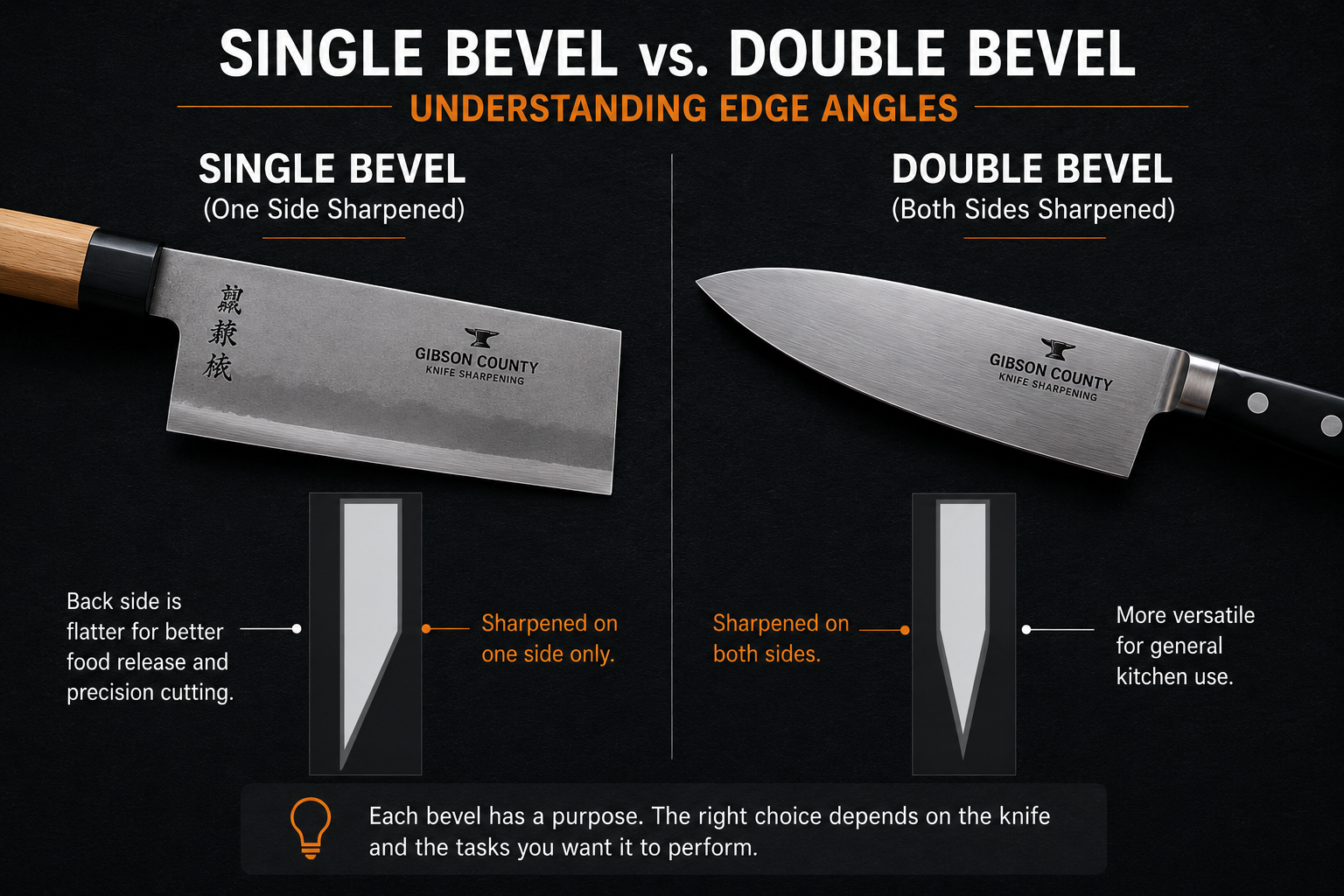
A knife bevel is the angled surface that forms the cutting edge. Most kitchen knives are double bevel, but some traditional Japanese knives use a single bevel design for specialized cutting tasks.
What is a bevel?
The bevel is the angled part of the blade that narrows down to the cutting edge. It may be small and subtle, or wide and easy to see depending on the knife.
Bevel geometry affects sharpness, durability, cutting feel, steering, and how the knife should be sharpened.
What is a double bevel knife?
A double bevel knife is sharpened on both sides of the blade. This is the most common edge style for Western chef knives, santoku knives, gyuto knives, paring knives, utility knives, and most everyday kitchen knives.
Double bevel knives are practical, versatile, and usually easier for most home cooks to use.
What is a single bevel knife?
A single bevel knife is sharpened primarily on one side. The opposite side is often flatter, slightly concave, or shaped differently depending on the knife style.
Traditional Japanese knives such as yanagiba, deba, and usuba are commonly single bevel. These knives are specialized tools and require more careful technique.
Quick comparison
| Feature | Double Bevel | Single Bevel |
|---|---|---|
| Sharpened sides | Both sides. | Primarily one side. |
| Common use | General kitchen prep. | Specialized slicing or preparation. |
| Ease of use | More forgiving for most cooks. | Requires more technique. |
| Sharpening | Usually simpler and more familiar. | Requires special attention to the bevel and back side. |
| Cutting behavior | Generally cuts straight and predictably. | May steer if used incorrectly or sharpened poorly. |
Why double bevel knives are common
Double bevel knives are popular because they work well for many cutting styles and are comfortable for both right-handed and left-handed users. They are also easier to maintain and sharpen correctly.
For most home kitchens, a double bevel edge gives the best balance of sharpness, durability, control, and ease of use.
Why single bevel knives exist
Single bevel knives are designed for precision. A yanagiba, for example, is made for long clean slices through fish. A deba is built for fish butchery. An usuba is used for very precise vegetable work.
These knives can perform beautifully when used for the right task, but they are not general-purpose substitutes for ordinary chef knives.
Edge angle matters
Edge angle is the angle at which the cutting bevel is sharpened. A lower angle can feel sharper and slice more easily, while a wider angle is usually more durable.
The right angle depends on the knife. A thin Japanese-style slicer may support a finer angle. A heavier workhorse knife may need a stronger edge that holds up better to daily use.
Do not convert single bevel and double bevel knives casually
A single bevel knife is not just a double bevel knife sharpened unevenly. The entire blade geometry may be designed around that single bevel.
Converting one style into another can change how the knife cuts, how it steers, how it contacts food, and how much steel must be removed. It should not be done casually.
How bevel type affects sharpening
Double Bevel Sharpening
The edge is usually sharpened on both sides, with attention to keeping the bevels balanced and removing the burr cleanly.
Single Bevel Sharpening
The main bevel and back side require different treatment. Over-sharpening the wrong area can damage the intended geometry.
Asymmetrical Bevels
Some knives are technically double bevel but not evenly split. They may favor one side more than the other.
Which bevel is right for you?
For most home cooks, a double bevel knife is the best choice. It is versatile, easy to use, easier to maintain, and works well for everyday kitchen tasks.
A single bevel knife makes sense when you want a specialized tool for a specific job and are willing to learn the care and technique that goes with it.
Key Takeaways
Most Kitchen Knives Are Double Bevel
Double bevel knives are sharpened on both sides and are the most common choice for everyday home kitchens.
Single Bevel Knives Are Specialized
Single bevel knives are usually designed for specific cutting tasks and require a different sharpening approach.
Edge Angles Must Match the Knife
The best sharpening angle depends on the blade, steel, geometry, and how the knife will be used.
References
The following sources were used in preparing and supporting this article.
KS-123 Knife Angle Setter
Tormek
tormek.com
Knife Sharpening Basics
Korin
korin.com
How to Sharpen Any Knife: Back to Basics
Work Sharp
worksharptools.com