Damascus Steel: History, Pattern, and Performance
Historical wootz and modern pattern-welded Damascus can look similar, but their patterns come from different materials and processes.
Damascus steel is not one single material. Historical wootz developed its pattern within crucible steel, while modern pattern-welded Damascus uses layers of contrasting steels. In kitchen knives, performance still depends most on the cutting steel, heat treatment, and geometry.
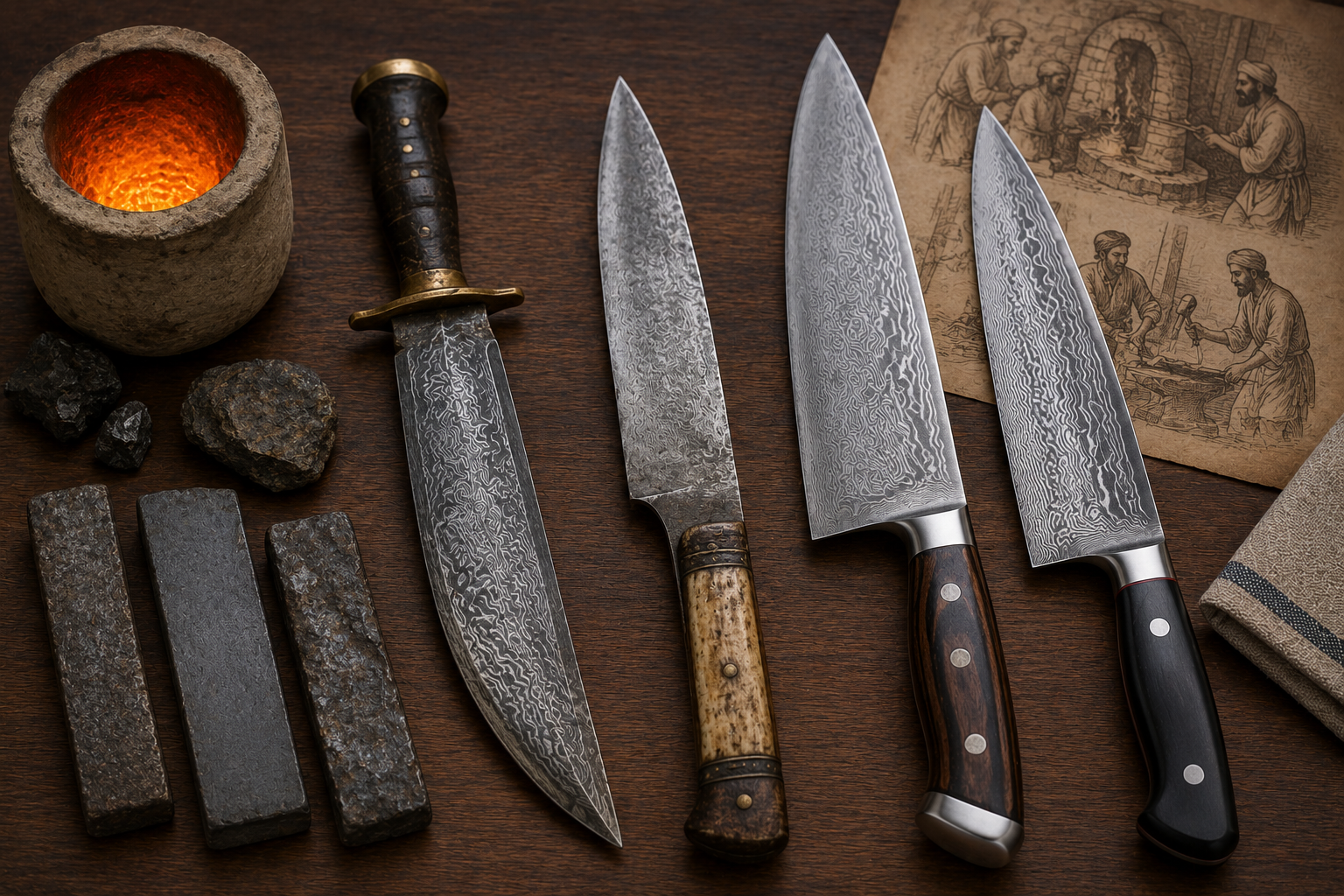
Two Different Materials Share the Name
Historical wootz Damascus and modern pattern-welded Damascus are not the same steel. One develops patterned bands within a crucible-steel ingot; the other is made by forge-welding separate layers of steel.
Historical Wootz Damascus
Wootz was a high-carbon crucible steel produced in South Asia and traded as ingots.
The Metropolitan Museum of Art describes wootz as a crucible steel whose pattern comes from bands of clustered iron carbide within the material.
Blades made from this steel became associated with Damascus through trade and regional sword production, although the steel itself originated elsewhere.
How the Historical Pattern Formed
The pattern was not produced by stacking visible layers.
Research by Verhoeven, Pendray, and Dauksch found that the characteristic bands were created by carbide-forming elements and cementite particles within the steel.
The final appearance depended on:
• Ingot composition.
• Controlled cooling.
• Careful forging temperatures.
• Thermal cycling.
• Grinding, polishing, and etching.
The process was a complete production system, not one secret folding recipe.
Modern Pattern-Welded Damascus
Most modern knives sold as Damascus use pattern-welded steel.
Two or more compatible steels are stacked, forge-welded, drawn out, and manipulated. After shaping and heat treatment, etching reveals contrast between the layers.
Common patterns include random, twist, ladder, raindrop, feather, and mosaic.
The pattern follows the physical arrangement of the layers rather than carbide bands within a single crucible-steel ingot.
Historical and Modern Damascus Compared
| Material | How the Pattern Forms | Typical Modern Use |
|---|---|---|
| Wootz or crucible Damascus | Carbide-rich bands develop inside one high-carbon steel ingot | Historical blades and specialist reproductions |
| Pattern-welded Damascus | Different steels are layered, welded, and manipulated | Custom knives, decorative billets, and some full-blade construction |
| Damascus-clad kitchen knife | Patterned outer layers surround a separate cutting core | Modern production and artisan kitchen knives |
| Surface-applied pattern | Etched, printed, or laser-marked decoration | Appearance without layered internal construction |
Damascus-Clad Kitchen Knives
Many kitchen knives use patterned cladding around a separate core steel.
The core forms the cutting edge. It usually has the greatest influence on:
• Edge retention.
• Toughness.
• Corrosion behavior.
• Sharpening difficulty.
• Maximum practical hardness.
The patterned cladding mainly contributes appearance and may provide corrosion protection, depending on the steels used.
Layer Count Is Not a Quality Grade
More layers can change pattern density and appearance, but they do not automatically improve sharpness, edge retention, toughness, or cutting ability.
What Actually Determines Performance
A well-made monosteel knife can outperform a poorly made Damascus knife.
Evaluate:
• The steel that forms the cutting edge.
• Heat treatment.
• Blade thickness and geometry.
• Edge angle and finishing.
• Construction quality.
• Handle comfort and security.
• Manufacturer or maker reputation.
Damascus describes construction and appearance—not a guaranteed performance level.
Sharpening and Care
Damascus kitchen knives are sharpened according to the cutting steel and existing edge geometry.
The pattern does not require a completely different sharpening method, but careless abrasion can scratch or reduce contrast in the cladding.
• Hand wash with mild soap.
• Dry immediately.
• Avoid dishwashers and prolonged soaking.
• Keep the edge away from bones, frozen food, and hard cutting surfaces unless the knife is specifically designed for them.
• Avoid abrasive cleaners on etched finishes.
• Protect reactive steel from rust.
A fading etched pattern does not necessarily mean the blade is damaged.
Key Takeaways
The Name Covers Different Materials
Historical wootz and modern pattern-welded steel create their patterns in different ways.
The Edge Steel Matters Most
In a clad kitchen knife, the core steel, heat treatment, and geometry drive cutting performance.
Pattern Is Not a Guarantee
Layer count and visual complexity do not automatically mean better sharpness or durability.
References
The following sources were used in preparing and supporting this article.
Ten Wootz Steel Ingots with Bag
The Metropolitan Museum of Art
metmuseum.org
The Key Role of Impurities in Ancient Damascus Steel Blades
The Minerals, Metals & Materials Society
tms.org
Five Myths About Damascus Steel
Knife Steel Nerds
knifesteelnerds.com
The History of Powder Metals in Damascus Steel
Knife Steel Nerds
knifesteelnerds.com
Damascus Knives
ZWILLING
zwilling.com