Managing a Restaurant House Knife Set
A clear system for identification, inspection, rotation, storage, maintenance, and replacement keeps shared restaurant knives safe and ready for work.
House knives pass through many hands. Assigning responsibility, tracking each knife, separating active and out-of-service blades, maintaining backups, and recording recurring damage creates a safer and more reliable system.
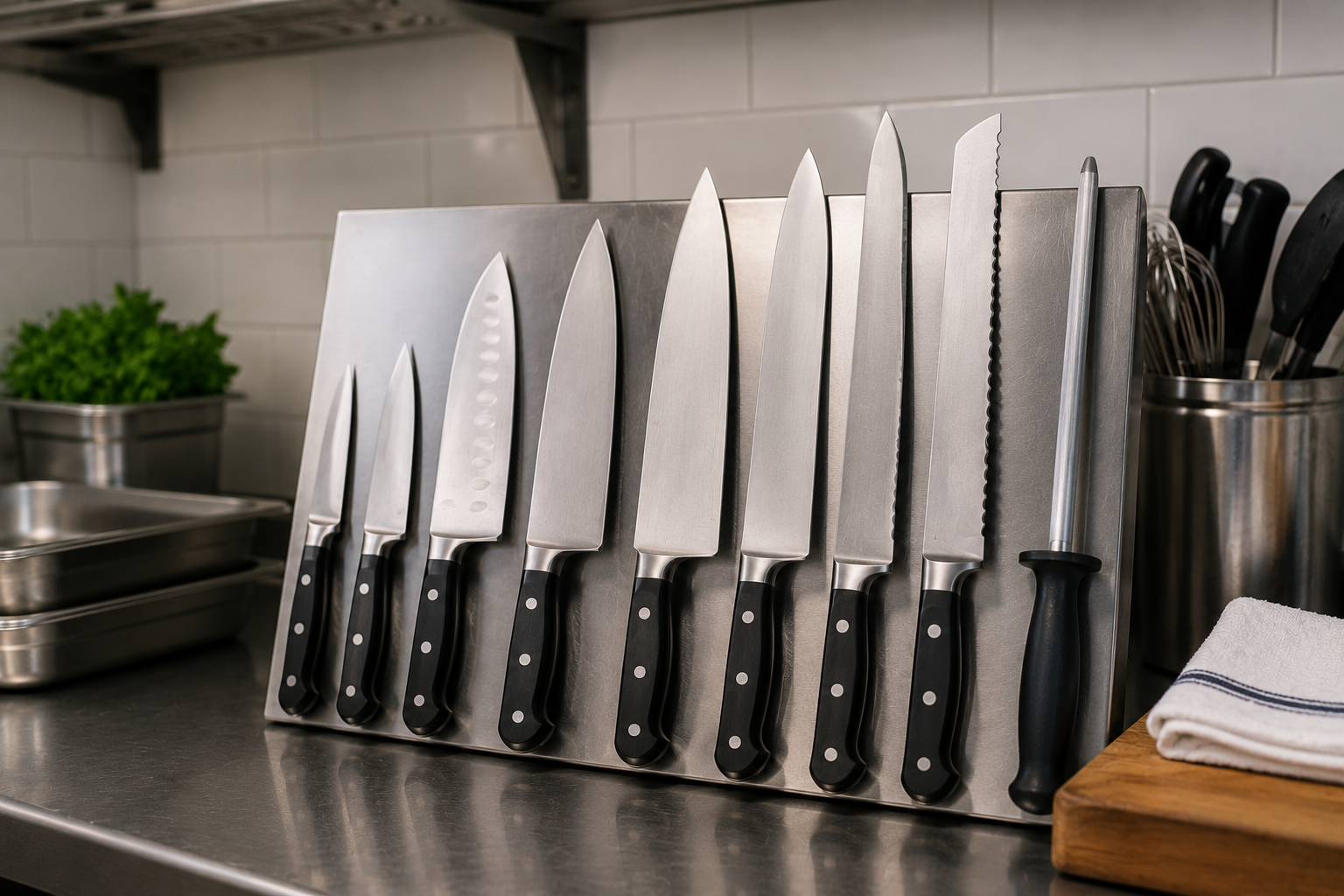
The Practical Approach
Identify every house knife, assign responsibility, inspect it regularly, track its service history, maintain sharp backups, and remove damaged knives from use immediately.
Shared Knives Need a System
A house knife belongs to the restaurant rather than one cook. It may be used by prep staff, line cooks, managers, dish staff, and temporary employees.
When everyone uses the knives but no one is clearly responsible for them, dullness, damage, missing tools, poor storage, and delayed maintenance become predictable.
The goal is not a complicated program. It is a simple, visible system that makes the condition and location of every knife clear.
Choose a Practical Core Set
Most restaurants are better served by a smaller number of durable, replaceable knives selected for the work actually performed.
Using identical or similar knives where practical simplifies training, replacement, sharpening, and comparison of wear.
Standardization does not mean every task needs the same knife. Specialty work may still require a different blade, geometry, flexibility, or size.
Benefits of Practical Standardization
Consistent Handling
Similar handles, weight, and balance reduce adjustment when employees switch knives.
Predictable Service
Similar steels and geometry make routine sharpening and maintenance easier to plan.
Easier Replacement
A retired knife can be replaced without introducing an unfamiliar tool.
Clearer Training
Employees learn one practical set of expectations for use, care, and storage.
Identify and Inventory Every Knife
Each knife should have a durable identifier that does not create a food trap, weaken the handle, interfere with cleaning, or make the knife uncomfortable.
The inventory should record:
• Knife identifier.
• Type, size, brand, or model.
• Assigned station or department.
• Current status: active, backup, awaiting service, retired, or missing.
• Sharpening and repair history.
• Recurring damage or unusual wear.
Identification makes it possible to connect each knife with its actual workload and service record.
Assign Clear Responsibility
One person should oversee the program. This may be an executive chef, kitchen manager, sous chef, prep lead, or another designated employee.
Oversight does not mean one person performs every task. It means someone confirms that inspections occur, damaged knives are removed, sharpening is scheduled, serviced knives return to the correct group, and the inventory stays accurate.
Who Does What?
Employees
Use knives correctly, clean and dry them, report problems, and return them to storage.
Shift Lead
Confirms that knives are present, serviceable, and stored correctly.
Program Manager
Tracks condition, schedules service, approves repairs, and retires unsafe knives.
Sharpening Provider
Documents edge work, repairs, unusual wear, and knives that may need replacement.
Inspect Active Knives Regularly
Do not wait until a knife becomes nearly unusable.
• Check the edge for chips, rolls, flat spots, and uneven performance.
• Inspect the tip for bending or breakage.
• Check the handle for looseness, cracks, swelling, or gaps.
• Look for rust, pitting, staining, or trapped residue.
• Confirm that the knife is clean, dry, and in its assigned location.
• Remove any knife that feels unstable, contaminated, or unsafe.
Employees do not need to diagnose the exact problem. They only need clear criteria for keeping, reporting, or removing a knife.
Use a Simple Condition System
| Status | Condition | Action |
|---|---|---|
| Active | Clean, dry, sharp enough, stable, and free of unsafe damage. | Return to assigned station or storage. |
| Maintenance | Mild loss of performance or a condition approved for light maintenance. | Send only to an authorized person using approved tools. |
| Service | Dull, chipped, damaged, corroded, inconsistent, or no longer responsive to maintenance. | Guard, label, record, and separate for sharpening or repair. |
| Retired | Unsafe, structurally damaged, impractical to repair, or no longer suitable for the work. | Remove permanently from the active inventory. |
Separate Out-of-Service Knives
Never place loose damaged knives in a sink, drawer, box, or unmarked container. Guard and label each knife, then place it in a secure location separate from ready-to-use tools.
Maintain a Three-Part Rotation
The kitchen should have enough serviceable knives to remove a problem blade without stopping production.
Active Group
Knives currently assigned to prep and line stations.
Backup Group
Clean, sharp knives ready to replace any blade removed from service.
Service Group
Guarded and identified knives awaiting inspection, sharpening, repair, or return.
Service According to Performance
Even identical knives can receive very different workloads.
A continuously used prep knife may need attention much sooner than a similar knife at a low-volume station. Backup knives may need little sharpening but still require inspection for corrosion and storage damage.
Calendar dates help with planning, but each knife should be evaluated individually.
Gibson County Knife Sharpening is not a high-volume production shop. Every restaurant knife receives individual inspection, sharpening, deburring, testing, cleaning, and review.
Control Maintenance and Daily Use
The restaurant should define who may hone, touch up, or sharpen house knives and which tools may be used.
Employees should also know the daily rules:
• Use suitable wood, rubber, or commercial plastic cutting boards.
• Move food with the spine or a bench scraper.
• Do not twist, pry, strike the spine, or open packages with kitchen knives.
• Do not force thin knives through bones or frozen food.
• Report dullness and damage immediately.
Uncontrolled maintenance can create inconsistent angles, rounded edges, damaged tips, poor burr removal, and unnecessary steel loss.
Clean, Dry, and Store Every Knife Properly
Shared knives require consistent sanitation and storage.
• Wash each knife promptly according to the restaurant’s approved food-contact utensil procedures.
• Keep knives visible and never leave them hidden in sinks, tubs, towels, or dishwater.
• Dry the blade, edge, handle, rivets, and joints completely.
• Keep racks, guards, blocks, and rolls clean and dry.
• Use assigned storage that protects each edge and makes missing knives obvious.
• Avoid loose drawer storage unless every blade has individual protection.
Quality house knives should generally be washed by hand unless the knife manufacturer and restaurant procedure specifically approve another method.
Track Damage and Know When to Retire a Knife
Repeated chips, rolls, broken tips, corrosion, and short service intervals may reveal problems with a station, task, employee, board, storage method, or edge choice.
A working knife does not need to look new, but retirement may be appropriate when:
• The handle is loose, cracked, swollen, or separating.
• The blade has a structural crack or severe bend.
• Deep corrosion or pitting affects the edge or tang area.
• Repeated repairs have made the profile impractical.
• The knife has become too narrow or thick behind the edge for its intended work.
• It can no longer be cleaned, controlled, or used safely.
Replacement may be more responsible than another repair.
Practical House Knife Routine
• Assign an identifier and storage position to every knife.
• Inspect active knives before use or at the start of each shift.
• Remove dull, damaged, rusty, contaminated, or unstable knives.
• Guard, label, record, and separate every out-of-service knife.
• Replace removed knives with clean, sharp backups.
• Track sharpening, repairs, and recurring problems.
• Return serviced knives to the correct rotation group.
• Review inventory, replacement needs, and damage trends regularly.
Key Takeaways
Assign Ownership
One person should oversee inventory, inspection, service, repairs, and retirement.
Track Every Knife
Identification and service records reveal recurring damage and help prevent lost tools.
Maintain a Rotation
Sharp backups allow dull or damaged knives to leave service without disrupting production.
References
The following sources were used in preparing and supporting this article.
Young Worker Safety in Restaurants: Food Preparation
Occupational Safety and Health Administration
osha.gov
Food Services: Kitchen Equipment
Occupational Safety and Health Administration
osha.gov
FDA Food Code
U.S. Food and Drug Administration
fda.gov
Food Safety Culture
CDC Restaurant Food Safety
cdc.gov